
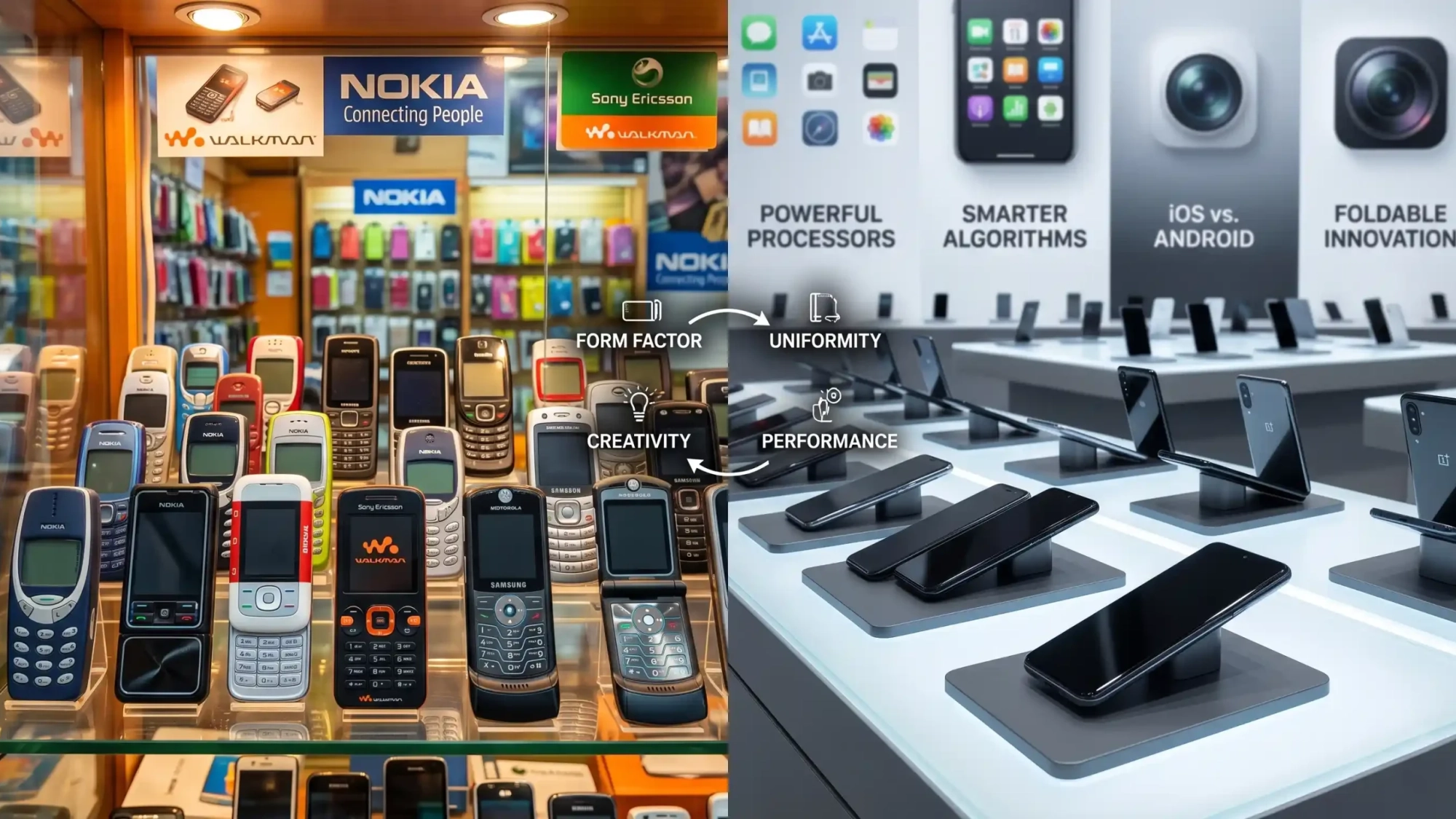
Can you recall the excitement of entering a mobile shop from the years 2000 to 2010? It was always as exciting as visiting a gallery for technology-based artworks. What do you see when entering such shops now? Rows upon rows of monotonous black glass tablets!
Those days, however, were the time of distinctive and unique design of mobile phones. Not only did Nokia provide great cell phones; the company even managed to impress everyone with their distinctive twists on the models 3250 and 5300. Sony Ericsson incorporated both technological innovations and stylish design in their products, adding sliding mechanisms and special buttons for using a walkman. Samsung offered various flip phones, while LG tried its best to surprise customers with new and bold ideas like the dual screen Chocolate phones or the Rear-key phones.
However, what was the difference-maker? What made a Samsung flagship, an iPhone, or OnePlus so similar in design?
The transition came when touchscreens came into play. With the growing demand for bigger screens, batteries, and advanced antennas, the creativity in form factor was put on the back burner. We opted out for sleeker designs, eliminating unique keypads and weird form factors in favor of a flat display filling every inch of the frame. The innovation is definitely there, but now it lies under the surface – powerful processors, smarter algorithms, and periscope lenses. Foldable screens, another trend nowadays, do not differ much from what we have already used for a decade – the screen itself.
There appears to be an intriguing question: did we give up our tech personality in exchange for sheer efficiency?
As the exterior design has reached its peak, how can you select your new device? One piece of advice here: Stop staring at the front. Given that they all have the same look, try to make your decision based on something that sets them apart. Check out the software platform (iOS vs. Android), examine the camera performance in dim conditions, and take into account the overall weight. While they may be identical on the outside, they can feel completely different in your pocket.
It had to happen, and now there is no way to revert to the thick buttons of the early 2000s. Yet, once in a while, it’s always nice to take a glance at that old Nokia and think…what if?
I’d love to know: What was the most uniquely designed phone you ever owned?
Leave A Comment