
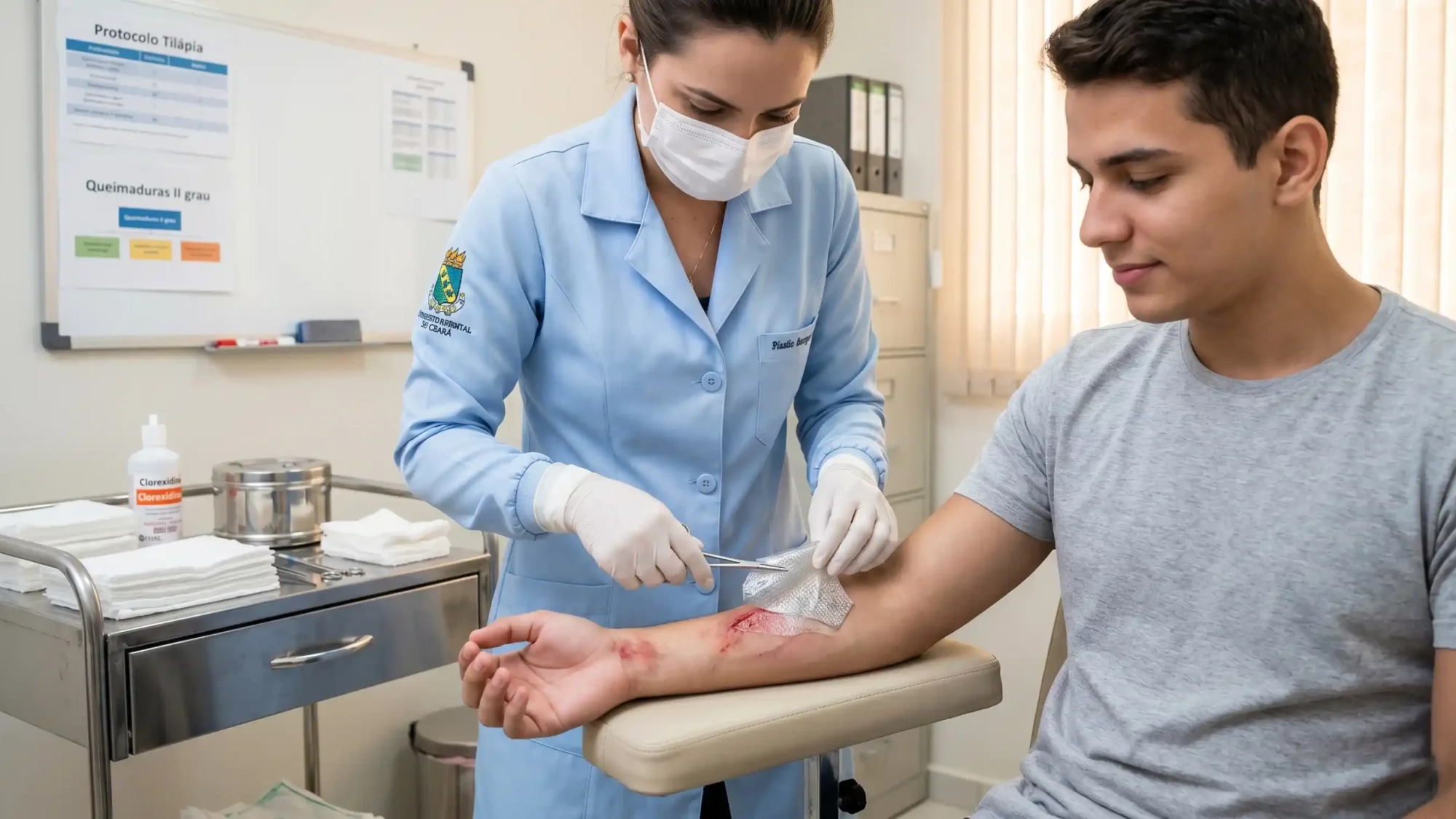
If someone said that you could use a fish to treat a burn, you’d probably be dubious about such an idea. However, there’s nothing fantastical about this statement because it is one of the greatest inventions in burn care medicine.
The scientists at the Federal University of São Paulo have utilized sterilized tilapia skin (Oreochromis niloticus) to treat second- and third-degree burns with great success. There’s evidence proving that this method alleviates pain, speeds up recovery time, and is cheaper than traditional burn care.
Thus, does the burn treatment with a fish skin work? Is this method more effective than regular burn care? What is the best burn care practice? You’ll find the answers to all these questions in this article.
Is Fish Skin Burn Treatment Real?
Yes — it’s real, and it’s been through clinical trials, not speculation.
Back in 2016, scientists in Fortaleza, Brazil, started Phase II clinical trials for treating burns with sterilized Tilapia skin applied to the wound site (Lima Júnior et al., 2020). It proved successful; their results showed that, in many cases, the new fish-skin bandage helped wounds heal more effectively than the old standard treatment of applying silver sulfadiazine cream, which is effective but requires painful dressings each day (Bustaman et al., 2026).
Several studies since have confirmed these initial results (WHAM Evidence Summary, 2024).
The Science: How Tilapia Skin Helps Wounds Heal
The skin of a fish is not just a covering to protect an injury; it interacts with injured tissues from a biochemical perspective. According to scientific research, here are some key facts:
1. Very High Collagen Levels
Tilapia skin is made up of unusually high levels of Types I and III collagens, which are precisely the kinds of proteins that make up the structure of human skin (Lim-A-Verde et al., 2021; Frontiers, 2021).
2. Better Moisture Retention
A central tenet of current wound management is keeping the wound in a moist state, which promotes quicker healing. The tilapia skin acts as a natural barrier that does not allow the wound to dry up and thus quickens the re-epithelialization process – the physiological process where fresh skin cells move in across the wound (Bustaman et al., 2026).
3. Effective Pain Management
Certainly, one of the most significant advantages for patients is decreased pain. Dressings like gauze need to be changed daily, and changing it may be a painful procedure because of the sticking of the cloth to the damaged areas. Tilapia skin, on the other hand, sticks to the skin itself and needs no changing for days in a row, often until the complete recovery of the patient (WHAM Evidence Summary, 2024).
Fish Skin Preparation for Medical Purposes
It is essential to recognize that fish skin sourced from markets or kitchens cannot be utilized as burn dressings. The following procedures are required when preparing medical Tilapia skin:
- Biological decontamination using chemicals
- Irradiation with gamma rays to ensure removal of any lingering viruses and bacteria
The outcome is a product that is entirely odor-free, sterile, and harmless to the wound site. The product has a shelf life of up to two years when stored under room temperature or refrigeration conditions (Lim-A-Verde et al., 2021; WHAM Evidence Summary, 2024).
What Is the Best Way to Treat a Burned Skin?
Even though the application of Tilapia skin is one of the greatest medical breakthroughs, the best course of action in healing a burn always varies according to the level of damage. In treating burns, medical practitioners have categorized the process in three main stages:
Stage 1 – First Aid (The Most Crucial 20 Minutes)
The most critical response to any freshly acquired burn is cooling the affected area with tepid (not cold) tap water for 20 minutes straight (PMC7951672). This stops the progression of heat injury to deeper tissues and significantly reduces the overall severity of the wound.
Don’t do:
❌ Ice – triggers vasoconstriction and increases tissue injury
❌ Creams/butter/oil/toothpaste – locks in heat and raises infection risk substantially
❌ Cotton wool – fibers stick to the wound
(PMC428524)
Stage 2 – Management of Minor Burns (1st and 2nd Degree)
In minor cases, the objective of management is to ensure that the affected area remains clean, moist, and shielded from any infection.
- Cleaning: Soap or 2% chlorhexidine wash (PMC7951672)
- Bandaging: Non-adhesive bandages can be used to maintain sterility until a proper examination can be made (PMC428524)
- Observation: Look out for any signs of infection such as increased redness, swelling, warmth, or pus discharge
Step 3 — Professional Treatment (2nd and 3rd Degree Burns)
In cases involving severe burns that extend deep into tissue, involve extensive areas, or are full thickness burns, it is important to seek professional medical treatment without delay. In such scenarios:
- The Biological Dressing, made up of Tilapia skin or silver products, is the clinical norm to prevent sepsis and metabolic problems (Lim-A-Verde et al., 2021).
- Skin transplantation — transferring healthy skin from one part of the body to another where there is a burn — may be the best long-term treatment for full-thickness burns.
IMPORTANT NOTE: In any case where the burn affects a large area of the body, the head, hands, feet, or genitals; and is deep enough to appear painless, urgent medical assistance is crucial.
Who are the current adopters of fish skin treatment?
This therapy was first used and remains widely adopted in Brazil because the innovation was designed to be an economically feasible choice for countries with resource limitations when it comes to treating wounds and burns. Since the conventional method using silver sulfadiazine requires costly daily dressing changes involving skilled nurses, fish skin treatment presents clear cost-effectiveness.
Nevertheless, research is expanding beyond the boundaries of Brazil. Several reviews from reliable sources suggest that fish skin can be effectively used as a xenograft alternative throughout the world’s burn centers, and further expansion is expected soon (Bustaman et al., 2026).
Frequently Asked Questions (FAQs)
Question: Can fish skin therapy be found anywhere else besides Brazil?
Answer: While it has seen more widespread use in Brazil since its development, interest abroad is rising, with some overseas hospitals now considering using the method on their patients based on scientific studies.
Question: Can any diseases be passed from fish skin?
Answer: There is no chance of that occurring if the treatment is done correctly because the rigorous process of gamma irradiation kills all pathogens. Fish-borne illnesses cannot be contracted from the dressing (Lim-A-Verde et al., 2021).
Question: Is Tilapia skin applicable to all burn injuries?
Its best success has been in treating second- and third-degree burns. Full-thickness burns can receive fish skin therapy until the condition stabilizes enough for a final procedure like skin grafting.
Question: Is there any fish smell?
No. After sterilizing the fish skin, it does not have any smell at all (WHAM Evidence Summary, 2024).
Question: What is the difference between xenografting and skin grafting?
Skin grafting involves using the same skin from the person who needs treatment, while xenografting entails transplanting a biological tissue from a different organism, which in this case would be from Tilapia fish.
The use of fish skin from the tilapia as a burn dressing is a medical breakthrough that has been scientifically proven to reduce pain, speed up healing processes, and offer a cost-effective, sustainable solution to traditional methods of wound treatment; although its use is predominantly focused on Brazil at present, it is gaining popularity elsewhere, and with ongoing research and increased production levels, fish-based biological dressings could soon become commonplace in burn centers around the world—but if you have suffered a burn, first aid is crucial: start by applying cold running water for 20 minutes and avoid any home remedies on an open wound.
References
- Bustaman, A. L., Soekmadji, P. N., & Sanjaya, A. (2026). Tilapia Skin in Burn Injuries: A Narrative Review of Pathophysiology, Current Management, and Therapeutic Applications. PMC. https://pmc.ncbi.nlm.nih.gov/articles/PMC12949593/
- Lim-A-Verde, M. E. Q., et al. (2021). Nile tilapia skin (Oreochromis niloticus) for burn treatment: ultrastructural analysis and quantitative assessment of collagen. Acta Histochemica, 123(6), 151762. https://doi.org/10.1016/j.acthis.2021.151762
- Lima Júnior, E. M., et al. (2020). Innovation in Burn Treatment through Application of Tilapia Skin As Xenograft. Journal of Burn Care & Research, 41(3), 598–602. https://doi.org/10.1093/jbcr/irz205
- PMC. (2021). Overview of burn treatment. https://pmc.ncbi.nlm.nih.gov/articles/PMC7951672/
- WHAM. (2024). Evidence summary: Fish skin to treat burns. Wound Care & Environmental Therapy, 44(1). https://journals.cambridgemedia.com.au/wcetfr/volume-44-number-1/wham-evidence-summary-fish-skin-treating-burns
Disclaimer: This information should be considered for awareness purposes only and is not intended to be taken as medical advice. Medical professionals should always be consulted for any medical condition or disease including burns.
Leave A Comment