
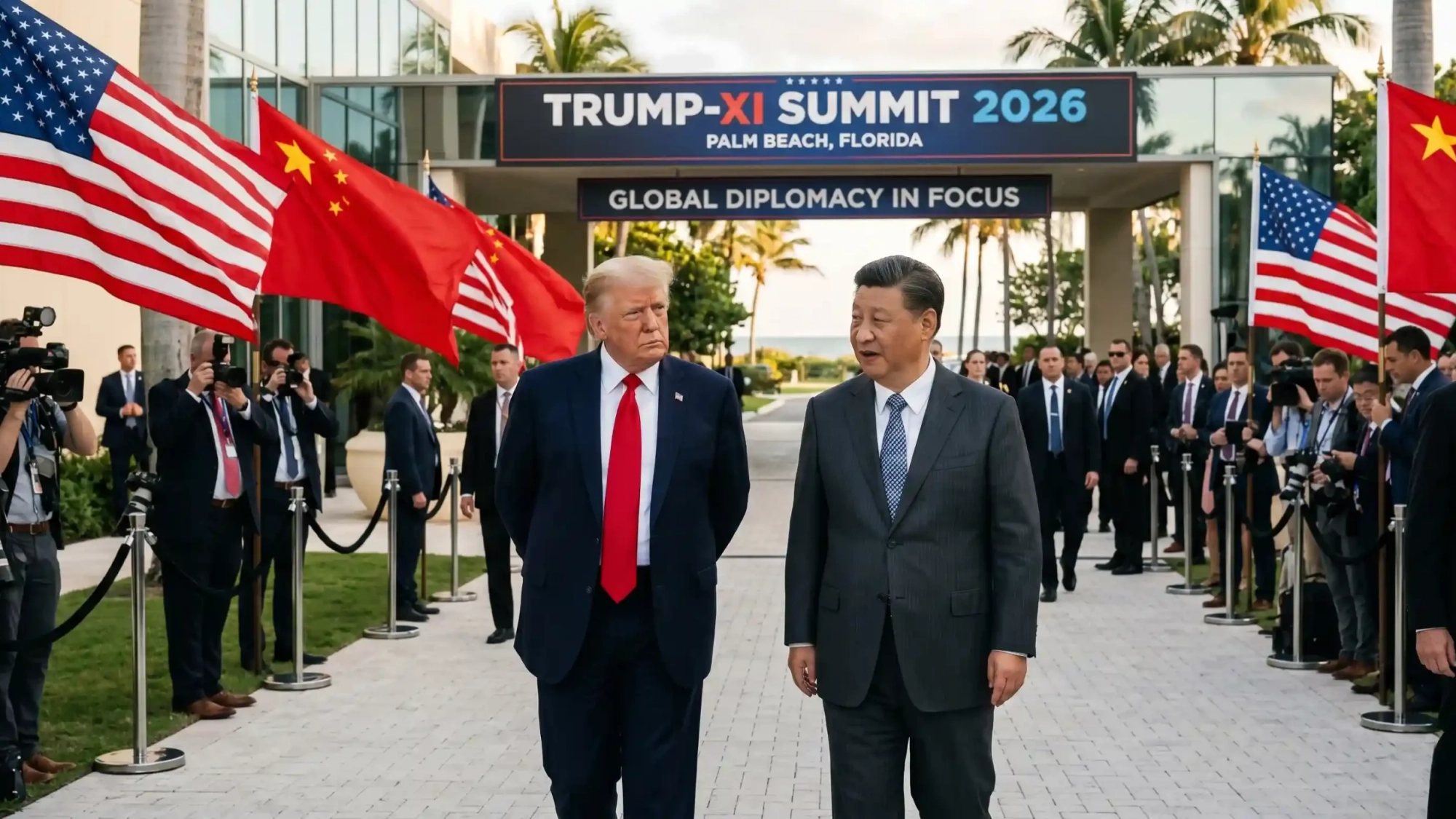
Few times in history has the world paused to pay attention to any diplomatic talks? This time, however, the world is holding its breath for this diplomatic summit. As the Air Force landed in Beijing earlier today, there were more than the usual camera crew’s ready to record the arrival of the US president in China – this was going to be a historic moment in recent years.
This is no ordinary business negotiation. It never was.
A World That Cannot Afford to Wait
The importance of this meeting becomes clear when one considers how events have progressed since February 2026. The increased tensions in the conflict between the US and Iran created immediate consequences for the global energy market, not due to the conflict itself, but due to the additional measures taken by the United States in response, including the blocking of the strategic Strait of Hormuz, through which about a fifth of all the oil consumed in the world passes daily.
This move had immediate consequences. The price of fuel was increasing, while shipping costs were soaring, making it extremely important for the countries that relied the most on the Strait of Hormuz to keep an eye on Washington.
Against this background, Trump travels to Beijing to attend a meeting on May 14-15, and here for once both sides can truly have reasons to listen to each other.

So, Is There Hope for Ending the “Iran War” Between Washington and Beijing?
Honestly speaking, I don’t believe that some kind of full-scale agreement will be reached by the end of this week. Such things hardly ever happen in real life.
What can happen, however, and rather soon, is a grand bargain between the two nations that would stabilize the situation on the international arena without involving either party to make concessions.
Here is how such an agreement can be reached.
First of all, China has one advantage which makes it different from all other nations in the world: it is a leading buyer of Iranian oil. This allows Beijing to exercise economic pressure on the Iranians in order to force them to change their positions in regard to the Strait of Hormuz.
However, in exchange, Beijing will most likely have some demands of its own. Rumors swirling around diplomatic circles point to a “Hormuz for Trade” plan: Beijing assures the reopening of the Strait, and Washington lightens up its naval blockade on the Iranian coast and relaxes some of the controls it has placed on the export of technologies to Iran. But whether Trump will agree to those terms is an open question.
It should also be noted that there is Pakistan’s part in all this. Yesterday, the Chinese foreign minister, Wang Yi, told Islamabad that it needed to “step up” its mediation role — an important signal suggesting that Beijing prefers to act as guarantor of any agreement that might be reached, rather than mediator. It is a wise strategy. Should it succeed, China gets the credit. Should it fail, Pakistan shoulders the blame.

The Elephant in the Room: Can Trump Keep the Deal?
It is the thing that nobody wants to say openly but everybody thinks about.
Just in the last two months Trump threatened “swift end” of the Iran crisis and signed the naval blockade of the region shortly afterwards. He decided to continue the ceasefire despite his initial hesitation only 12 hours ago. And just yesterday he pulled back a high-level diplomatic visit to Islamabad stating “internal divisions” in Iran.
Trump’s unpredictability poses a tricky problem for the team of President Xi Jinping. Indeed, it is almost impossible to build a reliable security strategy based on such an unpredictable player. Why should Beijing invest in a deal that may be easily undone on social media? At the same time, China fully understands that President Trump is desperately trying to achieve some success before the upcoming midterm elections in 2026. It is a weakness, and China will exploit it.

Whom Did Trump Bring With Him on the Plane? And Why It Is Important
One of the most surprising facts about this meeting is who traveled with Trump on the Air Force One plane. Unlike previous delegations led by the U.S. President, which always had a plethora of generals and diplomats, Trump came with Elon Musk, the head of Tesla, and Jensen Huang of Nvidia.
Almost everything else can be gleaned from that information. While this meeting is primarily about geopolitics, the summit is also a commercial enterprise for the U.S. President, with a primary goal of opening China up to American tech companies struggling to do business in China.
However, while Xi Jinping will likely not agree to such terms, the fact that Musk and Huang were invited indicates where Trump believes his victories will come from, especially when it comes to Iran.

What Are the Most Likely Outcomes?
No diplomatic summit ends up delivering on the hype set out prior to it. However, looking at what both sides might get from the meeting and what they are realistically ready to offer, the following can be said about potential outcomes:
The most likely outcome is the “Boeing & Beans” Trade Deal, which is supposed to involve large scale purchases of American aircraft and agricultural products that are intended to help lower the deficit.
Critical minerals pact may become another realistic outcome as China holds an upper hand in global rare earth elements trade. This kind of temporary truce would be important for US technological industries.
Pact of opening up the Strait of Hormuz for free passage could be achieved. Whether or not this happens will depend completely on the results of the confidential talks between two leaders.
As for the technology – opening up that Trump wants to achieve from the meeting, this scenario looks unlikely because Beijing refuses to play along.
The Welcome Mat — and What Lurks Below
According to all reports, China is giving Trump a “State Visit Plus” experience — the whole nine yards, from the state banquet at the Great Hall of the People to a private tea ceremony. Anyone familiar with the 2017 trip by then-President Donald Trump to Beijing will know what to expect from such a reception. China knows how to give an American president the sense that he’s the most powerful person in the world for 48 hours.
But beyond the pageantry, there is a long-term strategy being played out by the Chinese leadership.
China’s Xi Jinping knows very well that Trump will be facing tough times during his upcoming midterm elections in November 2026. In the event that the political situation changes and Trump becomes a lame duck, the transformative pact struck today will become much less credible. This fact explains why Beijing is not willing to place too many eggs in one basket at the moment, preferring small, sustainable victories over a grandiose agreement.
The Bottom Line
With the lights off and cameras gone, a managed détente looms: a toned-down tone from the trading partners, a finely calibrated joint communiqué, and maybe a gesture by Iran, backed by China, to defuse the situation at Hormuz—vague enough for each side to claim victory. An indefinite resolution of the US-Iran conflict was always too much to ask for, but what is realistic in China is a period of stability that avoids escalation while diplomacy works its course. For China, acting as peacemaker in a crisis helps maintain its reputation as an irreplaceable negotiator; for President Trump, making headlines for any deal described as “big” is more than sufficient, no matter how long it lasts.
The following is an analysis that is reflective of information gathered up until May 13, 2026. It should be noted that events are unfolding quickly and the situation could be different at this time.
One of the most stupid president in the history of United States.