
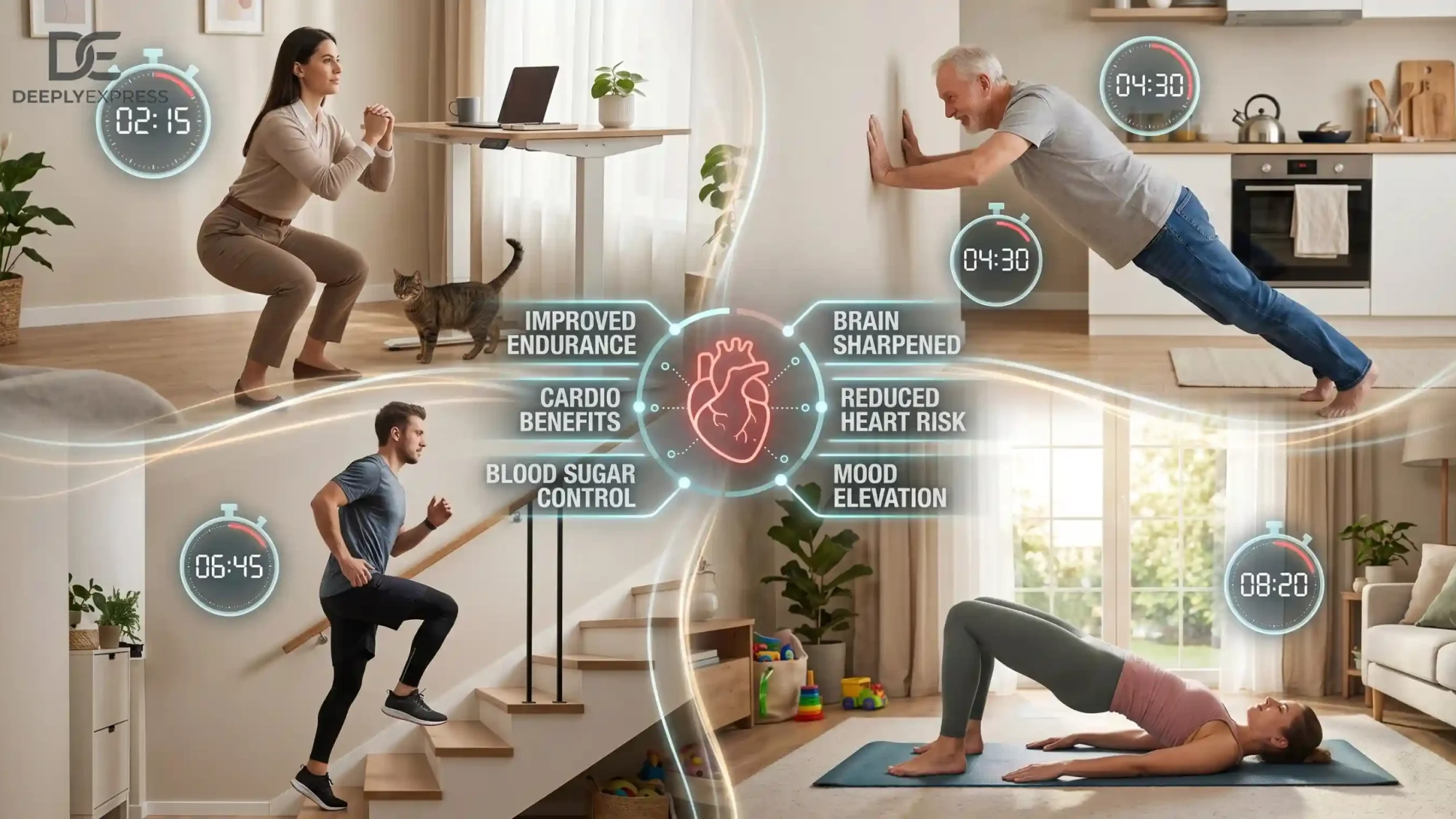
Everyone approaches fitness as either/or. If you can find an hour to get yourself down to the gym, dress yourself appropriately and go through your routine, then you have a good workout; otherwise, you didn’t. The unspoken rule about needing to be a certain amount of time is probably keeping more people inactive than any other fitness myth.
The ironic thing is that the scientific community has been disproving this belief for decades now. But there are some things that need to be pointed out.
THE 10 MINUTES THAT ALREADY EXISTS IN YOUR LIFE
When we think about how a day progresses, the few minutes that pass while waiting for the coffee. The time after lunch and getting back to work. The period between tucking kids into bed and turning on Netflix. Ten minutes isn’t something that needs to be added, but is sitting dormant in the form of brief moments that normally end up as screen time.
What scientists have been looking at, specifically, is an equally simple question: if just one of those moments were spent in focused activity, how would the body respond?
And it turns out that more happens than many people believe.
Vigorous intermittent lifestyle physical activity, or VILPA for short, has become the preferred phrase used to describe this phenomenon. The idea behind this concept is simple bursts of activity spread throughout the day and not all packed into a single, long visit to the gym. Several studies conducted between 2024 and 2025 have confirmed that idea.
A report conducted in 2025 for the British Journal of Sports Medicine examined women who performed about 3.4 minutes of rigorous activity each day. Women who participated in these exercises were 51% less prone to heart attacks and had a heart failure risk 67% lower than women who didn’t engage in rigorous activity at all. Even small increments in physical activity of under two minutes at once reduced the risk of cardiac disease by 30%.
A workout routine consisting of 10 minutes three times weekly was proved to improve endurance of the participants by 20%, as cited by the Society of Behavioral Medicine. Blood pressure was seen to be regulated better by three 10-minute walks in a single day than a single 30-minute one. This cannot be overlooked.
However, this does not give one any leeway in terms of neglecting lengthy exercise routines if they bring joy. This is merely information proving the legitimacy of the 10-minute approach.
WHY THE GYM REQUIRES MORE EFFORT THAN YOU THINK
A visit to the gym requires more logistics than people realize. There is travel required to go back and forth. There is payment for a membership involved on a continual basis. There is the confidence required in a gym setting among others observing your workouts, and that’s no easy task. Then all of these have to fit into a scheduling pattern that works.
If just one of these doesn’t happen, which happens a lot, the workout is no longer possible. Not out of slothfulness, but rather due to the complexity of the process.
As one fitness guru explains, the process of beginning with a simple routine is much more successful compared to a major exercise regime or joining a gym. “When you become convenient to a few minutes of manageable time at home or in the office, then the development of the habit becomes much simpler.”
This is the real reason why home based micro exercises are so important. They may not be necessarily more efficient compared to the exercises at the gym. But at least they can be done by people who currently do nothing.
Accessibility is more important than optimization. An exercise routine which actually takes place is always more effective than an ideal routine which never happens.
WHAT IS HAPPENING IN YOUR BODY DURING THESE SHORT SESSIONS
If you put yourself under stress for just 10 minutes, several changes will occur physiologically within you, which can be accumulative over time periods spanning weeks and even months.
- YOUR HEART UNDERGOES TRAINING STIMULATION
Fitness of the cardiovascular system is increased through the continuous rise and fall of heart rate. Research shows that even brief one- or two-minute surges of exercise decreased the probability of heart disease by 30%. If such stimulation occurs on a consistent basis, your heart gets used to pumping blood effectively and your resting heart rate gets progressively lower with improved post-exercise recovery. - A METABOLIC CUE IS DELIVERED EACH DAY
Regular physical activity in between sedentary intervals enhances the amount of non-exercise activity thermogenesis in one’s body each day, according to an expert in clinical exercise physiology. This entails the body burns up more calories even when the person is resting and not working out. Short sessions of exercise increase the metabolism, which helps you use more energy each day. The ten minutes initiate this process. - IMPROVED BLOOD SUGAR LEVELS
Long hours of sitting down cause increased insulin resistance. However, short movements disrupt this cycle. Contraction of muscles removes glucose from the blood stream directly and not by using insulin. Short exercise sessions keep your muscles engaged, making it easier for them to absorb glucose efficiently. Over time, you will notice a better energy balance in your body and avoid the risks related to Type 2 diabetes. - YOUR BRAIN SHARPENED AS YOU EXERCISE
The findings from a randomized control study conducted in 2024 showed that 10 minutes of physical activities led to significant improvement in attention and executive function abilities among healthcare providers when compared to individuals who did not engage in such a practice. In a literature review done in 2024 and published by Communications in Psychology, a single bout of exercise led to increased cognitive sharpness in adults aged between 18 and 45 years. Your brain reacts very fast to exercise. The effect of clarity after walking or doing some exercises for several minutes is real. - EXERCISE FOR LESS THAN FIVE MINUTES LOWERS CANCER RISK
In an observational study conducted by JAMA Oncology, it was found out that 4 to 5 minutes of vigorous exercise daily reduces cancer risks compared to people who do not undertake any exercises at all. This is because the benefits of exercises include reduced chronic inflammation, insulin resistance, and improved immune responses. - MOOD CHANGES RAPIDLY AND EFFECTIVELY
Exercise stimulates the production of endorphins, which function as the body’s natural stress reducers. Endorphins elevate our mood and help us feel good, enabling us to cope with stress much more effectively. Short exercise gives your nervous system a boost to handle stress, calms you down, and gives you control over your day, according to one clinical psychologist. And for people who spend the majority of their day at a desk, that’s enough.
AN ACTUAL 10-MINUTE WORKOUT BASED ON THE EVIDENCE FROM SCIENCE
In as little as 3 to 7 minutes, you can have a quick tour of the three key components of physical fitness: cardiovascular endurance, muscular strength, and flexibility. Having the whole 10 minutes makes things much easier for yourself.
This workout requires no equipment, no special clothing, and needs no more floor space than your height. It can be done in an apartment, in a hotel room, in a bedroom, or outside in your yard.
- Warmup: Minutes 1 to 2
March on the spot, shrug your shoulders, make big circular arm movements, and turn your torso slowly from side to side. There’s no skipping this part. Joints and muscles need proper circulation before being worked hard. Two minutes will cut the risk of injuries for the remainder of the routine. - Squats: Minutes 2 to 4
Stand with your legs slightly wider than hips. Sit back into the move as if you were sitting on a chair behind you while maintaining your weight through your heels. Stand up. Repeat in a controlled manner. It’s all one exercise, yet it hits four major muscle groups at once – glutes, quads, hamstrings, and core muscles. It is the most productive lower body workout you can do without dumbbells. - Push Ups or Wall Push Ups: Minutes 4 to 6
With regular push-ups, position your hands slightly outside of shoulder-width, and maintain a straight line with your body from your head to heels. With the wall push-ups, stand at arm’s length away from the wall, and put your hands in front of you on the wall as if you were doing regular push-ups but on the slant. Wall push-ups are not any worse; it’s just where they need to be for starters. - High Knees: Minutes 6 to 7
Jog on the spot and drive one knee towards your chest while alternating your legs. This will help spike your cardio. In just one minute of doing this exercise, your heart rate will reach the training zone level. Should you be able to converse comfortably during the brief period of intense exercise, then you should know that you are out of the proper intensity range. You are in the zone should it already be difficult to talk. - Glute Bridge: Minutes 7 to 9
Position yourself on your back with knees slightly bent and feet flat on the floor while keeping a comfortable distance between your feet. Push up using your heels until your hips point towards the ceiling and contract your glutes strongly before holding the position for a second before slowly lowering down. This strengthens your hip muscles which have been greatly weakened by prolonged sitting periods. - Cool Down Stretch: Minutes 9-10
Raise your arms above your head for several seconds before folding over your legs and reaching towards your toes for a few more seconds. Complete with a stretch you feel you need.
This completes the workout session. This program provides cardiovascular, strength, and flexibility exercise in a 10 minute window. If done three to five times a week, the results become measurable and tangible.
WHAT YOU CAN TRULY EXPECT, AND WHEN
The first week will be more difficult than what the week implies. Real work, meaning genuine exertion, lasts about ten minutes in a session. That’s why.
By week three, the same session will get easier. Instead of taking your foot off the pedal, keep it there but give yourself a slight increase in difficulty: more reps, slower movements, or extra rounds. That’s how progress works.
According to a 2025 study, sessions of just five minutes per day performed for four weeks increased both physical and psychological well-being among physically inactive individuals.
By the six-week mark, you will begin to find yourself out of breath a little less when climbing stairs, your posture feels more natural, and you do not suddenly lose your energy like you did before mid-afternoon. These are not life-changing differences, yet real nonetheless. But it goes on from there.
There is another advantage, one that may not be obvious until it happens: the psychological change. You do not beat yourself up about skipping an extensive workout. Progress adds up quickly, creating large changes to your overall life. A person who regularly gets through short exercises becomes an individual who cares about their well-being, and that is priceless.
5 MISUNDERSTANDINGS PEOPLE HAVE ABOUT MICRO WORKOUTS
People treat it as a complete program from the first workout. Three workouts a week are more than sufficient to begin with. Habit formation comes before perfection of your routine.
They do it slowly to not break their heart. But for this to be cardio, it should take some effort from you. Walking your way to do squats halfway through will do much less compared to going for about 80% of your capabilities.
They don’t spend time warming up or cooling down. It’s essential and should be done every single time. Without it, you’re prone to injuries and cannot practice safely for long.
They wait for physical changes during two weeks. It takes much longer to see results. Strength training, endurance and your mood are affected sooner. Waiting for something else causes premature abandonment.They quit once it becomes easy. No. Once it becomes easy, it’s time to increase resistance or change exercises.
FREQUENTLY ASKED QUESTIONS
- DOES A 10 MINUTE WORKOUT ACTUALLY COUNT AS REAL EXERCISE?
Yes, a 10-minute workout can count as real exercise according to the World Health Organization and peer-reviewed scientific studies. The results of a 2025 study published in the British Journal of Sports Medicine indicated that only three minutes and 40 seconds of intense physical activity per day substantially decreased heart risks. The main thing about exercises is their intensity and regularity, not duration. - HOW OFTEN SHOULD SOMEONE PERFORM MICRO WORKOUTS?
Three or even five workouts per week provide sufficient cardiovascular and endurance benefits according to peer-reviewed studies. For instance, according to the Society of Behavioral Medicine, three weekly sessions increased endurance by almost 20%. It is always good to move as much as possible every single day. The key to success lies in doing something regularly.
- CAN 10 MINUTE WORKOUTS ASSIST IN WEIGHT LOSS EFFORTS?
They play a role but are not the key factor here. Weight depends mostly on what we eat. What short, regular workouts will do for us is boost our metabolism, maintain muscle mass, balance out blood glucose levels, and generally make our bodies more active from an energy expenditure standpoint. In this sense, we should consider this a contributing factor to weight loss rather than a decisive one. - WHICH 10 MINUTE WORKOUT WILL BE MOST BENEFICIAL IN TERMS OF EFFECTIVENESS AT HOME WITHOUT THE USE OF ADDITIONAL EQUIPMENT?
A combination of exercises that touch upon all three major aspects of physical fitness will produce the best result. Two to three minutes warming up, two minutes bodyweight squats, two minutes pushups, one minute of jumping jacks for cardio, two minutes of glute bridges, and one minute of stretching. All three aspects of fitness are covered in a single exercise routine. - ARE MICRO WORKOUTS AND HIIT THE SAME THING?
This is accurate since both terms can be described in the same way but still differ in terms of structure and intensity. Any exercise session that lasts less than 15 minutes can be regarded as a micro workout irrespective of its nature. HIIT refers to high-intensity interval training, where short bursts of intense effort alternate with breaks. A vast majority of micro workouts follow this pattern due to higher cardio benefits, but some people choose to do their bodyweight exercises without any break. HIIT is just one way to create micro workouts. - CAN BEGINNERS PERFORM 10-MINUTE WORKOUTS AT HOME?
Yes, in fact, this would be the right choice for sedentary individuals, who have never done any type of physical activity before. Starting from something simple helps build a habit first before working on developing the endurance and strength of the body. When the person manages to complete 10 minutes of exercise in about a month, it is the time to increase intensity and duration. Before starting exercising if there are some medical conditions like coronary artery disease or hypertension, it is wise to talk to a doctor. - HOW LONG BEFORE 10 MINUTE DAILY WORKOUTS SHOW VISIBLE PHYSICAL CHANGES?
Any changes in body composition – that is, visible changes in muscle tone or fat – will take about six to twelve weeks of regular effort in order to be seen, and it needs nutrition to go with it. Functional changes such as breathlessness, posture, and energy levels will manifest earlier, around three to four weeks. This is significant to notice since it means your efforts are really doing something tangible before it is visibly apparent.
DEEPLYEXPRESS: CLOSING THOUGHTS
The case for 10 minutes isn’t about using a quick way to get into peak physical condition.
It’s about being honest about where the average individual is – right now, when he or she
is getting no exercise at all.
That describes the average person.
If you’ve been waiting for a time frame that works better, or for conditions that are just right,
you’ll be better off using those 10 minutes that you’ve got today.
Start here. Move on from here. Everything else will follow.
References used in the above article are studies done by the British Journal of Sports Medicine (2025), the American Journal of Lifestyle Medicine (2024), JAMA Oncology, Communications Psychology (2024), the Society of Behavioral Medicine, Kaiser Permanente Health, and MDPI Journal of Functional Morphology and Kinesiology (2024).
Important Note: This article is for informational purposes only and should not be considered medical advice. If you suffer from some diseases already, seek your doctor’s consultation prior to starting a workout regime.
Leave A Comment