
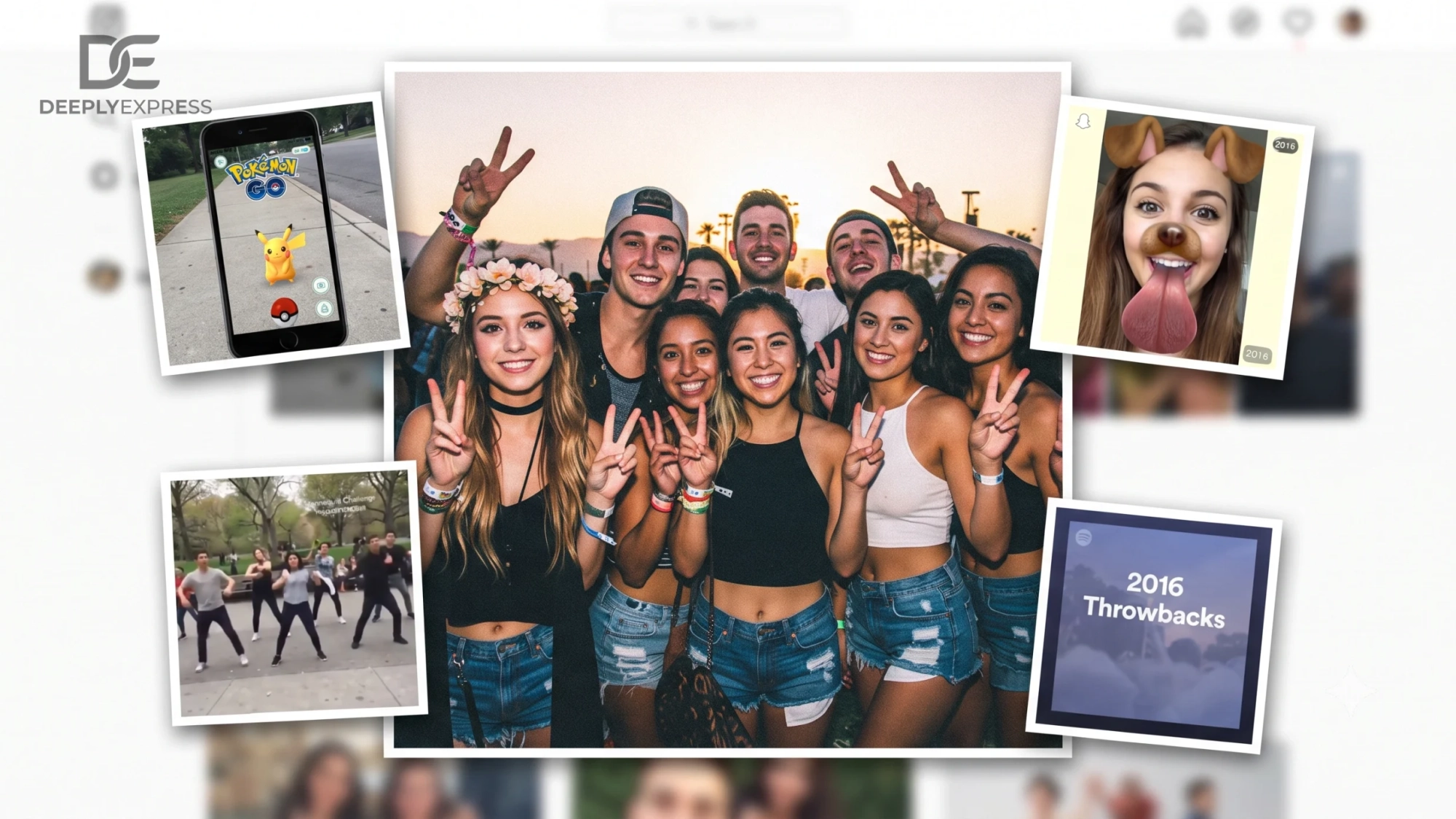
On midnight of January 1, 2026, something strange happened on social media. Instead of New Year resolutions and goal-setting posts, millions of people started posting photos from ten years ago. The captions said “2026 is the new 2016,” and the aesthetic was unmistakable: Snapchat dog filters, over-saturated palm tree pictures, choker necklaces that are probably too thick, peace signs from someone’s 21st birthday, screenshots of apps that don’t exist anymore. Plus, within days, ABC News, Fast Company, Forbes and NPR had all documented the “2026 is the new 2016 trend.” Even Wikipedia got a page for it. During the same week, the hashtag #2016 was used in more than 37 million posts on Instagram and more than 1 million on TikTok. Searches for ‘2016’ on TikTok increased by 452 percent in a week.
This was no minor internet moment. It was the defining cultural conversation of early 2026, and the reasons behind that have more to do with it than simple nostalgia.
WHAT DOES THE “2026 IS THE NEW 2016” TREND MEAN?
The trend started when users realised it was exactly ten years since 2016. Something about the decade marker: people scrolled through their camera rolls and found photos from a certain type of life: less curated, more spontaneous, devoid of the visual anxiety that characterizes how most people present themselves online today.
The format was easy. Find a 2016 photo. Install it. Caption: Something like “2026 is the new 2016” in the caption, or post it with a knowing wink at the time. Celebrities quickly amplified the moment. Reese Witherspoon, John Legend, Demi Lovato, Charlie Puth and Hailey Bieber also hopped on the bandwagon, sharing old photos and doing 2016 throwbacks. Rae Sremmurd took to their 2016 smash hit “Black Beatles” and posted throwback Mannequin Challenge videos. Suddenly, what had begun as a personal memory exercise turned into a communal time machine that the whole internet was piling into all at once.
By mid-January, Spotify reported user-created playlists titled “2016” had surged by over 790 percent since January 1. Most added tracks included Justin Bieber’s “Sorry” and Zara Larsson’s “Lush Life.” The culture had discovered its comfort playlist.
WHAT REALLY MADE 2016 SO IMPORTANT
To understand why people are reliving 2016 in particular, you have to remember what that year felt like from the inside. It was not a good season. “Fuck 2016” was trending by December 2016. Brexit was done. Political anxiety was running high in the U. S. The Pulse nightclub massacre. But there was a quality to the internet of that time that’s really hard to replicate today.
Pop culture was communal in a way it is not today. Beyoncé released “Lemonade”, probably the last album that felt like a real mass cultural event that the whole internet responded to at the same time in the same way. Drake’s “One Dance” was all over every playlist. Chainsmokers and Rihanna were everywhere. Stranger Things hit Netflix in season one and was a true water-cooler moment. These were not algorithmically sorted finds. They were common experiences, shared by all, at about the same time.
Pokémon Go changed what social media felt like. The game was downloaded more than 500 million times worldwide in 2016, and for a while it did something remarkable: It got people outside and talking to strangers in their neighborhoods. People met at gyms, formed walking groups, and met in parks without knowing each other. It was one of the last times a tech product actively created spontaneous, physical community at scale.
The last inclusive viral trend was the Mannequin Challenge. Students, families, professional sports teams, celebrities, and former First Lady Michelle Obama joined in. It was so simple a format that no performance ability was required. Everyone could freeze and point a camera. No barrier to entry, no algorithm deciding who got seen, no monetization strategy behind it.
Social media was a different fabric. TikTok was still not a global app. X was still Twitter, just a larger shared town square. Instagram was for food, holidays, and friends, not personal brands, affiliate codes, and sponsored posts with disclosure disclaimers. Musical.ly was the short-form video predecessor to TikTok, but was small. The influencer economy as we know it was in its infancy. They posted what they wanted because they felt like it, not because it was a content strategy.
WHY 2016 NOSTALGIA IS HITTING HARDER THAN NORMAL
The nostalgia cycle in fashion and culture usually runs on a twenty-year schedule. Some 20 years later, the popular enjoys a revival, which is why the early 2020s were dominated by fashion from the 2000s. That 2016 nostalgia hit a decade early, in 2026, says something significant about the current cultural mood.
Nostalgia is a bittersweet feeling of longing with true warmth, psychologists say, and is a biological coping mechanism. It makes people feel more socially connected and more optimistic in uncertain times. Between 2016 and 2026, we saw a global pandemic, a dramatic acceleration in AI technology that made it harder to trust what you see online, social media fragmenting into echo chambers controlled by algorithms, and what many internet users now call “doomscrolling.” Nobody used that word in 2016.
Journalist and former Vogue editor Leah Faye Cooper summed up the appeal to ABC News: “People are really craving a time that felt simpler, a time that felt really optimistic. Katie Devlin, trends editor at Stylus, told Vogue that 2016 is considered “the last moment of true mass culture,” before algorithms began narrowing what different people were seeing online and fragmented virality into separate bubbles.
This is a comparison of cultures, not a political one. People don’t miss the politics or problems of 2016. They want the internet of that time: the communal feeds, the spontaneous posting, the lack of pressure to perform, and the absence of AI-generated content competing for attention with their personal posts.
HOW THE TREND SPREAD AND WHO KEPT IT GOING
The mechanics of infection were unusually fast. Within hours of January 1, 2026, posts were popping up all over TikTok, Instagram, and Threads with nearly identical captions. The BBC said searches for “2016” soared within TikTok in the first days of the year. A dedicated hazy purple blue TikTok filter that recalled the saturated Instagram aesthetic of the time became widely adopted, producing hundreds of millions of posts in its first weeks.
The format also gave people a rare permission structure that social media rarely offers: an excuse to post something old, imperfect, and personal, without feeling out of place. In a time when feeds are polished to a high gloss, and every post carries implicit pressure to perform, the 2016 trend gave people explicit social permission to post a grainy photograph of themselves at a music festival looking genuinely happy, with no need to align it with a current aesthetic or a content strategy.
The cultural weight of Wikipedia recording the trend before January had even passed the viral moment, and into a recorded cultural phenomenon.
WHAT THE TREND IS REALLY TELLING US
The most interesting thing about the “2026 is the new 2016” phenomenon is what it reveals about the current relationship between people and the internet they use every day.
Euphoria Magazine presented a viewpoint that garnered significant attention: “We go back to the aesthetics of times that felt emotionally similar to our present moment, not because we want to escape into the past, but because the past provides us with a vocabulary for what we are experiencing now.” The chokers and the Snapchat filters and the oversaturated photographs aren’t a costume. They are a language for something hard to say straight: a longing for an internet that felt more human, less monetized, and less surveilled.
The “Dead Internet Theory,” which suggests that modern social media is so dominated by bots, AI content, and algorithmic amplification that the experience of genuine human connection through it has become rare, gained new cultural traction in 2026 partly because of this trend. For many people, the last clear memory is 2016 – a social internet where that concern wasn’t yet necessary.
THE RESPONSE FROM FASHION & BRANDS
The retail and brand world was moving fast. The Abercrombie and Fitch offshoot Hollister featured a heavily filtered carousel of 2016 icons, from Polaroid cameras to the era’s signature skinny jeans. Back in 2016, TRIANGL was super popular for their bikini suits, and the brand teased new products styled to suit the original 2016 aesthetic. Nostalgia in consumer culture doesn’t stay on social media, as analysts at CNBC said in February 2026. Brands with product lines that appeal to nostalgia are watching the trend closely. It goes to actual buying behaviour.
The trend is already translating into real revivals in fashion. The most emblematic necklace of 2016 fashion, the chokers, are back. Athleisure and the early 2010s prep aesthetic of Abercrombie and Hollister are the new street style and editorial photography muses. Celebrity stylist Oriona Robb put it best: “What we’re seeing is not people trying to become their 2016 selves. “It’s people using known visual references to say who they are in this moment.
FREQUENTLY ASKED QUESTIONS
- WHAT DOES ‘2026 IS THE NEW 2016’ MEAN?
It’s a viral phrase that exploded on social media on January 1, 2026, in which users claim that the cultural vibe of 2026 is the same as that of 2016. The phrase is celebrated with people posting throwback photos from ten years ago with captions referencing 2016 aesthetics, songs, memes, and moments. It speaks to a nostalgia for what many describe as a simpler, less algorithmically controlled time of social media. - WHAT STARTED THE 2026 IS THE NEW 2016 MEME?
The reason for the trend is that 2026 will be the 10th anniversary of 2016. That milestone, along with real-life exhaustion with the current social media landscape (AI content, aggressive algorithms, performance pressure, and doomscrolling), prompted millions of users to reflect on a time that felt more communal and spontaneous. It went off on January 1, 2026, and was covered by major publications in the same week. - WHAT WAS SO SPECIAL ABOUT 2016 THAT PEOPLE ARE NOSTALGIC FOR IT?
2016 was the year of Pokémon Go, Beyoncé’s Lemonade, Stranger Things season one, the Mannequin Challenge, and “Damn, Daniel.” Social media at the time felt more personal and less driven by performance and monetization. TikTok had not yet launched internationally, the influencer economy was in its infancy, and feeds showed content from people you actually knew rather than content selected to maximize engagement. - IS THE “2026 IS THE NEW 2016” TREND STILL ONGOING?
The trend peaked in early 2026, but its cultural footprint continued throughout the year. Brands responded with nostalgia marketing campaigns, 2016 fashion items began appearing in stores, Spotify playlists from the era surged by over 790 percent, and cultural analysts continued using the phrase as a reference point for understanding the broader mood of 2026 consumers. - WHAT 2016 TRENDS ARE ACTUALLY COMING BACK IN 2026?
Choker necklaces, athleisure, oversaturated photo filters, matte liquid lip colors, the early 2010s prep aesthetic from brands like Abercrombie, flower crowns, and bold statement earrings have all seen search and sales increases. Musically, tracks from artists like Drake, The Chainsmokers, Rihanna, and Justin Bieber are seeing new streams, and “2016” playlists on Spotify grew by over 790 percent in the weeks following January 1.
Leave A Comment