
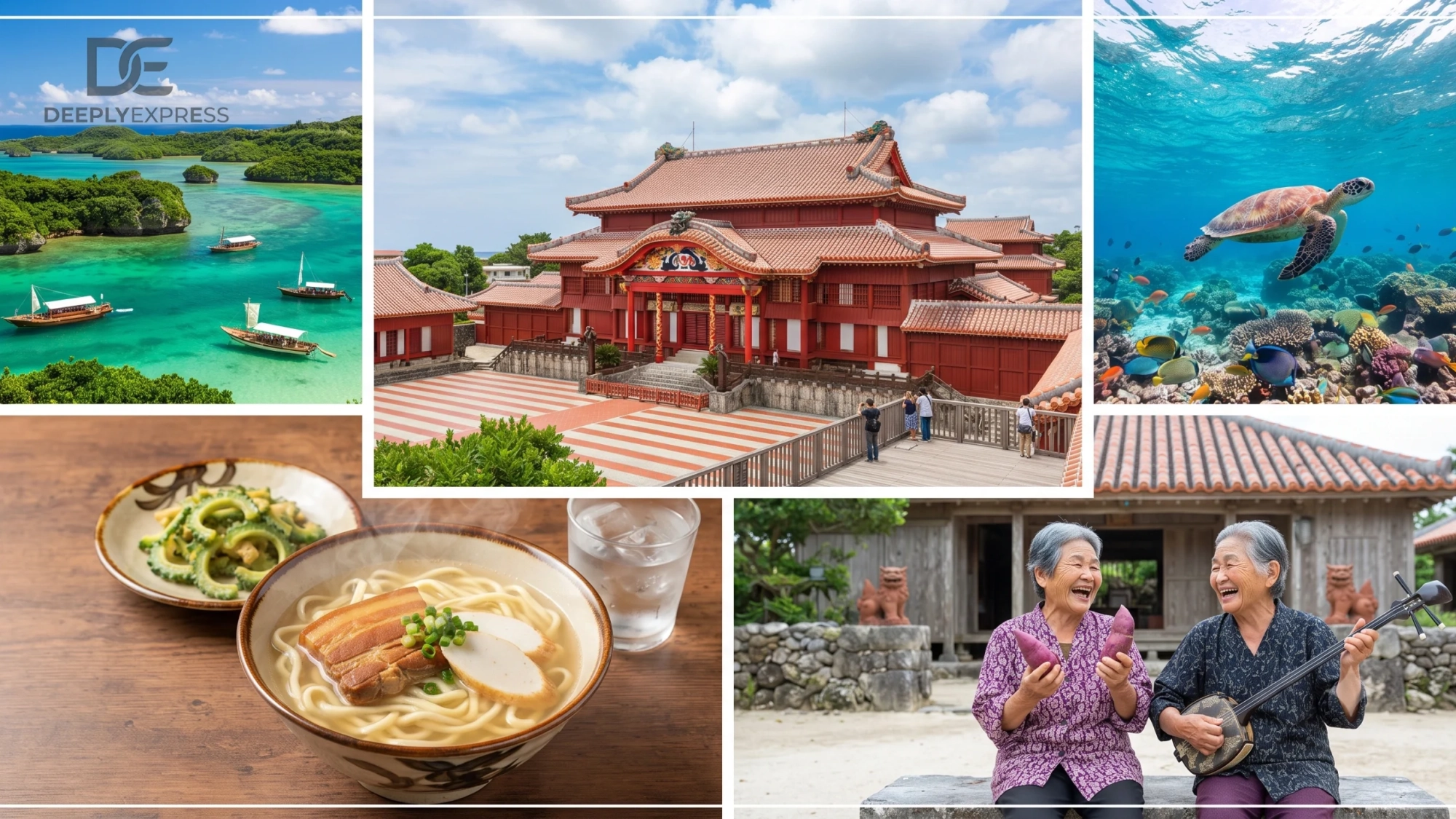
When most people plan a trip to Japan, they think first of Tokyo. Then, Kyoto. Perhaps Osaka. Okinawa was rarely featured on the shortlist for Western travelers until 2026, when Expedia published its annual travel trends report and ranked the island second on its list of the world’s top trending destinations, behind only Big Sky, Montana. Between 2024 and 2025, searches for flights and accommodations for Okinawa increased by 71 percent. That kind of growth signals something real happening, not a manufactured travel trend, but a destination that has quietly earned its attention. Before you go, this guide has all the information you need.
TOP DESTINATIONS OF 2026, WHY OKINAWA IS ONE OF THE MOST SEARCHED
Expedia’s 71 percent jump is the result of several factors, not just one. Shuri Castle, the UNESCO-listed royal palace that anchors Okinawa’s capital Naha, was ravaged by a fire in 2019 and has been under restoration ever since. The main hall reconstruction is due to be completed in autumn 2026, so this year will be a milestone moment. Travelers who go now will see the restoration completing in real time and be among the first to experience the fully rebuilt castle.
Beyond the castle, Okinawa is quietly offering what Tokyo and Kyoto can no longer provide: space. The crowds that overwhelmed both cities in recent years pushed travelers toward alternatives, and Okinawa delivered on almost every front: beaches, culture, safety, Japanese service standards, and a subtropical island pace that mainland Japan cannot replicate.
WHAT SETS OKINAWA APART FROM THE REST OF JAPAN
Most first-time visitors don’t realize this until they get there, but Okinawa isn’t quite Japan. Not in the way Tokyo is Japan, or Kyoto is Japan.
The islands were an independent kingdom called the Ryukyu Kingdom for roughly five centuries, from the 15th century until Japan formally annexed them in 1879. During those centuries, Ryukyu traded extensively with China, Korea, and Southeast Asia, accumulating a culture that absorbed elements from all of those places while remaining distinctly its own. The architecture has Chinese influences. The cuisine is based on sweet potatoes, bitter melon, and pork, in ways that have little to do with the cuisine of mainland Japan. Older residents still speak the local language, Uchinaaguchi, and cultural festivals preserve it. Even the music is different, based on the sanshin, a three-stringed instrument brought from China by trade routes.
This special identity is not some tourist stunt. That’s what makes Okinawa more than a pretty island. You are visiting a culture that was genuinely separate from Japan for most of its recorded history, and that history is still present in the architecture, the food, and the everyday rhythms of the place.
SHURI CASTLE: THE ONE PLACE TO VISIT THIS YEAR
If there is one single reason why 2026 is the right year for Okinawa, it is Shuri Castle. The Ryukyu kings built the original structure in the 14th century, and it has burned and been rebuilt multiple times over its history, including destruction during the Battle of Okinawa in 1945. The most recent fire, in October 2019, gutted the main hall and several surrounding structures, and the painstaking reconstruction that followed has been ongoing for five years.
The exterior has already been reconstructed. The main hall is planned to open in full in autumn 2026, restored using traditional Ryukyuan techniques that reflect the building methods used in earlier restorations. Even before completion, visitors can observe the process of restoration itself from designated viewing areas, while the castle grounds and surrounding Shuri district in Naha are already fully open and worth exploring in their own right.
The architecture is striking: the red lacquered exterior and curved rooflines are clearly Chinese in influence, echoing the aesthetic of the Forbidden City, but filtered through centuries of Ryukyuan adaptation. This is like nowhere else in Japan.
THE BEACHES: THE UNKNOWN OF OKINAWA’S ISLANDS
Okinawa is more than one island. It is an archipelago of more than 160 islands, 50 of which are inhabited, stretching from the southern tip of Kyushu toward Taiwan. The beaches on the main island are beautiful. The outer islands’ beaches are another thing.
- KERAMA ISLANDS
The Kerama Islands are a 35-minute high-speed ferry ride, 35 km west of Naha. The waters here are so clear, divers and snorkelers call them “Kerama Blue,” because on calm days you can see further than 40 meters. Sea turtles are so common that if you go snorkeling you are almost guaranteed to see them. Humpback whales migrate to the warm Kerama waters to breed from January to March and day trip whale watching tours run daily from Naha’s Tomari Port during peak season.
The Kerama Islands are the easiest add-on to any Okinawa trip, and make a strong case for extending a four-day visit to seven days.
- MIYAKOJIMA
Miyako is a 50-minute flight south of Naha, and consistently ranks as one of the best beaches in all of Japan. Miyako is great for do-it-yourself snorkeling, with warm shallow waters. Beaches are always open and free. There is no real public transport on Miyako, so a rental car is essential, but the road network is compact, and driving is easy. - ISHIGAKI & YAEYAMA IS.
Ishigaki is the gateway to the Yaeyama Islands, the southernmost inhabited islands of Japan, which are actually closer to Taiwan than to Tokyo. A short ferry ride from Ishigaki is Taketomi Island, a tiny place where water buffalo cart rides move at the pace the island demands, red-tiled traditional houses line unpaved lanes, and Kondoi Beach is genuinely uncrowded. Take a longer ferry ride or short flight to Iriomote, where rivers cut through jungle so dense you can walk on it, and mangrove tours are the order of the day. On Ishigaki itself, Kabira Bay’s blue-green water and the black pearl farms that dot the surface of the bay earned three stars in Michelin’s travel guide.
OKINAWA’S BLUE ZONE: WHERE LONGEVITY RESEARCHERS GO
Okinawa is one of five designated Blue Zones in the world — places where people live measurably longer than the rest of the world. The other four are Sardinia in Italy, Nicoya in Costa Rica, Ikaria in Greece and Loma Linda in California. Some 68 in 100,000 Okinawans are over 100 years old. The reasons researchers provide are concrete and practical.
The traditional Okinawan diet is built largely around sweet potatoes, especially the purple beni imo variety, which makes up about 70 percent of the average elderly Okinawan’s caloric intake. A touch of pork, seaweed, tofu, and bitter melon round it out. It is a high-antioxidant, low-calorie diet.
Two cultural practices receive special attention. The first is “hara hachi bu,” a Confucian-inspired principle of stopping eating when you feel 80 percent full, which research suggests prevents the chronic overconsumption that fuels many modern diseases. The second is the “moai”, a lifelong social circle of five people who promise to support each other financially and emotionally for life. The Blue Zones research identified this structure as one of the most significant contributors to longevity, providing consistent social connection that counteracts isolation in old age.
For visitors, the best way to experience this culture is to spend time in the northern village of Ogimi, in the Yanbaru region, which has some of the highest centenarian rates in the prefecture and a slower pace that makes the longevity philosophy tangible rather than theoretical.
OKINAWA FOODS YOU MUST TRY
Okinawan food operates on a philosophy summed up in the word “nuchigusui,” which translates roughly as “medicine of life.” Food is understood as nourishment that heals, not just fuel that satisfies, and the best meals reflect that.
Okinawa soba is not soba on the mainland. Thick wheat noodles are used, the broth is made from pork bones and bonito, and it is typically topped with braised pork belly (rafute), fish cake, and pickled ginger. It’s the comfort food of the island, and you can find it everywhere from roadside stands to sit-down restaurants.
Goya champuru is bitter melon stir-fried with tofu, egg, and Spam or pork, and represents the champuru cooking style (“mixing”) that defines Okinawan cuisine. The bitterness of the melon is real and takes adjustment, but the nutritional density is extraordinary.
Awamori is the local spirit, distilled from long-grain indica rice rather than the short grain used in sake, and is typically served over ice or mixed with water. It has a distinct earthy quality very different from mainland Japanese spirits.
The Makishi Public Market in Naha is the best place to eat in the city. Buy fresh seafood from the ground floor vendors, then take it to one of the second floor restaurants to have it cooked to order. No fixed menus, no reservations needed.
WHEN TO VISIT OKINAWA IN 2026
Okinawa has a subtropical climate that runs warm most of the year, but timing your visit matters more than most travel guides suggest.
Spring, from March through May, offers the best overall conditions. Temperatures sit between 20 and 25 degrees Celsius, humidity is low by island standards, and the summer crowds have not yet arrived. Cherry blossoms in Okinawa bloom in late January and early February, the earliest in all of Japan, making a January or February visit worthwhile for those who want to see sakura without the mainland crowds.
Summer, from June through September, is warm enough for full beach days but carries meaningful typhoon risk. Several typhoons typically pass through or near Okinawa this time of year, so it’s important to be flexible with your itinerary. Those who can handle the weather uncertainty are rewarded with the warmest water and the most active coral reef ecosystem.
The second sweet spot is October through November: warm, clear, and substantially less crowded than summer. Water temperatures are still comfortable for swimming and snorkeling into November.
The Kerama Islands are whale watching season from January through March, with humpbacks reliably present, and the mild winter temperatures make this period ideal for those who want to explore culture and history rather than beaches.
HOW TO GET AROUND OKINAWA
Within Naha, the Yui Rail monorail connects the airport to central Naha and the Shuri Castle area efficiently. From the major stations, you can walk to most of the city’s main sights.
Outside of Naha, a rental car is not optional. It is the only practical way to reach the beaches, Cape Manzamo, the Churaumi Aquarium, and the northern Yanbaru National Park. Foreign drivers require an International Driving Permit. Budget approximately 3,000 to 6,000 yen per day for a standard compact rental, with fuel costs additional.
Outer islands are accessed by ferry or regional flight. High-speed ferry from Tomari Port in Naha to the Kerama Islands. There are airports on both Miyako Island and Ishigaki with budget carriers providing regular 50 to 60 minute flights from Naha. If booked in advance, one-way fares from Naha can be as low as 8,000 yen.
Just like the rest of Japan, Okinawa does not have tipping. Trying to tip is really awkward. The correct way to express appreciation after a meal is to say “gochisosama deshita” (meaning “it was a feast”) as you leave.
FREQUENTLY ASKED QUESTIONS
- HOW MANY DAYS IN OKINAWA?
The main island can be covered in four or five days: Naha culture, Shuri Castle, a beach day, and the northern driving route through Churaumi Aquarium and Cape Manzamo. Extend your itinerary by a couple or three days and head out to the Kerama Islands. If you want to fly to Ishigaki or Miyako, tack on at least two more days. For a first visit that includes one outer island group, seven to eight days is the sweet spot. - IS OKINAWA SAFE FOR SOLO TRAVELERS?
Japan has one of the lowest crime rates in the world and Okinawa shares that standard completely. Okinawa is one of the safest islands in Asia and is a favorite among solo travelers and solo women travelers. The main island has walkable urban areas, reliable transport within Naha, and English signage at all major tourist sites. - WHAT IS THE BEST BEACH IN OKINAWA?
Kondoi Beach on Taketomi Island for pure atmosphere, Kabira Bay on Ishigaki for scenery, and the Kerama Islands broadly for clarity and marine life. On the main island, Emerald Beach inside Ocean Expo Park is the most reliable for swimming near the Churaumi Aquarium. Cape Maeda and its Blue Cave are best for snorkeling off the main island.
- DO I NEED A VISA TO VISIT OKINAWA FROM OUTSIDE JAPAN?
Travelers from many countries, including the United States, United Kingdom, Canada, Australia, and most European nations, can enter Japan (including Okinawa) without a visa for stays up to 90 days under Japan’s tourist exemption program. Requirements can change, so checking the current policy with the Japanese Embassy in your home country before travel is always advisable. - IS OKINAWA EXPENSIVE COMPARED TO MAINLAND JAPAN?
Okinawa is generally comparable to mainland Japan in terms of accommodation and food costs, though the outer islands can run slightly higher due to logistics. Budget travelers can eat very well on 1,500 to 2,500 yen per meal and find reasonable guesthouses from around 5,000 to 8,000 yen per night on the main island. The highest added cost for most visitors is the rental car, which becomes necessary for any meaningful exploration outside Naha. - WHAT LANGUAGE DO PEOPLE SPEAK IN OKINAWA?
Standard Japanese is the primary language used in daily life and tourism. The indigenous Okinawan language, Uchinaaguchi, is spoken by some older residents and preserved through cultural events. English signage is available at major tourist sites and airports, and most businesses serving visitors have staff who can communicate basic information in English.
Leave A Comment