
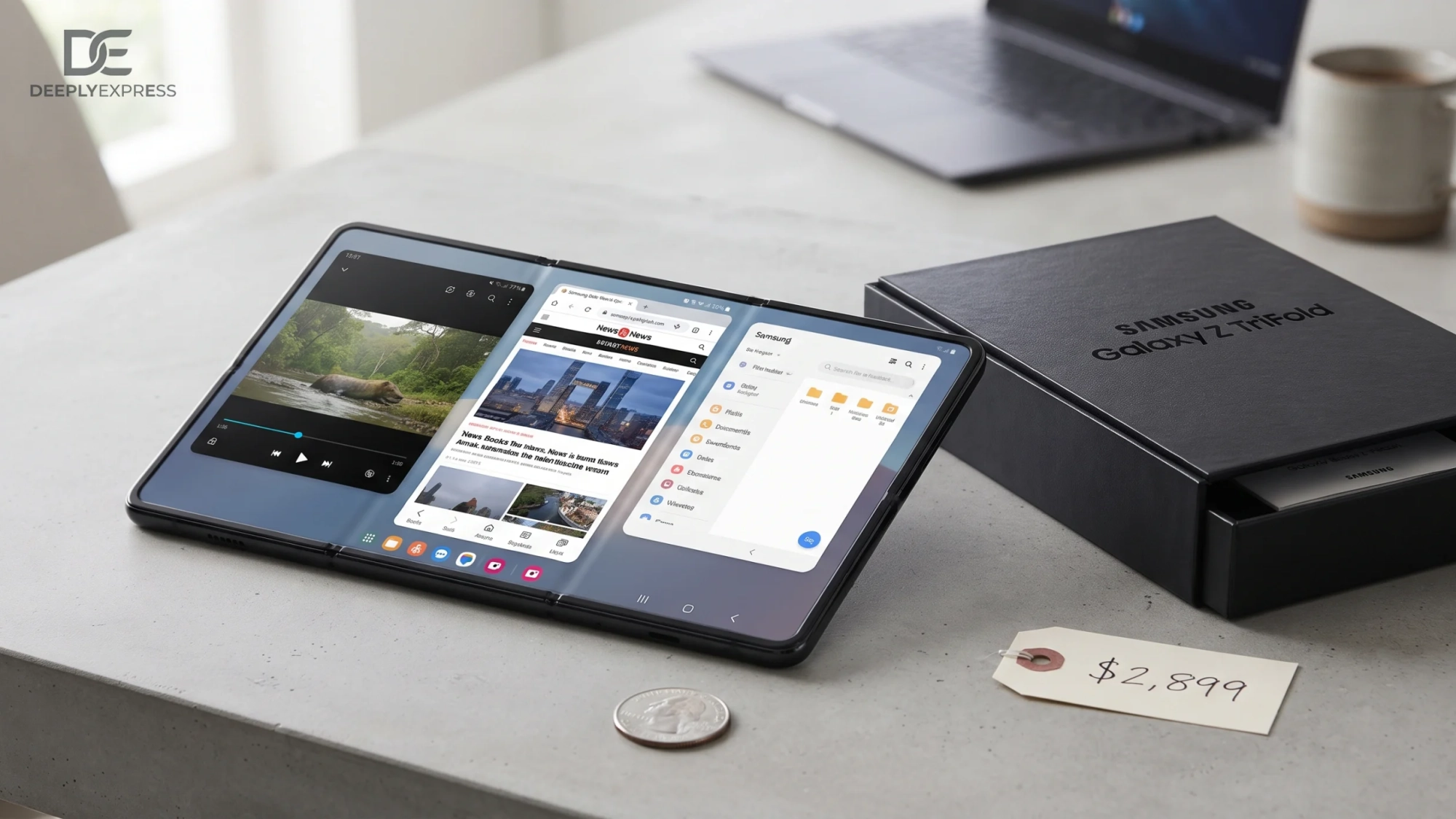
This is the detail you won’t find in most reviews of this phone, simply because they were written before it happened: In March 2026, roughly three months after its debut in the United States, Samsung quietly cancelled the Galaxy Z TriFold. “We’re not making any more of them after the existing stock sells out,” a Samsung spokesperson told Bloomberg. Any honest Samsung Galaxy Z TriFold review published today has to answer a different question than the one people were asking in January, not just whether the phone is any good, but whether it makes sense to buy a device its own maker has already walked away from.
WHAT YOU REALLY GET FOR $2,899
The Z TriFold is priced right for some truly weird hardware. It folds in half, from a 6.5-inch cover screen to a 10-inch main display—the biggest ever built into a Galaxy phone—and it’s thin enough when unfolded, at 3.9 millimetres at its narrowest point, to feel more like a tablet than a phone. It has a Snapdragon 8 Elite chip with 16GB of RAM and 512GB of storage, and a 5,600mAh battery with 45W wired charging. The rear camera system features a 200MP main sensor, a 12MP ultrawide lens, and a 10MP telephoto lens, while the front camera offers 10MP for selfies and video calls. It is also the first Samsung phone to feature full Samsung DeX on device without the need for an external monitor, and it has a seven year commitment for OS and security updates. The company is releasing the phone in one configuration: crafted black with 512GB of storage. It’s also only being sold through Samsung itself, not mobile carriers, which means there are fewer financing options than you’d typically get with a flagship launch. The IP48 rating offers water resistance, but lacks a formal dust rating, something to consider if you’re often outside.
WHY IT GOT DISCONTINUED SO FAST?
Folded, the Z TriFold has a thickness of 12.9 millimetres and a weight of 309 grammes. That makes it substantially thicker and heavier than the Galaxy Z Fold 7’s 8.9 millimetres. That thickness was the biggest complaint out of virtually every hands on, and it’s almost certainly the reason why Samsung pulled back so quickly instead of committing to a yearly refresh. The good news for those still wanting this form factor is that a successor has already been confirmed. The Galaxy Z TriFold 2 is in development, with a hinge redesign that aims for around 8.9mm folded, fixing the original’s biggest weakness, with a launch targeted sometime in 2027.
WHAT REVIEWERS REALLY LIKED
Almost every early review complimented the size and quality of the unfolded display for video, games and reading, and how well Samsung hid the crease across all three panels. People also liked the DeX multitasking experience, with reviewers saying they got real productivity gains, not a gimmick, once they got used to the format. Battery life was decent in day to day testing, occasionally beating Samsung’s own S25 Ultra in side by side comparisons, and the phone’s ability to survive 200,000 rated folds suggested some real engineering confidence behind the hinge.
WHAT REVIEWERS REALLY DIDN’T LIKE
Apart from the thickness and weight, the camera system was constantly criticised for its limited 3x optical zoom, mediocre selfie camera and inconsistent low light performance despite the flashy 200MP sensor. There’s no S Pen support, no Samsung Care Plus protection plan to buy it, and the camera bump causes the phone to wobble noticeably when placed on a flat surface. The phone also can’t be propped up in a partial fold, like the Z Fold 7 can, which makes it awkward for watching content without holding it. Third party apps do not always scale cleanly to the unusual aspect ratio, reviewers noted.
SHOULD YOU REALLY BUY ONE NOW
If you can find one at or below its original $2,899 price, then consider yourself lucky to be buying into a truly impressive first generation product that has been abandoned, more like a proof of concept than a device with a guarantyd multi year ecosystem ahead of it. It’s a real trade off worth sitting with, especially as Samsung’s own premium foldables normally cost $1,500 to $2,000, putting the TriFold already priced well above the rest of its own foldable lineup before it was discontinued. If it’s the giant screen and DeX productivity that appeal to you, and you’re not in a rush, then waiting for the slimmer Z TriFold 2 in 2027 is the more rational move for most people. If you want the biggest folding screen Samsung makes and are willing to be an early adopter of a phone that’s already got one foot in the past, it’s still a remarkable piece of engineering.
FREQUENTLY ASKED QUESTIONS (FAQ’S)
- IS THE SAMSUNG GALAXY Z TRIFOLD STILL AVAILABLE TO PURCHASE?
Samsung confirmed in March 2026 that it will not produce any more units after the current inventory is depleted and will only be available through the remaining stock at Samsung Experience Stores and Samsung.com. - WHY SAMSUNG KILLED THE GALAXY Z TRIFOLD SO QUICKLY?
The most likely suspect is the thickness and weight of it when folded which was the most consistent complaint across the early reviews and which is directly addressed in the confirmed Galaxy Z TriFold 2. - IS THE GALAXY Z TRIFOLD WORTH 2,899 DOLLARS IN 2026?
Only for the particular buyer who wants the largest folding screen on the market today and knows they are buying a discontinued, first-generation device, not an ongoing product line. - HOW THICK IS THE GALAXY Z TRIFOLD COMPARED TO THE GALAXY Z FOLD 7?
The Galaxy Z Fold 7 is 7.9 mm thick, while the Galaxy Z TriFold is 9.9 mm thick. The Z TriFold, when folded, measures 12.9mm thick, compared to the Z Fold 7’s 8.9mm, making it considerably chunkier, although it is thinner than the Z Fold 7 when fully opened.
Today’s Samsung Galaxy Z TriFold review must be honest about what this phone actually is: an ambitious, truly capable device that Samsung has already moved on from. It’s still one of the more interesting phones released in 2026, just not one built for people who want long-term certainty about what they’re buying into.
Leave A Comment