
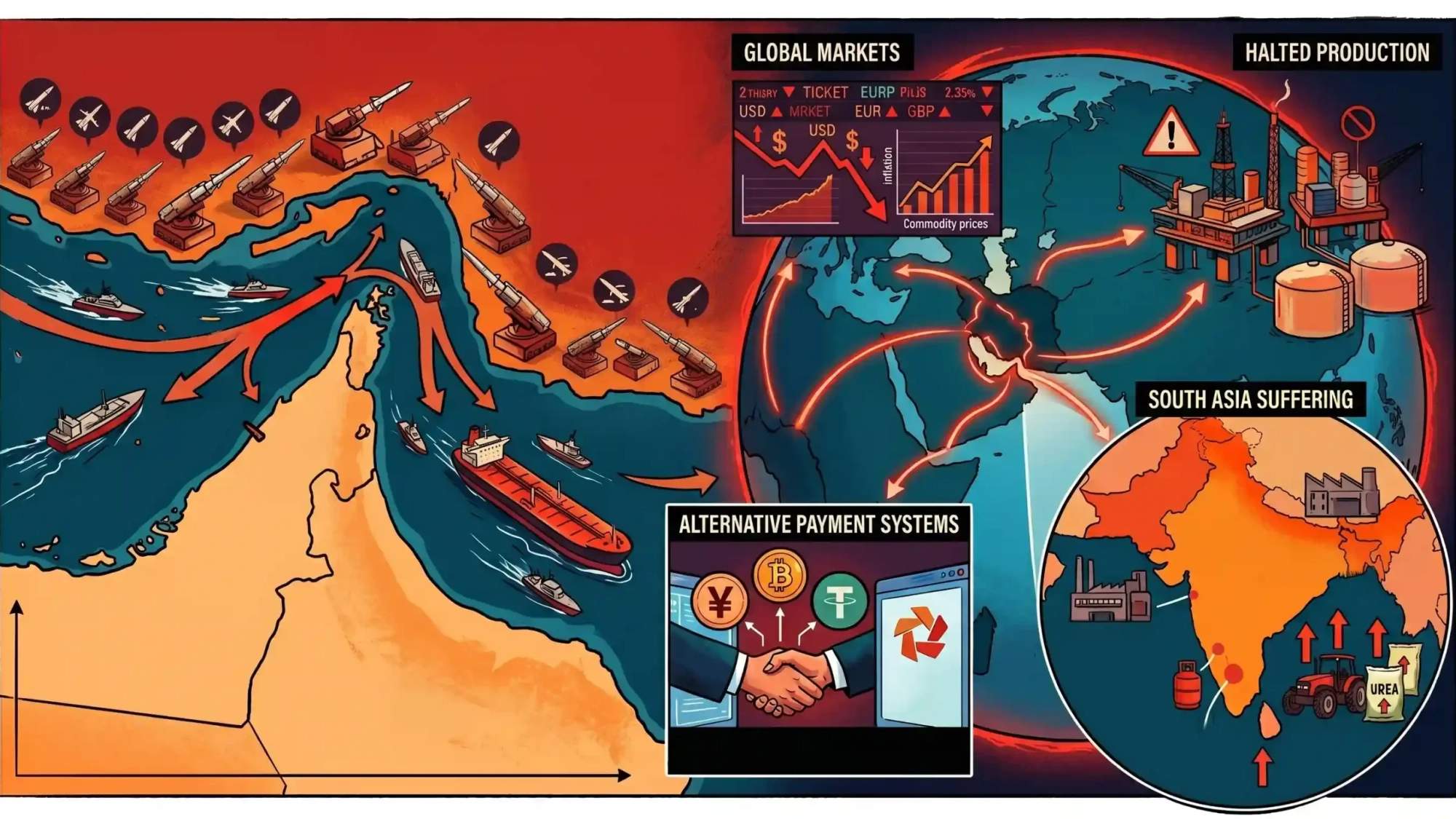
The Strait of Hormuz became the heart of a major global energy crisis in the mid-2020s. By 2025, around 20 million barrels of oil flowed through it daily, making up about 25% of worldwide seaborne oil trade. In March 2026, when Iran clashed with the U.S. and Israel, they closed the strait. This had huge impacts all over the world, but South Asia suffered most of all.
What Is the Strait of Hormuz, and Who Controls It?
The Strait of Hormuz sits between three countries: the United Arab Emirates to the south, Iran to the north, and Oman, including its capital Muscat, to the east. At its smallest, it’s just 21 nautical miles wide – that’s 39 kilometers – divided into two navigable channels, each 2 miles wide, with a 2-mile buffer zone in between.
Now, people often wonder how Iran controls the strait when it borders other nations. Well, the deal breaker here is geography. With its long northern shoreline, Iran pretty much dominates the shipping routes. Plus, the Iranian Islamic Revolutionary Guard Corps (IRGC) keeps up a big naval force using fast boats, drones, and missiles on the coast. Starting in March 2026, they took charge of managing all ship traffic too. This means ships have to fill out thorough forms detailing everything from cargo to crew to travel routes. Once approved, those ships get escorted through the northern passage by the IRGC Navy, effectively putting them in Iranian-controlled waters. So, even though the strait touches multiple countries, Iran’s military might allow them to call the shots.
Yuan, Crypto, and the Strait: Iran’s Toll System Challenges Dollar Dominance
On March 30-31, 2026, Iran’s parliament greenlit the “Strait of Hormuz Management Plan.” They made official a toll system already in place. For oil tankers, this means paying about $1 per barrel of crude, though rates differ by nationality. So, a VLCC toting 2 million barrels would shell out roughly $2 million for each trip through the strait.
Iran’s demand for payment in Chinese yuan, handled by Kunlun Bank through China’s CIPS system or in crypto like Bitcoin and USDT, really sticks out. They aren’t using SWIFT, which makes this even more unusual. Also, this is the first time a country is using crypto for revenue at a key maritime bottleneck. Lloyd’s List reports that at least two ships have paid in yuan, and the sums can reach up to $200 million per vessel.
This shift has major implications for the U.S. dollar. When Iran opts out of using the dollar-based financial system, they boost the process of de-dollarization in the global energy market. If other nations follow suit, accepting yuan for crucial resources, the dollar might not be the go-to global reserve currency for everyone anymore.
Does International Law Apply to the Strait of Hormuz?
This is a super tricky question in maritime law. According to the United Nations Convention on the Law of the Sea (UNCLOS), ships have the right of “transit passage” through international straits, a right that can’t be stopped. But here’s the kicker: Neither Iran nor the US has approved UNCLOS. This makes things murky, ya know?
Iran says only “innocent passage” should apply in the Strait of Hormuz. That’s way stricter and lets them control who can pass through. On the other hand, the US and most countries think transit passage is now part of customary international law and applies to everyone, so Iran can’t just change the rules like that.
It’s clear that shutting down an international strait like Hormuz goes against the freedom of navigation, which most countries agree on. Yet, during an armed conflict, Iran says it needs to do this for security reasons. So, legal experts are split on whether Iran’s toll system is a legit use of their coastal rights or if it’s illegal interference with shipping.
Worldwide Impact: Oil Prices, Inflation, and Shipping Chaos
The recent disruption sent Brent crude prices surging past $90 per barrel, triggering inflation worldwide. In April 2026, major Gulf producers collectively halted 10.5 million barrels per day of production. With minimal alternative pipeline capacity, a lot of oil can’t find its way to global markets. To add to that, LNG prices skyrocketed in Europe and Asia. Qatar, the second-biggest LNG exporter, doesn’t have many other ways to ship the stuff.
South Asia’s Vulnerability: Energy Shocks and Welfare Losses in the Hormuz Crisis
South Asia took the biggest hit. Countries there rely heavily on imports. India, for example, gets 40-50% of its crude imports and two-thirds of its LNG through one specific strait. They’re focusing on household LPG supplies, leaving small and medium-sized enterprises to downsize. Pakistan imports 99% of its LNG from Qatar and the UAE, where price hikes are raising power generation costs and hurting the textile industry. Things are looking bad for Bangladesh too; its garment industry, responsible for 80% of export income, sees growing energy costs cutting into profits.
According to the Kiel Institute, South Asian nations are looking at welfare losses ten to twenty times greater than what the United States will suffer. That’s a stark difference showing just how much more vulnerable South Asia is in this crisis.
From Energy Blockade to Food Security Threat: The Strait of Hormuz Ripple Effect
The next few weeks and months are super important. If things stay closed for a long time, we could see issues move from energy to food security. You see, natural gas is a big part of making fertilizer, and the shortage’s already led to huge urea price hikes – around 50% – in South Asia. As the growing season begins in the Northern Hemisphere, farmers in India, Pakistan, and Bangladesh have to worry about soaring diesel prices for getting their crops to market.
On a global scale, how long this plays out is the main factor. The International Energy Agency points out that there’s still some extra oil production capability, mostly in Saudi Arabia, but this can’t help if the Hormuz Strait stays blocked. If the problem drags on, we might actually run short of resources, not just see prices go up. This would hit developing economies hard, especially those already dealing with a lot of debt and inflation.
DeeplyExpress.com Analysis Desk
Strait of Hormuz crisis is a serious test for the rules-based system that supports global maritime trade. When Iran tried to charge a toll, even if it was legally challenged, other nations might follow suit at their chokepoints. This could hurt the free flow of energy and disrupt international business too.
South Asia needs to act fast to secure its energy future. They should increase renewable energy use, build up petroleum reserves, and rely less on imports through one route.
The rise of Yuan and crypto payments in Iran’s toll system is pretty significant too. They show potential for a bigger challenge to the US dollar’s lead in energy trading. How the US and its friends handle this could decide if it stays an oddity in their region or turns into something that shakes up how global trade is financed.
Right now, the Strait of Hormuz is a hotspot where energy, geography, and big power conflicts meet. It’s huge, and any troubles there mainly hurt the world’s most vulnerable people, who can least afford such disruptions.
This isn’t just about ship routes; it’s about shaping how global trade works in the future. What countries do now will matter for decades?
Leave A Comment