
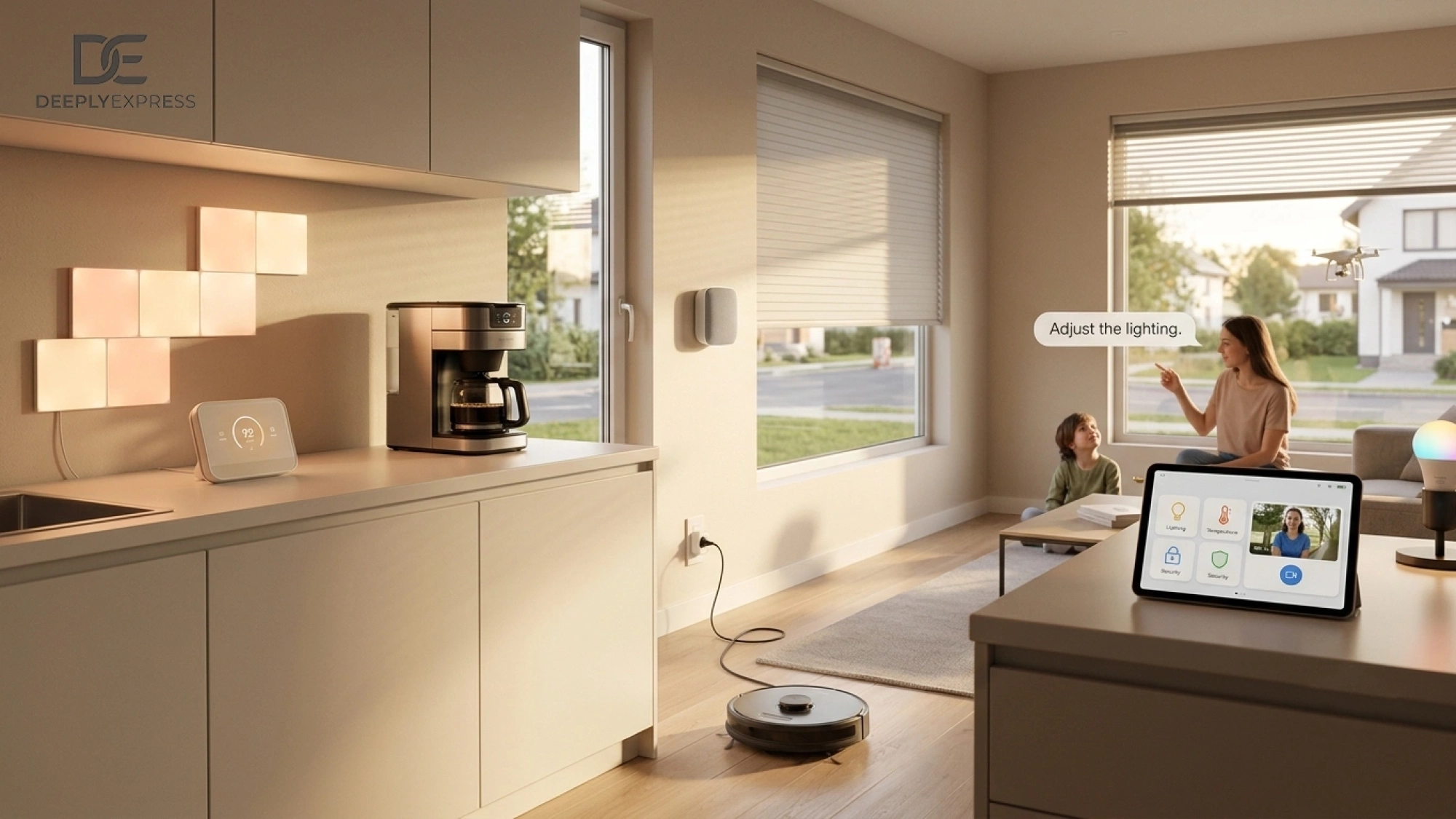
The best smart home devices of 2026 aren’t the ones with the longest spec sheets or the flashiest showroom displays. They become part of your everyday life; they perform so consistently that you don’t even see them as technology anymore. The smart home category has finally matured after years of fragmentation, unreliable apps, and products that required a troubleshooting session every other week. But it has not developed evenly.
There are some devices worthy to be in 2026. Some are expensive diversions, cloaked in marketing doublespeak. This guide explains which is which, and why.
WHY NOW IS THE TIME TO INVEST IN A SMART HOME
For years, the biggest barrier to buying smart home devices was the compatibility issue. Amazon Echo devices could not communicate with Apple HomeKit. Google Home had its own walled garden. Every new purchase meant betting on a platform and hoping your choice survived long enough to be worth the investment.
That was the equation before the Matter protocol. Backed by Apple, Amazon, Google, and Samsung through the Connectivity Standards Alliance, Matter is a universal communication standard that lets certified devices work across all major platforms simultaneously. Matter 1.4, released in late 2024, and expanded coverage to include cameras and video doorbells. Devices react more quickly and continue to function when a company’s servers fail, since the commands are processed on your home network, rather than being sent to a manufacturer’s cloud server.
The practical result is simple: a Matter certified smart plug or bulb bought today will function whether you switch from Alexa to Google Home next year or move to Apple HomeKit the year after. That’s a very different buying environment than we had even two years ago.”
The Consumer Technology Association reports that adoption of smart home devices increased 34 percent year over year in 2025. That growth is not coming from tech lovers. It is coming from mainstream buyers who now have reliable, reasonably priced options available to them.
SMART HOME DEVICES YOU’LL ACTUALLY WANT TO BUY: THE MOST OBVIOUS MONEY-SAVING DEVICE: SMART THERMOSTATS
One smart home device that’s always worth the investment? The smart thermostat. ENERGY STAR certified data shows that smart thermostats reduce heating costs by an average of 10 to 12 percent and cooling costs by around 15 percent annually. For a typical American household spending $1,500 per year on heating and cooling, that works out to $130 to $145 in real, measurable savings every year.
Two models are ahead of the category in 2026. The Google Nest Learning Thermostat 4th Gen (around $230) is the cleaner choice for households already using Google Home. It learns your schedule within the first week, shifts automatically to an energy-saving mode when it detects you have left, and features a redesigned ambient display that brightens as you walk toward the wall. It supports Matter, so it works with Apple HomeKit and Amazon Alexa, too, but its Google Home integration is the most polished.
The Ecobee Smart Thermostat Premium (around $249) is the better pick for everyone else. It is the only major thermostat that works natively with Apple HomeKit, Amazon Alexa, and Google Home at the same time. It also comes with a room sensor (another $50 value) that provides a real-world solution to a problem the Nest doesn’t address out of the box: temperature differences between rooms. If your bedroom is always five degrees cooler than the hallway where the thermostat is, the Ecobee reads both places and strikes a balance. For most households, both devices will pay for themselves in 12 to 18 months.
VIDEO DOORBELLS: SECURITY WITH NO TECH DEGREE REQUIRED
The video doorbell category achieved practical maturity in 2026. No longer is the question if they work, but what features are worth paying for.
The Arlo Video Doorbell 2K ($130 for the 2K model, $80 for the HD version) offers a 180-degree field of view, enhanced night vision, an IP65 weather resistance rating, and compatibility with Alexa, Google Assistant, and Apple HomeKit without requiring a subscription for core functionality. For households seeking quality video with no recurring bill, it’s the simplest choice.
If you’re already in the Amazon or Ring ecosystem, the Ring Battery Video Doorbell Plus is worth a peek. Its wider, taller field of view captures visitors from head to toe, and catches packages left out at the door. Some storage and sharing features require a Ring Protect subscription starting at $4.99/month. If you already have a subscription in your house, the value stacks up nicely.
The Eufy E340 Video Doorbell is specifically designed for homes that want to never have to deal with a subscription. It’s a rare and increasingly popular outlier in the category with local storage, decent video quality, and no monthly fees.
ROBOT VACUUMS: THE CATEGORY THAT FINALLY LIVED UP TO ITS MARKETING
For more than ten years now, robot vacuum cleaners have been promising to take the place of manual cleaning. By 2026, they will have come close enough that the investment will be worth it for most households.
Roborock Q5+ ($400) – The Roborock Q5+ offers 2,500 Pa of suction and performs well on hardwood floors and low-pile carpets. It empties into a base dock, which can hold up to seven weeks’ worth of debris before you need to change the bag; for a busy family, that means going nearly two months without taking the bins out.
The iRobot Roomba Combo j9+ ($599) is the better choice for homes with pets or young kids. Its object-avoidance system can now detect and avoid charging cables, socks, and pet waste with enough reliability to operate unsupervised. iRobot actually has a first-year guarantee to back this up: Should the robot mess up with pet solid waste, they will send out a replacement.
One practical tip that isn’t listed on any product listing: Before the first run, spend ten minutes picking up loose cables and small objects from floor level and marking restricted zones in the app for areas with dense cabling. When you set up the environment for success instead of managed chaos, the robot becomes significantly more reliable.
SMART LIGHTING: THE BEST PLACE TO START FOR ANYONE NEW TO A SMART HOME
With smart lighting, getting into smart home is the least risky way. The stakes are manageable, and the payoff is immediate. You see it work the first evening you use it.
Philips Hue remains the premium one. The Hue Bridge v2 is a Matter bridge so that you can control all the Hue bulbs connected to it simultaneously via Apple Home, Google Home, or Alexa. A starter kit runs $60 to $80 and offers the most consistent and reliable smart lighting experience available today. If you already have Philips Hue hardware, there’s no need to replace anything to get full Matter compatibility.
Nanoleaf Essentials bulbs ($19.99 each) run natively on Thread, a low-power mesh networking protocol that works alongside Matter, for budget setups. They provide 16 million colours, with a tunable white spectrum of 2700K to 6500K. They also act as Thread routers themselves, contributing to the mesh network of your entire smart home for free.
Tapo bulbs from the same manufacturer also support Matter and true color rendering and are $12 to $15 each. They are a practical, well-reviewed starting point for households wanting basic smart lighting without a large upfront investment.
SMART PLUGS: THE MOST UNDERRATED DEVICE IN THE WHOLE CATEGORY
Smart plug: The least interesting smart home product. And they do it without much fuss, earning their place in almost every home.
A smart plug can make any ordinary lamp, fan, coffee maker, or space heater schedulable, automatable, or remotely turnable off from anywhere in the world. The Kasa EP25 ($17-$22) is Matter certified and includes energy monitoring, which shows you exactly how much power each plugged-in device uses every hour. US Department of Energy reports that standby mode devices consume 5 to 10 percent of the electricity in a typical home. An energy monitoring plug makes that waste visible and actionable the day you plug it in.
One of the most cost-effective first purchases you can make in any smart home setup is a starter pack of four smart plugs, which costs $30 to $40.
SMART HOME DEVICES TO AVOID IN 2026
SMART REFRIGERATORS: THE MOST OVERHYPED CONSUMER TECH CATEGORY
Smart refrigerators seem like a smart upgrade until you live with one. The AI-driven inventory tracking that promises to notify you when you are low on milk constantly fails to know what things are in real-world home environments. A shared grocery list that family members update manually is more accurate and costs nothing.
The price premium is no small thing. A good standard fridge from LG, GE or Whirlpool, 28 to 30 cubic feet, is $900-$1,400. Smart touchscreen-enabled models from Samsung or LG run from $2,500 to $4,000. That is a $1,500 to $2,600 premium for features the category has not yet reliably delivered.
It is also worth mentioning a long term concern: a traditional refrigerator lasts 15 to 20 years. Manufacturers may stop supporting proprietary software in a refrigerator within 5 to 7 years, leaving you with a major appliance that can no longer run its smart features. Take that money and buy smart thermostats, smart lights, and smart doorbells. Each of those will produce a measurable return on your investment.
SMART TOASTERS AND OTHER STRANGE GADGETS WITH NO REAL PURPOSE
In 2026, smart toasters with app controls, programmable browning profiles and WiFi connectivity exist. They’re also a class in which the label of “smart” introduces cost and points of failure and no useful function.
A toaster produces a short burst of intense heat. Electronics also are more likely to fail in that environment. More importantly, the problem a toaster solves (making toast) does not benefit from scheduling, cloud connectivity, or remote control. Across multiple major outlets in 2026, user feedback reports that smart toaster app features are typically abandoned within a few weeks of purchase. Nor is this one grievance. It is the expected result of solving a problem that doesn’t require a technological solution.
Same goes for Wi-Fi-enabled coffee grinders, smart oil diffusers, and most any other novelty kitchen gadget. The smart version rarely improves on the standard version of the product in ways that justify the added cost or complexity, when it works well.
BRANDS WITHOUT KNOWN MATTER CERTIFICATION
The price difference between a Matter-certified device and one without certification is typically $5 to $15. That little extra cost is worth it on every single purchase.
Devices not Matter certified lock you into the manufacturer’s ecosystem. If the company stops supporting the product or shuts down (as several budget brands did in 2024 and 2025), the device becomes useless. You can’t bring your smart home platform with you when you change platforms. A Matter certified device will work with all the major platforms you use today, or tomorrow. Before you buy anything, be sure to look for the Matter logo on the packaging.
ONE RULE FOR BUYING ANYTHING.
Select your main ecosystem before purchasing devices. Apple HomeKit should be for iPhone and Apple Home devices. The Amazon Echo lineup offers Alexa users the broadest device compatibility and the most mature automation options. For the most seamless integration, Google Nest Home users should stick to the Google Home ecosystem.
Matter makes it easier than ever to switch platforms. But starting with a clear ecosystem decision saves you from owning devices that technically function but never feel fully connected.
By 2026, a fully functional starter setup costs $150-$300 total: a smart hub, two smart plugs, two smart bulbs, and a thermostat if you own your own home. That’s voice control, energy monitoring, automated lighting, and real utility savings. Next tip: install a video doorbell. Next, a robot vacuum.
Buy in that order, and you won’t waste money on gadgets that look good in a store and are unused two months later.
FAQS: FREQUENTLY ASKED QUESTIONS.
- WHAT ARE THE BEST FIRST SMART HOME DEVICES TO BUY IN 2026?
If you own your home, begin with a smart thermostat. Certified models save $130 to $145 annually on average, according to ENERGY STAR data, and both the Nest 4th Gen and Ecobee Premium pay for themselves within 12 to 18 months. If you rent, begin with two smart plugs and two smart bulbs. With instant scheduling, energy monitoring and voice control, the full price is under $60. - NOW, DO ALL THE SMART HOME DEVICES FROM DIFFERENT BRANDS COMMUNICATE WITH EACH OTHER?
If they are Matter certified, most are. Matter is a universal protocol supported by Apple, Amazon, Google and Samsung that allows certified devices to work across all platforms. Devices that don’t have certification still require you to commit to one specific ecosystem, which limits your flexibility significantly. - IS A SMART REFRIGERATOR A GOOD BUY IN 2026?
No, for most households. The AI inventory tracking does not work reliably in real-world use, and the price premium over a comparable conventional refrigerator is $1,500 to $2,600. If you want something that’s going to be practical and not cost the earth, then a standard fridge from a reputable brand is your best bet. Invest the savings into devices that have a proven ROI. - WHAT’S THE COST OF A STARTER SMART HOME SETUP IN 2026?
A complete working system, with voice control, energy monitoring, automated lighting and climate control, costs $150 to $300. The video doorbell will retail for about $430. You do not need to spend more than that to have a genuinely useful smart home. - WHAT IS MATTER AND WHY YOU SHOULD CARE ABOUT IT WHEN SHOPPING FOR SMART HOME GADGETS?
Matter is a universal communication standard created by Apple, Amazon, Google, and Samsung, allowing devices from different brands to work on the same platform without compatibility issues. The Matter logo on a device means that it will work with your current smart home and any future platform you switch to. This is the most important thing to check before you buy any smart home product in 2026.
Leave A Comment