
74 matches, 65 days, $6.2 billion in media deals, a 26 percent decline in TV ratings, players carrying unseen injuries, scandal in T20 World Cup, and finally the declining relevance of test cricket. Time to pose the question that no one will ask on the broadcast desk.
— By DeeplyExpress Analysis Desk
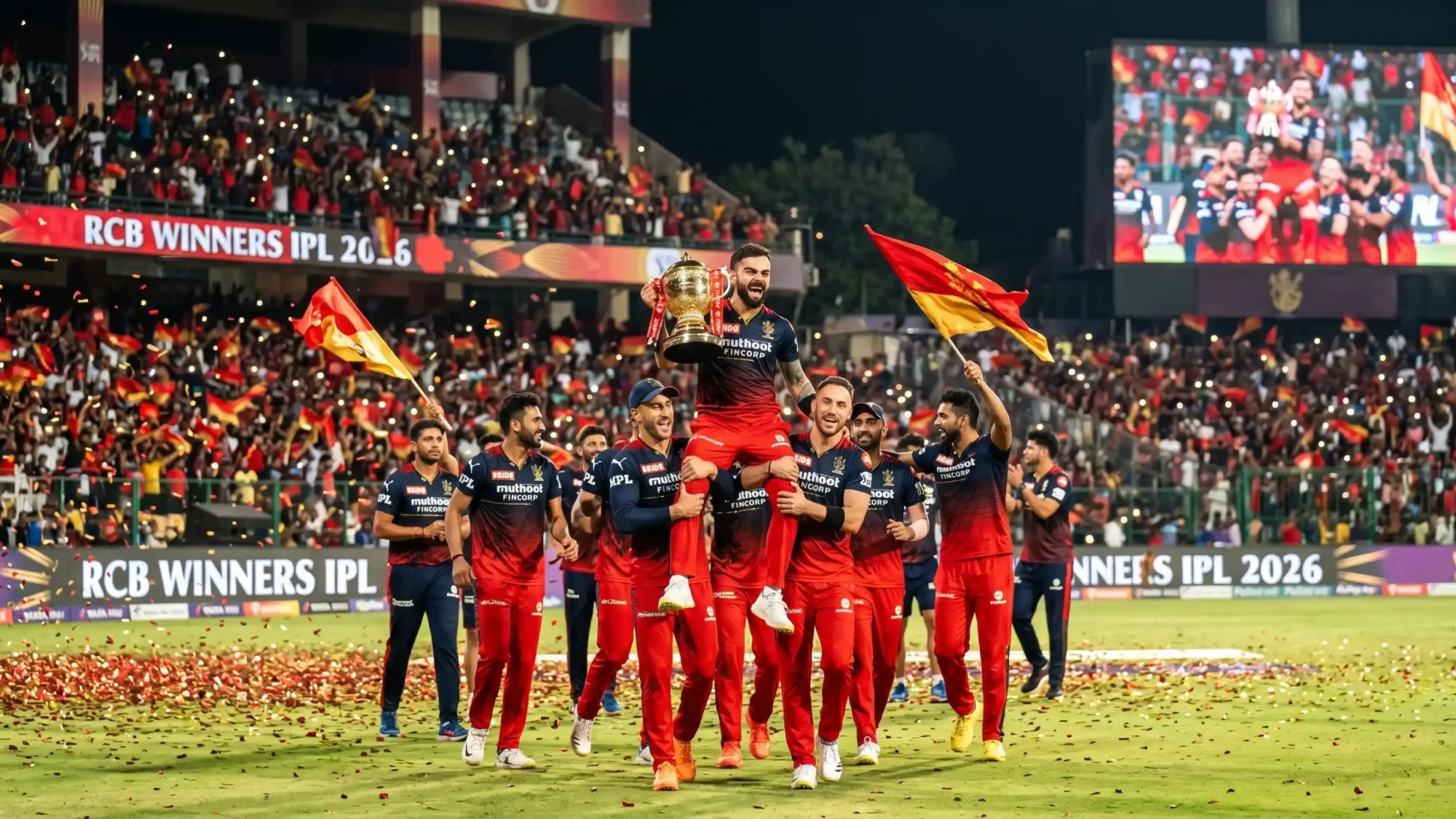
On May 31, 2026, Virat Kohli scored an unbeaten 75 from 42 deliveries – the quickest fifty in the history of the IPL for Kohli – that steered Royal Challengers Bengaluru to victory over Gujarat Titans in the final of the IPL 2026 in Ahmedabad’s Narendra Modi Stadium by five wickets. Royal Challengers Bengaluru became the third side to have successfully defended their IPL crown, after Chennai Super Kings and Mumbai Indians. It was truly a spectacular day of T20 cricket. And yet, before long, the far more critical question arose: what exactly was this doing to the game of cricket?
IPL 2026 – And The Numbers Behind Its Massive Size
Let’s begin with numbers because they speak volumes about the nature of the tournament. In total, 74 matches were played in IPL 2026, from March 28 to May 31, thus making IPL 2026 a 65-day event for 10 franchises on 13 grounds. For comparison, the ICC’s premier T20 event of its kind was held only in February and March of this year. Specifically, ICC Men’s T20 World Cup 2026 held from February 7 to March 8 in India and Sri Lanka (20 nations took part in it) included a mere 55 matches.
This means that the tournament involving just 10 privately-owned franchises of one country included 35% more games than ICC’s premier event which featured teams of the whole cricketing world. IPL took more than two times longer than the above-named event. Originally, the plans were even more ambitious. For example, according to the announcement made by IPL Governing Council, the number of games would increase to 84 in 2026, while 94 matches were supposed to be played since 2028.
| Tournament | Matches | Duration | Teams | Format |
| IPL 2026 | 74 | 65 days | 10 franchises (1 country) | Private franchise |
| ICC T20 World Cup 2026 | 55 | 30 days | 20 nations (worldwide) | International |
| PSL 2026 | ~34 | ~30 days | 8 franchises | Private franchise |
| BBL (Australia) | ~56 | ~50 days | 8 franchises | Private franchise |
| CPL (Caribbean) | ~34 | ~25 days | 6 franchises | Private franchise |
| ICC WTC Final (2025) | 1 Test | 5 days | 2 nations | International Test |
Hidden Cost: Players Suffer with Their Bodies
One of the most telling narratives regarding IPL 2026 was off the ground. That is, what was being kept hidden about what was being done inside it?
For India’s contingent in the T20 World Cup, there was barely any rest period until IPL 2026 took place. Within 18 days after the end of the T20 World Cup, the IPL started – hence the players had no time to recover from one tournament to another. The result was clear for all who were watching the IPL.
It came to light that some of India’s biggest stars in the IPL 2026 included Jasprit Bumrah, who suffered from a minor injury in his knees. Players like Varun Chakravarthy, who had sustained a hairline fracture, still played in the matches despite the injury. The latter’s team physios opted to keep their mouths shut regarding the matter.
“IPL TV ratings fall by 26%. The BCCI needs to be worried — IPL has turned into a batting show rather than a game of cricket.”
–Harsh Goenka, businessman, via social media, May 9, 2026
Other players who were most affected by visible fatigue and performance dip include Jasprit Bumrah (3 wickets in 10 matches) and Hardik Pandya (146 runs and 4 wickets in 8 matches). They are some of the most match-winning cricketers India has, yet they arrived at the IPL fatigued having been part of an international cricket event that concluded just a few weeks ago.
| Alerting on Burnout In IPL 2026, several players representing the India team competed despite still recovering from injuries sustained during the T20 World Cup. This is evidenced by the participation of Jasprit Bumrah in 13 matches when he was suffering from a knee injury. Varun Chakravarthy played while suffering a hairline fracture. |
Even the Audience Is Getting Fatigued
The most significant sign of all came from the viewers’ side itself. With an exceptional level of quality, with scores of over 200, great teams and individuals, Kohli at his best, IPL 2026 saw a drop in its television viewership that greatly worried the BCCI.
In the first half of IPL 2026, BARC India and TAM Sports report a reduction in viewership numbers by 18.8% and an average of 26%, respectively. This is not just a minor difference but a structural problem showing us that viewers who have witnessed nearly two decades of IPL have reached their “viewer saturation” level.
There are several reasons behind that. The main one is the prohibition of all online gaming sites based on real money, enacted according to the Promotion and Regulation of Online Gaming Act of 2025. What is more, too much T20 cricket during the year has also made people tired of this format.
“IPL has 74 games. T20 World Cup has 55 games. ICC oversees world cricket, but an individual franchise league in India continues to last longer than its own premiere international competition.”
— DeeplyExpress Analysis
The situation is further ironic. The very success of the IPL has set the stage for its failure. One sports analyst remarked, with so much cricket being played all year long in IPL, BBL, PSL, SA20, ILT20, The Hundred, MLC, and many others, it is impossible not to develop immunity from their impact. Cricket becomes something that you can simply switch off in the background.
The Franchise Boom: Each Country Now Has Its Own League
The financial success of the IPL has made other countries follow its footsteps, and today there exist more private T20 franchise leagues than ever before.
IPL 74 matches, 65 days, $6.2B media rights. The original and still by far the largest. | PSL Expanded to 8 teams in 2026. PSL 11 was played behind closed doors initially due to Iran war impact on economy. |
BBL One of the oldest, running since 2011. ~$1.13B broadcasting deal with Foxtel/Channel 7. | CPL Increasingly dominated by IPL franchise cross-ownership. Talent pipeline for bigger leagues. |
SA20 Directly linked to IPL franchise owners. Critical development platform for young SA talent. | The Hundred ECB sold equity stakes in all 8 franchises. August window. |
ILT20 / MLC  Newer leagues expanding cricket’s footprint into non-traditional markets. | BPL / LPL  Smaller leagues with governance challenges. LPL’s 2025 edition was postponed multiple times. |
The number of leagues is so much throughout the season that cricketers have to constantly travel and get exhausted, which results in mental stress, burnout, and a high chance of getting injured. Many big players such as Ben Stokes and Trent Boult have even stopped playing in specific formats for some time to reduce their workload. Many players from West Indies like Andre Russell and Sunil Narine have turned out to be more franchise cricketers than international ones.
“The Soul Is Fading”: How T20 Leagues Are Killing the Test of Cricket
It is the one issue that is at the heart of everything for those who regard cricket as more than just an entertainment product. Test cricket – five days, two innings, the total testing of ability, attitude, and character – was not just the older form of the game. It was the form which distinguished the truly great players from those who were good but nothing more.
With the emergence of the IPL since 2008, there has only been one clear trend in Test cricket over time – that it has become less culturally significant. The ICC launched the World Test Championship expressly to provide some kind of competitive edge to this format of the game and to keep interest alive. But even now, the WTC cannot draw the crowds that the T20 leagues do.
The economics are unyieldingly straightforward. The best players receive $2 million to $15 million per year through their T20 franchise agreements alone. It may take an entire Test series to earn a tenth of this amount through national agreements for the same player. Neither the ICC nor any of its national boards will ever be able to offer anything even remotely close to the kind of money being offered by franchise cricket. This results in Test matches becoming purely a matter of schedule convenience.
“Over the last five years, there has been a marked rise in the percentage of people that view the T20 World Cup as the most prestigious competition organized by the ICC – while Test cricket has become less relevant than before.”
– ESPNcricinfo analysis, 2025
What does this mean for the upcoming generations of cricketers? What would a young cricketer growing up anywhere in the world today see? IPL Auctions – with the money of their future riding on it. The economic success or failure of a career in cricket today depends upon T20 bids rather than Tests. And nobody in power has tried to change this equation yet.
The Corruption Problem: CSK, Canada, and the Pattern Nobody Wishes to Mention
No honest assessment of franchise cricket can evade the issue. Wherever there has been a growth in the number of T20 leagues, there has also been a growth in the amount of gambling going on – whether legal, semi-legal, or indeed completely illegal. More matches mean more betting markets. More betting markets mean more opportunities for players and corruptors to come into contact with each other.
The CSK example
Cricket’s biggest ever domestic tournament has seen its share of corruption scandal in the past. The 2013 Indian Premier League was rocked by a serious scandal involving spot-fixing and gambling. Following this, the RM Lodha Committee investigation set up by the Supreme Court found that CSK and RR be suspended from participating in the tournament for two seasons – 2016 and 2017. Several individuals linked to the team were found to have placed bets on matches. It was a serious structural problem, not just a mistake made by an individual – and it all happened in the most professional of leagues.
The T20 World Cup 2026 corruption
The corruption case has not been a thing of the past. In April 2026, the ICC’s Anti-Corruption Unit opened an official investigation into one of the matches played in its own T20 World Cup, which happened mere weeks before the IPL 2026 kicked off. The investigation revolves around Canada’s match against New Zealand in the group stage of the tournament played in Chennai based on allegations made in a 43-minute-long documentary called “Corruption, Crime and Cricket”, aired on Canadian broadcaster CBC on April 10.
It has been confirmed by ICC ACU that the investigation also includes an investigation of the recorded telephone conversation of the former coach of Canadian team Khurram Chohan and another former coach who had been threatened to lose his job if selected particular players.
| Investigations under way The International Cricket Council’s Anti-Corruption Unit is currently investigating match fixing allegations connected to the 2026 T20 World Cup, which is organized by the ICC itself. The issue of corruption isn’t solely an issue for franchise leagues. With money, poor governance, and high betting involved, integrity will be undermined wherever there is T20 cricket. |
Eight people have been charged with corruption in the T10 UAE league as well. Spot-fixing scandals have affected PSL, CPL, and BPL at different times. The recurring trend is that wherever there is a T20 league with significant betting and lower player remuneration compared to IPL, the chances of corruption increase. Even in IPL 2026, the BCCI had strengthened its Anti-Corruption Unit following accusations that owners of the franchises were consistently breaching protocols and accessing restricted areas, which also included contacting the players during the match in progress.
So Is the IPL Good or Bad for Cricket? The Honest Truth
The honest truth is that there is validity to each side, but more so from one side than the other — and the trend has been moving towards the latter.
The argument for the franchise approach holds some weight. There has been enough money created through the IPL to fund cricket academies, secure broadcasting contracts on an international level, and provide financial stability to players who were underpaid before. It has put elite cricket on the map of international viewership and created star players. For example, the first Women’s Premier League, modeled after the IPL, had 45 million viewers in its first year compared to 400% fewer viewers in past women’s cricket tournaments.
However, it becomes increasingly difficult to ignore the arguments against. If 74 games are played in a single 65-day tournament, the IPL is about much more than playing cricket. When a private league takes precedence over the global competition arranged by the ICC and even beats them in revenue, the ICC loses its ability to govern the sport.
| The Real Problem The issue is not about the existence of the IPL. It is about how there any isn’t governing body that can ensure the balance between the IPL and the well-being of the entire game. Since the BCCI is the governing organization that controls the IPL, it happens to be the most powerful group in the ICC. The BCCI generates an unreasonable amount of money for cricket in the world. |
What kind of reforms could be considered in a serious manner? They could include a capped number of franchise league games per season; an international calendar that guarantees player availability for international tournaments; a share of the IPL revenue dedicated exclusively to financing test matches in small countries; and an independent body for investigation of corruption allegations in all leagues, including those in non-full ICC member’s countries.
At the ICC, no one even wants to think about them seriously because there is too much money involved. There isn’t enough political will either. And the vicious circle continues with even more games, leagues, money, less test cricket, fatigue, opportunities for match-fixing… and fewer spectators.
Final Analysis
The back-to-back triumph for RCB is a wonderful tale. Kohli was a magnificent batsman in this tournament – possibly one of the best ever. The IPL, for all its faults, is still the premier league for franchise cricket in the world. This is absolutely true.
But this alone will not suffice. The sport that cannot safeguard its most arduous format, cannot regulate fairness in its quickest game, and cannot look after the well-being of its own players irrespective of its financial success is doomed to fail. IPL may not be the root cause of cricket’s misfortunes. However, it is undoubtedly the stage on which all its failures have been playing out.
If the ICC and BCCI want to take this game seriously, if they value it as a sport above everything else, they will come forward. Otherwise, they will only count their earnings. The events of 2026 make it clear which course they have taken.
All the information used for this investigation has been taken from verified sources that include ESPN Cricinfo, Gulf News, Inside Sport India, and many ICC official sources. All the information regarding any case under investigation shall be regarded as an allegation under investigation and shall not imply guilt at all.
Sources & References
- ESPN Cricinfo — IPL 2026 Final Scorecard & Report
- Gulf News — IPL 2026 TV viewership down 26% (May 2026)
- Inside Sport India — Fatigue or failure? India’s T20 WC squad in IPL 2026 (May 2026)
- DailyHunt / Cricket Gully — Too Much Cricket? India’s T20 WC players showing signs of burnout (May 2026)
- DNA India — Match fixing in T20 WC 2026? ICC launches investigation (April 2026)
- CricJudge — Match Fixing & Misconduct database (updated April 2026)
- India.com — BCCI tightens IPL Anti-Corruption Unit, franchise owners violating protocols (2026)
- Wikipedia — 2026 ICC Men’s T20 World Cup
- Arab News — Enduring cricket aspects that may carry over into 2026
Leave A Comment