

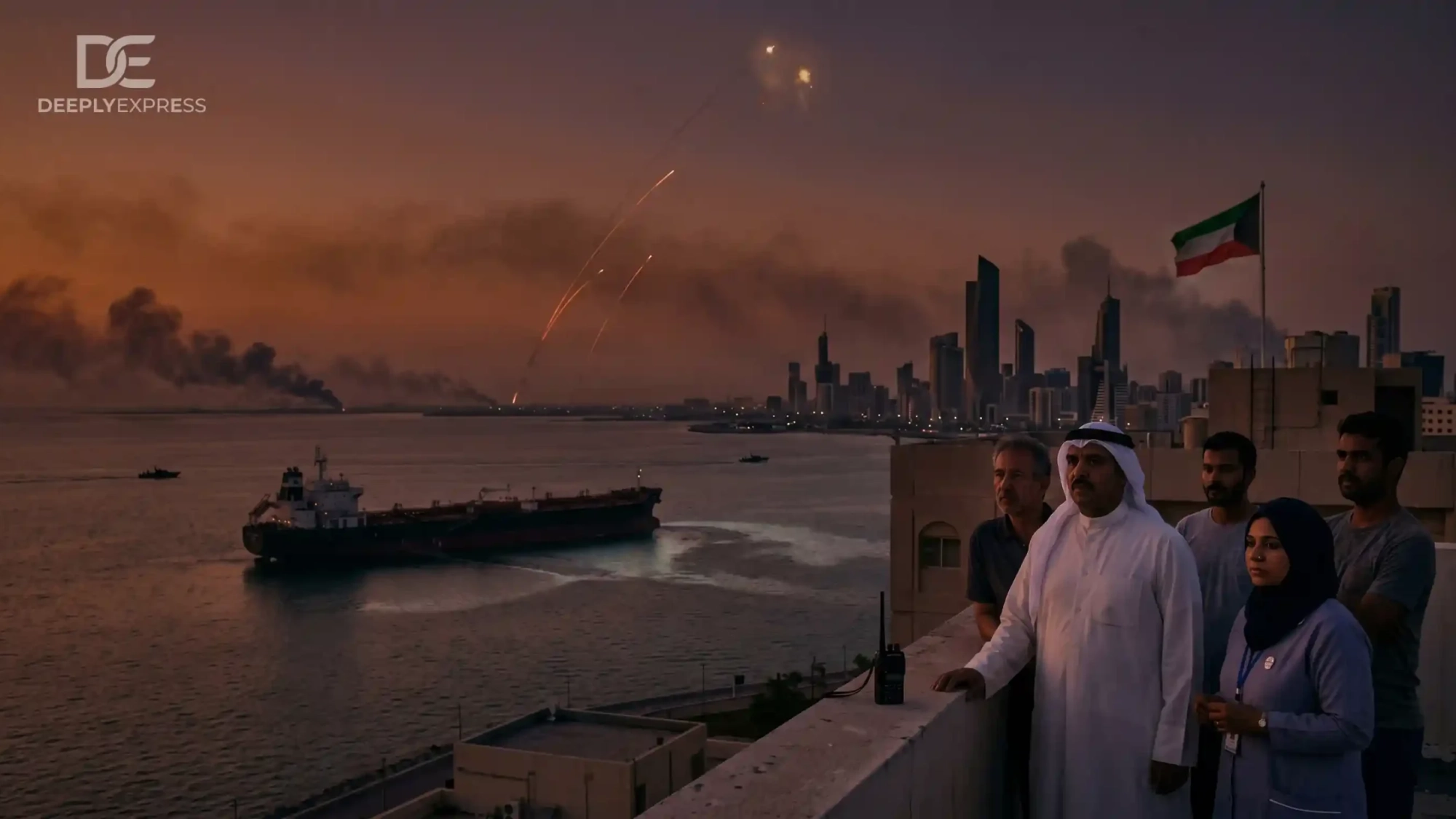
More than 100 days into this conflict, and the ceasefire agreement is crumbling before our very eyes. Iran has announced the Strait of Hormuz to be closed. Every flight was grounded in Kuwait. Missiles hit Jordan, Bahrain, and Kuwait for the second night in a row. But buried somewhere beneath all that – the fact that there are actual people involved – millions of them.
By DeeplyExpress News Desk
Think about waking up to sounds of sirens – no, not for a practice run, not for a training, but because at that moment there is a missile travelling through your city’s sky towards a military base three kilometers away from where you live. That is how people in Kuwait City have been living for the last 48 hours. On the night of June 10, families in Amman, Jordan went to sleep to the sound of sirens. The dawn of June 11 came over the Persian Gulf accompanied by news announced by Iran’s military that will affect the following weeks of this war: the 33-kilometer wide Strait of Hormuz – the passage that 20 percent of the world’s traded oil passes through – will not be open to any kind of ship traffic anymore.
1. IRAN BLOCKS STRAIT OF HORMUZ, ONCE MORE
The Strait of Hormuz has been blocked to ship navigation at 4:50 AM Tehran time on June 11. This move by Iran’s military force was not surprising for energy market players, who have been expecting this news ever since the onset of hostilities in Iran. However, it is the strictest move Iran has made to this point; previous moves were more like threats. Iran attributes the blockade to the second consecutive day of US airstrikes in its territory on June 10, which it sees as a violation of its “initial truce agreement.”
Gunboat patrols from Iran’s Revolutionary Guards Corps already opened fire against tankers trying to navigate through the strait. India summoned its ambassador to Iran following reports about clashes in the Strait involving some of its flagged tankers, while India’s Minister of Ports has revealed the death of three Indians when the US military forces engaged in combat with a Palau-flagged tanker in the Omani waters of the strait.
WHAT “CLOSED” REALLY MEANS FOR THE REST OF THE PLANET
- One-fifth of global oil transport and one-fifth of worldwide LNG flow through the strait every day
- Saudi Arabia, UAE, Kuwait, Qatar, and Bahrain have no other marine channel for exports
- Pakistan receives 99 percent of its LNG from Qatar and the UAE, almost exclusively through Hormuz
- South Korea, Japan, and Taiwan get 80-90 percent of their oil imports via the strait
- Oil prices, which are already at $111 per barrel since March, are set to increase further due to this statement
- US CENTCOM disagrees with the Iranian claim, stating that the water passage is still open, which puts shippers in a tough spot
2. KUWAIT CLOSES ITS SKIES – THEN OPENS THEM AGAIN
Kuwait’s Directorate General of Civil Aviation made the following announcement via Twitter at 4:50 AM, local time on June 11: “Kuwaiti airspace is temporarily closed, a precautionary measure aimed at preserving the safety and security of air navigation and passengers.”
Several dozen aircraft found themselves redirected. Travelers from Kuwait International Airport, which had already been damaged by Iran’s drones during attacks on June 3, found themselves stuck at this point or were forced to change their routes. “Hostile aerial targets” continued to be intercepted by the Kuwait Army. As it turned out, the IRGC’s drones attacked again – this time, Ali Al-Salem Air Base, the same one they had targeted the day before.
By midmorning of June 11, Kuwait’s civil aviation authority reported the airspace had reopened and all traffic “had returned to normal.” Normalcy in Kuwait in June of 2026 implies normal flights between missile interceptions.
There have been reports that either missiles, drones, or rockets are flying through Jordanian airspace. Get cover and take shelter immediately. Stay indoors and be aware of any local warnings and advisories.
— US EMBASSY JORDAN, SECURITY WARNING FOR AMERICAN CITIZENS, JUNE 11, 2026
3. JORDAN STRUCK FOR A SECOND STRAIGHT NIGHT – THE F-35 PROBLEM
The Iranian Revolutionary Guard Corps stated on June 11 at dawn that they have launched 12 missiles at the U.S. Air Base of Al-Azraq in Jordan, for a second night running. According to Iranian claims, the attack “destroyed facilities and a great many fighter jets” in the air base. However, the IRGC statement said that the attack destroyed F-35 jet hangars.
What can be verified and what cannot? According to Jordan’s military, on the first night of the attack, five missiles targeting Al-Azraq were shot down and the debris falling from the missiles caused no casualties or damage. The United States’ military official said that the first attack on Al-Azraq on June 9 carried out by Iran was not serious enough to have done considerable harm. Nearly all of the Iranian missiles or drones were either intercepted before or never reached their targets. The Iranian second assault on June 11 consisted of 12 missiles. Verification of aircraft losses independent of Western sources was not found.
The question of whether the F-35s were destroyed or damaged is of great importance. It is because the destruction of these planes will mean not only the loss of valuable assets but the loss of crucial technology for the United States and Israel as a guarantor of air superiority in the area.
4. A US STRKES IRAN AGAIN; THE CEASEFIRE BREAKS DOWN
On June 10, the US launched another series of strikes against “multiple targets” in Iran. This follows a similar strike two days earlier, which followed an attack on the Apache helicopter over Iran’s eastern border with Pakistan, and which Trump and Pentagon chief Pete Hegseth had announced in advance to Iran: you will be hit hard. This development could not come at a worse time for diplomacy. On the very previous day – on June 8 – Trump had achieved what was claimed to be a ceasefire between Iran and Israel. That ceasefire lasted a mere 24 hours before the Apache incident and the resultant retaliation made a mockery of it. As the UK House of Commons Library explains in the latest briefing: although there is supposedly still some kind of ceasefire in effect, shipping levels across the strait have sunk very low
REASONS BEHIND THE COLLAPSE OF THE CEASEFIRE
There have been other instances where ceases-fire has failed in this war before. The United States of America and Iran had a cease-fire back in June 2025 following the “Twelve-Day War”; the agreement lasted till February 28, 2026. Another cease-fire in April 2026 suffered constant tests through various acts of provocation. Every time that cease-fire gives respite, nothing has happened concerning the fundamental issues being demanded by either side – US exit from the area (Iran) or denuclearization of Iran (United States of America).
5. WHO PAYS THE PRICE—AND WHO CHOOSES A DIFFERENT ROUTE
The worst reality about this struggle belongs to those individuals who had not even played any part in initiating it. The residents of the Al-Salmiya district of Kuwait city who took refuge in shelters at 3 in the morning. The expatriates living in Bahrain who could hear the sirens go off near the U.S. Fifth Fleet naval base three kilometers away from their housing apartments. The stranded passengers in the airports that keep opening and shutting down with every wave of missiles.
KUWAIT CITY RESIDENT – JUNE 11, 2026 (VIA SOCIAL MEDIA)
“We are tired. The sirens scare the children. There are no flights anymore. We have never asked for anything like this. We are not soldiers. We are just civilians who wish to go to work and return back home.”
PAKISTANI NURSE WORKING IN BAHRAIN – JUNE 10, 2026 (VIA WHATSAPP, SHARED WITH DEEPLYEXPRESS)
“My hospital is packed with patients. Very few are here because of the attacks; most are suffering from sheer fear and shock. The elderly, the pregnant ladies. Should I tell them that the great powers are negotiating and that they have to wait?”
It is the states from the Persian Gulf that decided to provide shelter to America’s military forces that are now under the wrath of Iran. Bahrain with the presence of US Navy’s Fifth Fleet. Kuwait with its Ali Al-Salem air base. And Jordan with its Al Azraq military airport. These are not the countries that started this war. But rather, they are providing shelter to military bases of a country that is responsible for this war. This entire time, Iran has maintained its position during this war; stop America and Israel’s intervention in the Middle East region.
- Bahrain
UNDER FIRE
Headquarters of US Fifth Fleet. Iranian drones attacked this base again on June 10-11. The sirens were ringing all over Manama. The adviser of Bahrain’s king said that air defenses successfully thwarted attacks. Bahrain said Iranian attacks were “acts of terrorism.” - Kuwait
CLOSED/OPENED AIRSPACE
Ali Al-Salem AB was attacked for two consecutive days. The airport was closed at 4:50 AM on June 11; then it was opened. The terminal 1 was already damaged on June 3. Kuwait is trying to fend off Iranian aerial attacks and still manage to survive as civilians. - Jordan
BALLISTIC MISSILE STRIKES
Al-Azraq base was targeted by Iranian missiles for two nights in a row. IRGC said they managed to destroy the hangars for F-35s. Americans were advised to find shelters immediately. Jordan isn’t involved in the conflict, it only accommodates US facilities. - UAE
ON ALERT
The UAE denounced the Iranian attacks in the region as “terrorist attacks.” Al-Dhafra airbase still acts as an American base located in the UAE territory, thus placing Abu Dhabi inside the range of attack by Iran. The loss of the UAE economy due to the closing of the Hormuz is rising quickly. - Qatar
MEDIATION OPTION
Qatar has subtly but clearly shifted its stance. Qatar told Washington that it would not permit any strikes from Al-Udeid base. Qatar became the only GCC state that sent its foreign minister to Tehran. According to experts, Doha’s approach is driven by survival and negotiation rather than alliance obligations. - Saudi Arabia
OBSERVING
Unharmed by the direct strikes from Iran. “It has less to gain from retaliating against such attacks,” according to the IISS. Riyadh has massive leverage but has not wielded it.
6. THE QUIET PIVOT OF QATAR – AND ITS IMPLICATIONS
One of the actors to observe in relation to the current conflict is the state of Qatar. This country has hosted the US Al-Udeid Air Base since 2003; this base happens to be one of the biggest US facilities in the region, and the forward command post for CENTCOM. The US and Qatar enjoy an unusual status of a Major Non-NATO Ally between them. However, in the last three months, Qatar has continuously sent messages suggesting that it was not going to be a loyal ally of the USA until this conflict ended.
First of all, Qatar informed the USA that it would not permit the latter to conduct any kind of offensive operations against Iran from Al-Udeid Air Base. Then, it sent its Minister of Foreign Affairs to Tehran, becoming the only Gulf Cooperation Council member who continued to engage in diplomatic relations with the country whose missiles kept hitting Qatar. Finally, after Trump ordered the strike on Iran’s nuclear facilities in June 2025, Qatar criticized it and said that the attacks had been conducted on “the sisterly Islamic Republic of Iran.”
“Only Qatar among the GCC members has sent its foreign minister for talks in Tehran, yet again putting emphasis on security within the region.”
— MIDDLE EAST COUNCIL ON GLOBAL AFFAIRS, FEBRUARY 2026
Qatar’s “quiet pivot” is not betrayal nor weakness; it is the rational survival tactic of a small state that can ill-afford to find itself perpetually at odds with its immediate neighbors. In fact, Qatar’s quiet pivot is one of the most sensible foreign policies currently being formulated in the Middle East region.
“The state of Iran has not changed; it still wants an end to American and Israeli involvement in this region. The Gulf countries that are suffering as a result did not choose this fight. They are just too close to feel its impact.”
— DEEPLYEXPRESS ANALYSIS
7. COSTS HUMANS CANNOT QUANTIFY THROUGH STATISTICS
In Lebanon, attacks by Israel on Hezbollah — the Iran-backed militia operating within this war — have resulted in more than 3,600 deaths so far. In Iran, after a period of 100 days of airstrikes and bombardment, the loss suffered by infrastructure and consequently civilians is yet to be quantified. In Kuwait, in Bahrain, in Jordan, the residents who migrated for employment purposes and other similar reasons mainly from South Asia, Southeast Asia, and Arab countries are caught in a crossfire of military powers they cannot control.
As per reports from the World Food Programme, the shutdown of the Hormuz Straits has caused an increase in global food prices; and according to them, if the food price goes up 20-30% in the poor countries around the globe, then 20-30% consumption would go down. The budget of the World Food Programme in the US had gone down from $4 billion in 2024 to $731 million in 2026.
Whose interest does this serve? Well, the truth is, the interests of arms companies, energy dealers, and politicians who need a foreign enemy to maintain power domestically. Whom does it hurt? People in the Middle East; people who earn money due to the plane that has been constantly canceled; people who pay triple the price for their cooking gas; people who rush to shelters at three in the morning and have to explain to children what sirens mean.
WHAT COULD ACTUALLY RESOLVE THIS CRISIS
From left-wing to right-wing analysts, including the Institute for International Strategic Studies in London and the Middle East Council on Global Affairs, all share a common opinion: This conflict does not have a military resolution. Iran will not be bombed into submission by America. America will not be bombed out of this region. The only realistic route is the same as it has been since February 27, the day before all of this started: It involves a diplomatic process in which both sides receive enough of their demands to pull back from this brink. Pakistan remains the key intermediary in this scenario. Qatar has positioned itself as the country that will broker this deal if nothing else succeeds. Can either of those scenarios withstand another week of escalation?
DEEPLYEXPRESS: THE FINAL VIEWIran announced closure of the Strait of Hormuz. The airspace of Kuwait had been closed for a second time during a week, and then opened again instantly, as if nothing out of the ordinary happened. Jordan continued absorbing ballistic missiles for the second successive night. Three Indian seamen have lost their lives due to US shelling near Oman. And the ceasefire that was in place just four days ago ceased to be effective.
It should not be assumed that what is going on in the region is a manageable escalation process. On the contrary, each new step taken by either party creates new realities, new sources of tension, new political considerations, new military leaders with new instructions.
To the citizens of Kuwait, Bahrain, Qatar, Jordan, and the UAE, most of whom are simply workers and families that have migrated to the Gulf looking for security, the lesson of the past two days is among the most cruel: the security that you have purchased is actually conditional, depending upon the decisions of someone else, far away, and someone who will not be the one rushing to the safe spots when the warning sounds.
The world is not on its way to destruction. The world has been living in it for 103 days now, and another nightfall, with yet another series of sirens.
____________________________________________________________________________________________________________________________________________
The following article is based on reliable reporting carried out between June 10 and June 11, 2026. All IRGC claims of aircrafts and infrastructures being destroyed are relayed from Iranian state sources that have not been confirmed yet by the West. This report provides an objective and analytical report without any bias; no political stance is taken here.
Sources & References
- NBC News Live Blog — U.S. launches 2nd day of strikes; Iran fires back and says Strait of Hormuz closed (June 11, 2026)
- CNN Live Blog — Iran launches retaliatory strikes on US bases in Bahrain, Jordan, Kuwait (June 10–11, 2026)
- RFERL — US And Iran Exchange Strikes For Second Day — Kuwait airspace reopens (June 11, 2026)
- Gulf Business — Kuwait temporarily closes airspace, flights diverted amid Iran attacks (June 10, 2026)
- Al Jazeera — Iran attacks Bahrain, Kuwait and Jordan in retaliation for US strikes (June 10, 2026)
- Al Jazeera Live Blog — Iran war live: Tehran targets US forces in Bahrain, Jordan, Kuwait
- NBC News — Iran strikes American bases after U.S. attacks over helicopter crash (June 9–10, 2026)
- MS.Now / MSNBC — U.S. concludes latest Iran strikes, denies Strait of Hormuz closure (June 10, 2026)
- House of Commons Library — Israel/US-Iran conflict 2026: Reopening the Strait of Hormuz (June 2026)
- FDD Analysis — Don’t Bet on Qatar Standing by America in the Middle East (April 29, 2026)
- Amwaj Media — Qatar probes options as regional war returns to its soil (March 27, 2026)
- Middle East Council on Global Affairs — Between War and Dialogue: Can a US-Iran Confrontation Be Prevented?
- IISS — The Gulf States’ Offensive Options Against Iran (June 4, 2026)
- Safe Airspace — Kuwait Airspace Status — June 2026
- Wikipedia — 2026 Iranian Strikes on Kuwait
- Wikipedia — 2026 Iran War
Leave A Comment