
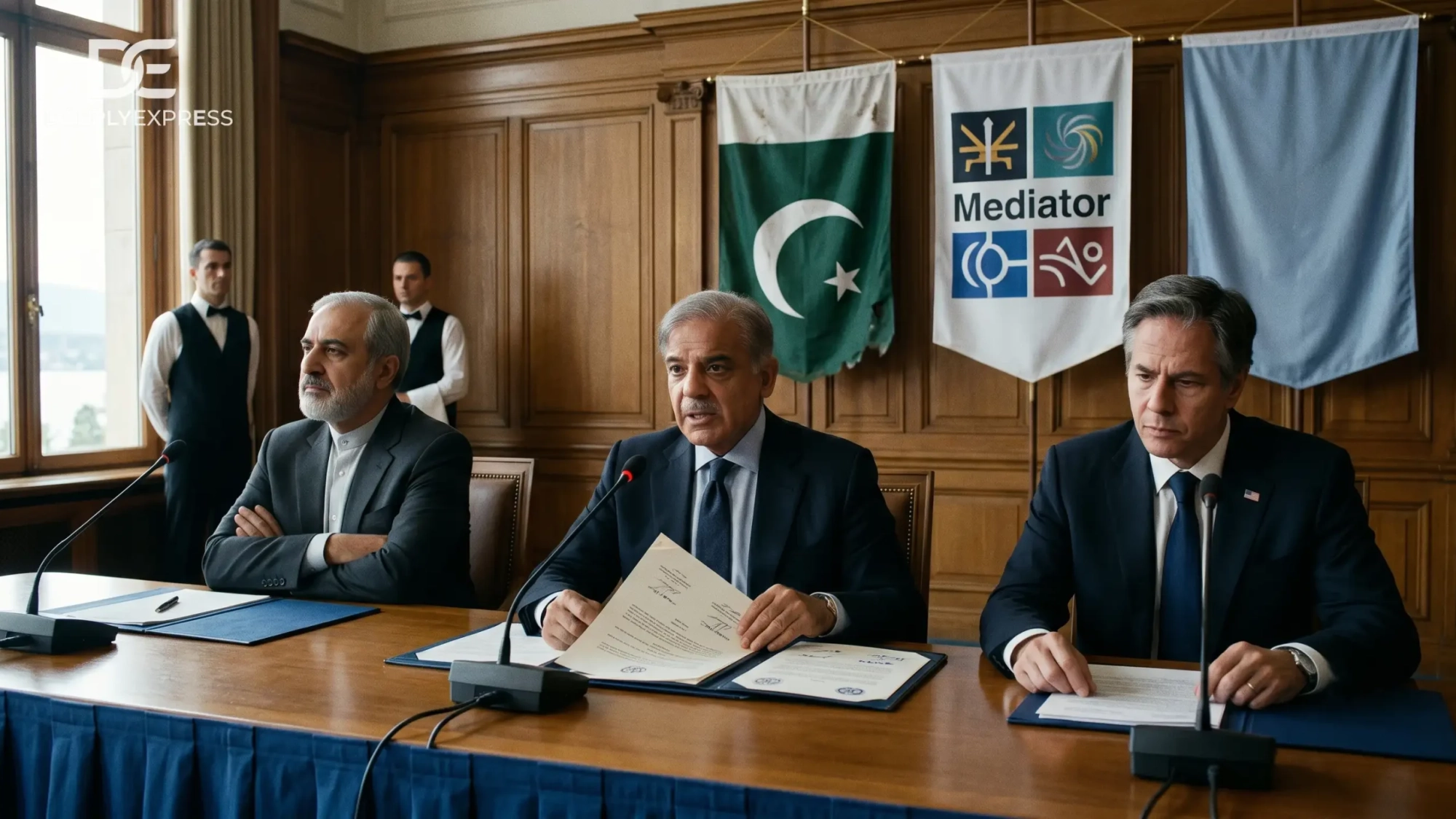
Pakistani Prime Minister Shehbaz Sharif declared to the whole world on June 14 that Iran and USA have signed a peace agreement. This agreement will be signed on June 19 in Switzerland. However, after 107 days of the war in which billions were wasted, people died, cities faced destruction, and all the world was at stake because of a blockage of water, the main question arises who really won?
By DeeplyExpress News Desk
It was Sunday morning on the 14th of June, 2026, and Pakistan’s Prime Minister, Shehbaz Sharif, had just turned his phone on. He had posted an X status that was seen within minutes by governments, markets, and individuals all around the globe. “After thorough negotiations, we can proudly inform that the Peace Deal between the United States of America and the Islamic Republic of Iran has finally been reached,” Sharif wrote. “Both parties have announced their complete withdrawal of military forces from all fronts, including from Lebanon. The final signing of the deal will take place on Friday, June 19 in Switzerland.” Minutes after this announcement, Donald Trump posted on Truth Social confirming that the deal had been made. Iran’s Deputy Foreign Minister also stated that the text of the deal had been completed. It had been almost four months since the start of the war, closure of the waterway, countless airstrikes, and a country torn apart by conflict. But now the real question remains – who emerged victorious?
WHAT THE DEAL ACTUALLY SAYS
The agreement signed on June 14 is officially referred to as a memorandum of understanding. It proclaims the immediate and indefinite halt of all military activities on all fronts, including Lebanon. Trump stated that the United States would lift its naval embargo of the Strait of Hormuz and that the maritime passage would open up for commercial navigation on June 19 following the official signing.
According to Iran’s Deputy Foreign Minister Kazem Gharibabadi, the entire document will be published following the signing process and added that the agreement “is not a sign of trust in the enemy and is written under conditions of mutual distrust.” And there you have the whole deal summed up in one sentence. This is no peace brought by friendship. It is a weary peace born of mutual calculation. After that, the negotiations go on for 60 days in regards to three crucial issues; ending of sanctions imposed by the United States on Iran, Iran’s nuclear program in the future, and establishing the mechanism that monitors compliance. This is when the tough talks start. They start in Doha this week, followed by Switzerland on June 19.
“We are glad to announce that after intense discussions, the Peace Pact between the USA and Iran has been reached. Both the parties have made the announcement for an immediate and permanent stoppage of all military activities on all fronts including in Lebanon.”
PRIME MINISTER OF PAKISTAN, MR. SHEHBAZ SHARIF, X POST, JUNE 14, 2026
When wars are resolved via negotiation and not defeat, the issue of victory becomes a bit complex. However, there are some facts that can be learned about this war in its 107-day course. We should take an honest look at them.
|
WHAT IRAN ACHIEVED
✅ Survived 107 days of attacks by USA and Israel without giving up
✅ Change of regime was NOT accomplished; supreme leadership system remained intact
✅ Reza Pahlavi could not reclaim power even after many attempts
✅ Succeeded in keeping Strait of Hormuz closed throughout the war
✅ Successfully showed Iranian rocket technology to the whole world through actual experience
✅ Succeeded in attacking Jordan, Bahrain, Kuwait all in one night
✅ Came out of the war without compromising on its nuclear project
✅ Was appreciated by its own people for defying a superpower
|
WHAT IRAN LOST
❌ Killing of Iran’s Supreme Leader Khamenei during the initial attacks by the USA and Israel
❌ Killing of several high-ranking military officers and IRGC commanders
❌ Deterioration in the country’s infrastructure as a result of the attacks
❌ Further damage to the economy because of the US Navy Blockade and ongoing war
❌ Destruction of various nuclear and military facilities in the country
❌ Iranian civilian casualties suffered the most from the whole war
|
|
WHAT THE UNITED STATES LOST
❌ Main declared objective of regime change failed to materialize
❌ Several aircrafts downed, among which were an Apache helicopter and an F-15E
❌ US bases in Bahrain, Kuwait and Jordan were attacked repeatedly
❌ Death of three Indian citizens following US troops firing at a civilian oil tanker
❌ Failure to open up the Strait of Hormuz despite being the biggest military superpower in the world
❌ US superpower reputation took a severe beating in both the Islamic world and the rest of the international community
❌ Erratic Trump statements compromised US negotiating position
|
WHAT PAKISTAN GAINED
✅ It made its peace deal announcement from its Prime Minister’s personal social media page
✅ Successfully achieved what no diplomat could achieve in 50 years: US-Iran talks
✅ According to CFR, Pakistan is “an unlikely but indispensable mediator”
✅ The UK’s Foreign Secretary made his first visit to Pakistan in four years due to that
✅ Pakistan’s PM was featured alongside Trump and Iranian President in deal communication
✅ Pakistan’s Field Marshal Asim Munir gained worldwide acknowledgment as one of the diplomats
✅ Pakistan established itself as a peace-loving country in a highly destabilized area
✅ It earned worldwide respect despite the economic problems it faced due to Hormuz’s closure
|
“Pakistan succeeded where other diplomats representing affluent democratic nations and international institutions have failed for nearly half a century – securing direct negotiations between Washington and Tehran.”
Council on Foreign Relations, April 2026
PAKISTAN’S REMARKABLE POSITION: MEDIATOR TO INTERNATIONAL POWERHOUSE
In order to know how much Pakistan accomplished during this war, one must consider its initial position before all else. Pakistan is a developing nation suffering from political divisions as well as economic woes and has previously been seen as the victim of international pressures instead of a player shaping international politics. In 107 days, everything changed.
Within the very first day of the war on February 28, Field Marshal of the Pakistan army Asim Munir took flights to Tehran and Washington bearing messages between capitals who would not dare speak directly to each other. The Council on Foreign Relations released an extensive report by the title “How Pakistan Became the Iran War’s Unlikely Peace Negotiator” that revealed Pakistan had “emerged as an essential mediator” and managed to accomplish what “wealthy democracies and leading global organizations had failed to do for nearly five decades.” This is remarkable information indeed coming from such a seemingly peripheral nation.
The truth is that Pakistan paid heavily for the above mentioned position. Closing the strait led to an increase in Pakistan’s energy prices. It is because the country buys most of its LNG from Qatar and UAE through the Strait of Hormuz. The cost of cooking gas, electricity, and other basic needs increased for the average Pakistani household during the 107 day period. However, the new respect and significance Pakistan received diplomatically cannot be overlooked.
THE DEEPLYEXPRESS ANALYSIS: LESSONS FROM THIS WAR
From this particular war, the following lessons have been drawn out which were absolutely necessary to be learned by the world. The first lesson that was learned is that in order to emerge victorious in war, one does not have to win every battle as long as one can be patient longer than their adversary. Iran was able to win the negotiation rather than winning any battles during this war. Second, a superpower image requires the accomplishment of goals other than mere military power. America failed to re-open a 33 km waterway even though America possesses the most powerful military force in the whole wide world.
IMPORTANT ANSWERS TO QUESTIONS REGARDING THE IRAN US DEAL
- Who announced the Iran US peace deal?
Pakistan Prime Minister Shehbaz Sharif announced the deal on June 14, 2026 in an X post. The United States president, Donald Trump, also confirmed the deal minutes after it in his Truth Social post. In addition, Iran Deputy Foreign Minister Kazem Gharibabadi confirmed that the deal had been completed and will be signed on June 19 in Switzerland. - Where and when will the Iran US deal be signed?
According to reports, the official signing ceremony is scheduled for June 19, 2026 in Switzerland. It is expected that the two countries will electronically sign the agreement. Technical pre-implementation sessions will be held between the two countries in Doha from June 15. - Did regime change happen in Iran?
No. There was no regime change. The regime of the Islamic Republic still remains intact, even though the US and Israel attacked and killed Supreme Leader Khamenei and other high-ranking officials in Iran. The son of the former Iranian king and ruler, Reza Pahlavi, who called out for help from the US and Israel to reinstate the monarchy regime, did not regain his rule. Memorandum of Understanding was signed by the Iranian regime and the US government. - Would the Strait of Hormuz open up again?
Yes. It was immediately lifted right after the announcement of the deal made by Trump on June 14. It will reopen its doors on June 19, but according to energy experts, it would take months before the supply of energy resumes at normal rates. - How did Pakistan contribute to the Iran US peace treaty?
Pakistan acted as the chief mediator between the United States and Iran for 107 days of war between the two countries. The Prime Minister of Pakistan Shehbaz Sharif and Chief of Army Staff Asim Munir engaged in diplomatic activities in a shuttle form between Washington and Tehran and negotiated the first ever meeting between the two countries for several decades to conclude the peace accord.
| DEEPLYEXPRESS BOTTOM LINE The peace deal between Iran and the US is truly something to feel relieved about, considering the Middle East has been living under the threat of war for 107 days. The Strait of Hormuz will open back up. The prices of oil will decrease. The sirens in Kuwait City and Bahrain will be turned off. The people of South Asia, who have paid more for everything since February 28, can finally take a deep breath. However, this peace deal agreement is definitely not a win for either party in terms of their goals. The US invaded Iran in an effort to change their government and ended up making a peace agreement with them. Iran invaded America to protect their nuclear energy production capabilities as well as their regional power. Now, they will undergo 60 days of talks regarding both issues. Thereal winner of the 107-day war was Pakistan. The country, which in January 2026 had just started making headlines for its diplomatic activities, came out to mark the end of the most important regional war of the decade. This is not a small thing. This is history. This is one of those rare times that the world stops what it is doing to take notice of what you have done. |
This article is an analysis of verified breaking news published on June 14 and 15, 2026. All information and assertions in this article have been quoted from reliable sources. The “Analysis” section is the viewpoint of DeeplyExpress.com
Sources and References
- CNBC: US and Iran reach deal to end the Mideast war with agreement set to be signed Friday (June 14, 2026)
- CBS News Live Updates: Iran and US reach deal, Trump and Pakistani prime minister say, as Israeli strikes in Lebanon threaten agreement (June 14, 2026)
- NPR: The US and Iran announce a deal to end the war (June 14, 2026)
- NewsNation: US Iran Peace Deal: When and where will the deal be signed? Shehbaz Sharif gives major update (June 14, 2026)
- Jerusalem Post: Trump announces US Iran peace deal has been completed, Strait of Hormuz to reopen (June 14, 2026)
- Council on Foreign Relations: How Pakistan Became the Iran War’s Unlikely Peace Negotiator (April 28, 2026)
- Britannica: 2026 Iran War (updated June 14, 2026)
- Gulf News: How Pakistan emerges as key mediator in US Iran war
- AP via AOL: Why Pakistan has emerged as a mediator between US and Iran
- Wikipedia: 2025 to 2026 Iran United States Negotiations
Leave A Comment