

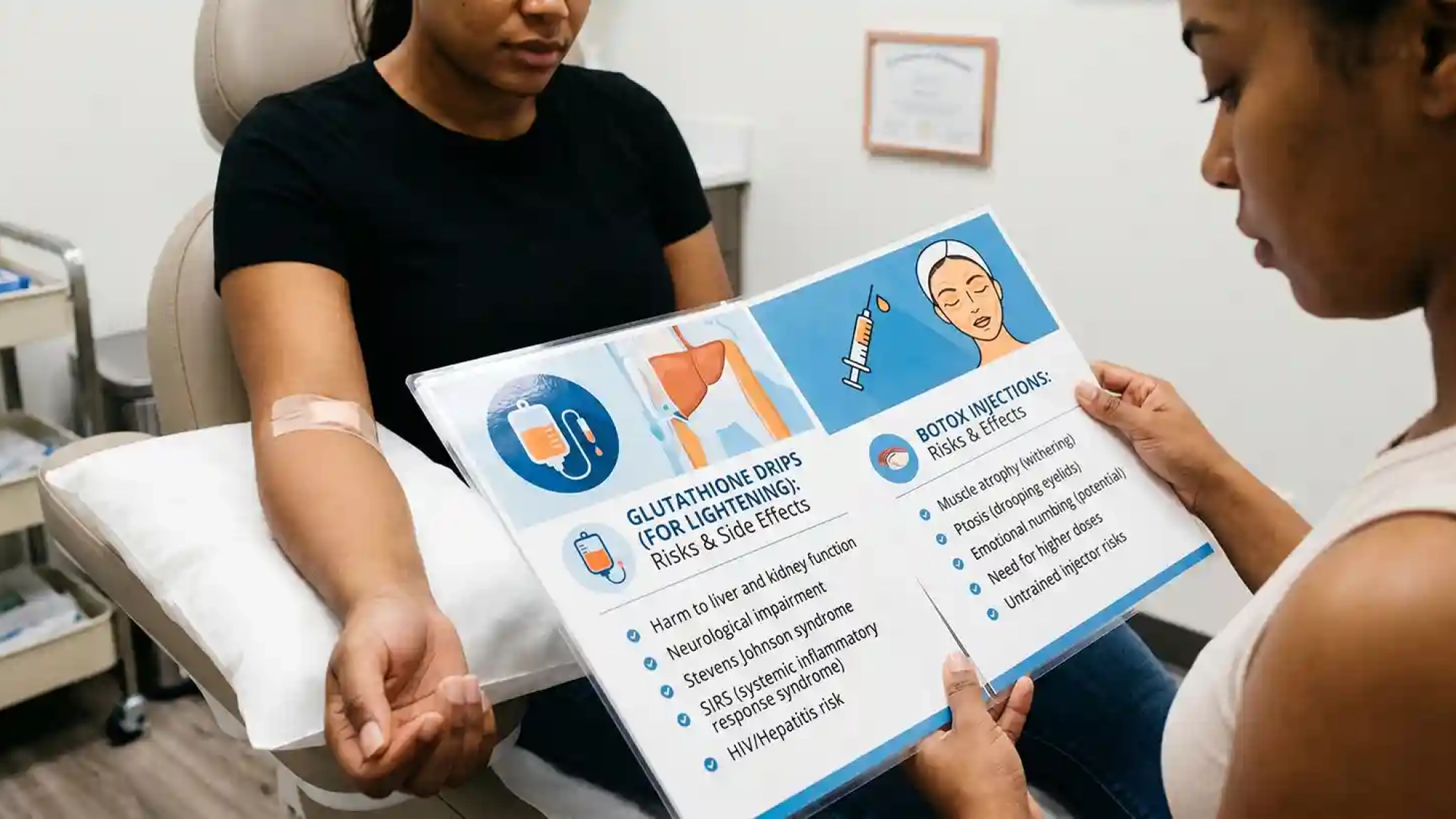
A woman died from a glutathione drip. In 2025, three individuals became sick from self-administration of Botox obtained online. No product has been approved by the FDA to lighten the skin through injections. However, the business generates $12 billion annually. It is time to see the whole picture.
By DeeplyExpress Beauty Desk · Reviewed against FDA, WHO & peer-reviewed sources
Each year, millions of individuals from all corners of the globe enter a clinic, beauty salon, and occasionally, an illegal back-room facility to get an injection, believing that such an intervention will make them look lighter, more youthful, or beautiful. The global market for skin-lightening injections is estimated at a whopping $12 billion in size. Anti-ageing injections, which include famous brands like Botox, form another huge industry, based on the belief that one’s visible age could be stopped in its tracks through the use of an injection. One common denominator between both of these markets is the silence surrounding their real effect within the body – a calculated silence.
Skin Whitening Injections: Revealing the Reality of the Drip
By far the most popular injection for skin whitening is glutathione, an antioxidant which occurs naturally in the liver. Glutathione is marketed as a “master antioxidant” that not only helps in whitening your skin by suppressing melanin synthesis but also acts as a detoxifier for the body as well as anti-ageing. It is commonly advertised as such from Lahore to Manila and then Lagos, with high-dose vitamin C dripped simultaneously into your system.
And here is the one thing that those same clinics do not want you to know about their glutathione drip: none of them have ever been approved by the FDA as skin lightening agents. None of them. This is not merely semantics; rather, this means something much more basic — scientifically speaking, there simply aren’t any peer-reviewed studies that support using injected glutathione for skin whitening, nor does there exist any guidelines for the dosing and duration of treatment. There simply isn’t anything published about this procedure.
“Regarding the safety of the intravenous preparation of glutathione, there is no scientific evidence to prove its efficacy, and there is only a small difference between its effective dose and toxic dose.”
— Muller Journal of Medical Sciences and Research, July-December 2025
The Department of Health of the Philippines gave a formal advisory when a 39-year-old female from Quezon City succumbed due to adverse effects following intravenous injection of glutathione and stem cell treatments. In 2025, a published case study reported on a patient who experienced full-blown SIRS after receiving a high dose of glutathione intravenously for skin lightening purposes – fever more than 41 degrees centigrade, elevated inflammatory markers, hepatic injury, and coagulation disorders. She survived because of aggressive treatment support. She was fortunate. Others are not.
|
GLUTATHIONE (WHITENING) ⚠️ Side effects noted
|
BOTOX / BOTULINUM TOXIN ⚠️ Known short and long-term risks
|
Anti-Aging Injections: Your Face’s Muscle Is Gradually Withering
Botox, the trade name for botulinum toxin type A, works via blocking nerve impulses in target face muscles, which prevents their contraction, thereby reducing wrinkle formation. Properly administered under professional supervision and at recommended dosages, its safety record after more than two decades of application is quite impressive. This is the truth about Botox that the industry is right to emphasize.
Less emphasized, however, are the effects of frequent and prolonged application. After FDA’s approval of Botox for cosmetic purposes in 2002, we have at best two dozen years’ experience working with Botox injections. Yet even that relatively small amount of time has made it apparent that the effects of Botox are not all that good for your face. The injections, it seems, lead to progressive atrophy of injected muscles. Because Botox paralyzes them for about three to four months during each procedure, they are never allowed to regain full strength and gradually begin to weaken.
STUDY CONDUCTED IN 2025: CHRONIC DISEASES HEIGHTEN BOTOX DANGERS
According to a research study conducted by Harvard Health in 2025 and published in a peer-reviewed journal, individuals who have certain types of chronic diseases such as auto-immune disorders and neuromuscular diseases as well as certain types of medications are at a much higher risk of developing side effects following their botox injection procedure.
There were three such cases reported by the CDC in New York, Texas, and Wisconsin between May and June 2025 when patients contracted severe symptoms necessitating hospitalization as a result of self-injection with a purchased online Botox of unknown provenance. All three patients required a special botulinum antitoxin for their condition that was, in fact, a botulism poisoning type. All three recovered, but only partially; one patient in particular conducted some research on how to inject Botox via social media before the actual procedure took place.
There is yet another way in which the use of Botox poses some risk that seems quite unexpected at first glance, but can be explained through neuroscientific knowledge. There are reports in scientific literature of Botox causing some kind of emotional numbing due to the absence of the brain’s emotional feedback loop. It is not the fact that Botox blocks your communication with others because of a lack of emotions being displayed on your face; it is about how your brain registers emotions, too, via facial feedback. Thus, the absence of frowning might lead to some unexpected psychological effects.
$12 Billion Business Based on Instability — and Colonial Legacy For an understanding of why so many are willing to take these kinds of risks, it is necessary to understand what drives their desire for fairer skin and youthful appearance in the first place
| $12B Global skin whitening market value 2026 (est.) | $15.7B Projected market value by 2030 | 40% Women in China, Malaysia, Philippines & S. Korea using whitening products (WHO) | 77% Nigerian women reported using skin lightening products | 80% Of global skin whitening sales are to women |
It should be noted that the preference for white skin is neither a novelty nor a peculiar desire, but a consequence of a certain historical context. In particular, scientists consider the development of the whitening industry to be a direct product of European colonization. During colonization, Europe established a clear hierarchical system in which whiteness was synonymous with beauty, intelligence, wealth, and high social status, while darker skin implied hard work, poverty, and inferiority. When the era of colonization ended, the aforementioned hierarchy was perpetuated in culture, matrimonial relations, employment trends, and even in a multi-billion-dollar industry with its own marketing strategy.
“They may have gone, but they didn’t go empty-handed. They took along with them their legacy of white superiority, which continues to have an effect on people and perpetuates colorism.”
— Amira Adawe, scholar studying global cosmetics and colorism, 2023
The problem with this situation is that those very companies who discreetly changed their “skin whitening” to “skin brightening” or “skin tone evening,” cosmetic terminology changes brought about because of public outrage, continue selling the same products, appealing to the same people, making the same implied statement: Lighter is better. The label changed, but the product didn’t. Nor did the profits, which, at $8 billion in 2020, are expected to be nearly $16 billion by 2030.
“Beauty industry is extremely manipulative. They do not necessarily say the word ‘white’ these days, but they will have light-skinned models, and they will talk about ‘PEACHY COMPLEXIONS’. “
— AMIRA ADAWE, RESEARCHER, COSMETICS AND COLORISM
Natural Process Being Hindered – With Costly Consequences
At the very heart of this issue lies a simple truth about biology. The melanin which lends coloration to human skin, hair, and eyes does not represent a flaw. It is, in fact, an essential component of human biology. Melanin is the main protective layer from ultraviolet radiation. Those who produce more melanin naturally enjoy better UV protection than those with less of it. By injecting glutathione and preventing melanin production to lighten skin, no flaw is being corrected. The process hinders a vital biological system and potentially causes, according to the FDA warning, a theoretical threat of developing skin cancer at a later point. In the same way, Botox stops something from happening. Wrinkles are created by movement, by laughter, frowns, squinting, and the expression of a human face. These are not examples of failure, but proof that a human being has lived his or her life. It is only natural for someone to want rid of the wrinkles in order to look younger, when society is always rewarding youth and punishing signs of ageing. However, the price one pays in terms of gradual muscle loss, dosage increase, emotional numbness, and the danger of fake products is never advertised in as big letters as the before and after photos.
WHAT A GOOD CLINIC WOULD ADVISE YOU ABOUT
Prior to the administration of any cosmetic injections, a good doctor would always: ascertain your health status for conditions that could make it dangerous to receive these injections; let you know that the FDA has never approved the use of injectable glutathione for skin whitening; educate you on the cumulative muscle effects of repeated Botox injections; ensure that you have access to information regarding the origin of the drug, including its certification number; and provide you with information concerning all possible adverse effects – not just some.
What the Evidence Actually Proves
However, this isn’t an appeal to say all skin care procedures are hazardous and none of the cosmeceutical methods are of use. What the evidence actually proves is quite different. Topical application of vitamin C serum, niacinamide, and azelaic acid is backed by reliable research as safe ways to correct skin dischromias without any associated health hazards associated with intravenous glutathione. Sunscreens, which happen to be the single most potent way of preventing aging that exists, save us from UV rays that cause both skin irregularities and wrinkles, and that’s just a lot cheaper without the reported negative effects on our wellbeing. Retinoids have been researched extensively for decades. In particular, regarding anti-aging, Botox treatments by a licensed and board-certified dermatologist or cosmetic doctor in clinical settings are safe enough at standard doses. When it comes to self-treatment, purchasing injections from dubious websites or using them under the supervision of non-professionals, the number of hazards increases dramatically. The CDC cases cited for 2025 have nothing to do with Botox treatments in general; these were examples illustrating the dangers of the self-treatment trend.
FINAL ANALYSIS
Wanting to feel beautiful is natural and justifiable. It’s not wanting to feel beautiful that is the problem; it’s being able to profit from culturally created insecurities, such as insecurities born out of colonization and discrimination, through the use of dangerous practices whose risks are consistently downplayed.
There are no injectable skin-lightening treatments currently approved by the FDA. Glutathione drips have led to at least one confirmed death as well as numerous hospitalizations. The prolonged use of Botox leads to muscle atrophy and other psychological side effects, but these are seldom mentioned in most clinics. This is not the alarmist view held by critics of beauty treatments; rather, these are medical facts backed by research as early as 2025 and 2026.
Before each injection, ask three things: Is this something that has been approved by a reputable authority for the exact use? What are all the side effects recorded, even the very rare and the long term ones? And why do I want this because I really do want it, or because the billion dollar industry is telling me that I should?
The answer to that question might be one of the most important lessons you will ever learn about your skin.
The information contained in this article is strictly informational and does not offer medical advice. Sources have been cited, and all claims can be credited from peer-reviewed journals, FDA, WHO, DOH Philippines, and published reports. If you are contemplating an injectable procedure, please contact a certified dermatologist or physician. Neither the website nor author is affiliated with the products and clinics listed.
Sources & References
- FDA Philippines — Advisory No. 2019-182: Unsafe Use of Glutathione as Skin Lightening Agent
- Muller Journal of Medical Sciences and Research — Is intravenous glutathione therapy safe as a skin whitening agent? (July–December 2025)
- Oliva Clinic — Glutathione Injection Side Effects — Risks and Safety 2026 (April 2026)
- BodyBio — Glutathione Injections: Are They Really Safe and Effective? (September 2025)
- Philippine DOH / Inquirer.net — DOH warns against IV glutathione after woman’s death (January 2024)
- CDC / MMWR — Severe Illnesses After Self-Injection of Botulinum Toxin (NY, TX, WI, 2025)
- Healthline — Botox Neurological Side Effects
- HerSpace MedSpa — Long-Term Botox: What Really Happens to Your Skin After Years (October 2025)
- Jessica DeFino — The $8 Billion Skin Lightening Industry (interview: Amira Adawe) (January 2023)
- MIR Online — Colourism as Capital: Skin Bleaching in the 21st Century (August 2025)
CNN — Skin Whitening: The global market, the risks, who makes the products
Leave A Comment