

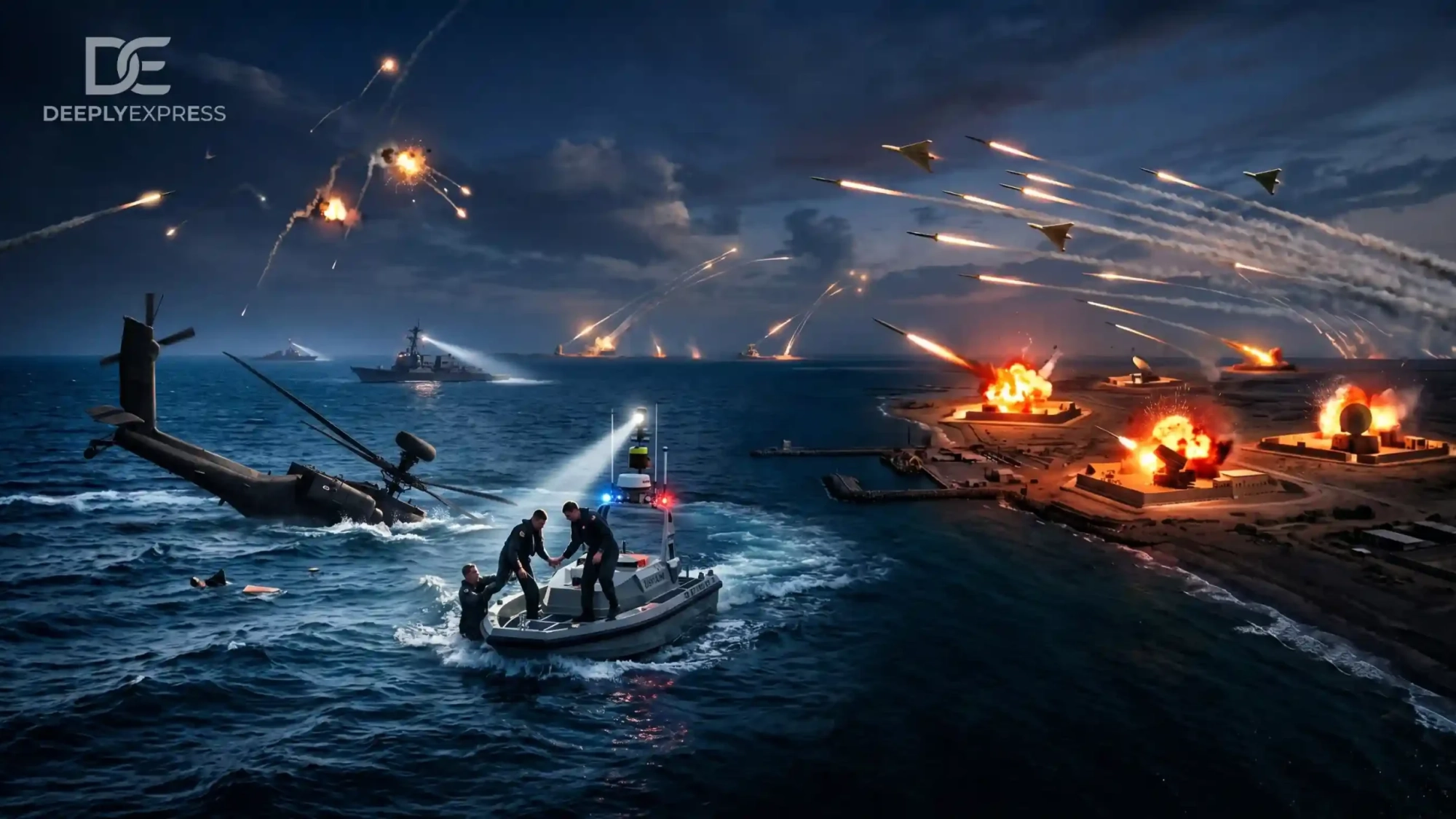
A Shahed drone. An Apache helicopter shot down. Two servicemen pulled out of the ocean. Retaliatory strikes by America against four targets in Iran. And then the IRGC in Iran targeting 21 US military locations in one night in three countries. The region has never been more perilous than it is now.
_________________________________________________________________________________________________________________________________________
By DeeplyExpress News Desk
On the night of June 9, 2026, a lone Shahed drone, the same low-cost, mass-manufactured system which has redefined contemporary warfare from Ukraine to the Persian Gulf, destroyed one of the most deadly aerial vehicles in the arsenal of the U.S. Army when it shot down an AH-64 Apache attack helicopter while flying above the Strait of Hormuz. Luckily for the two pilots aboard, both men were rescued from their ordeal at sea off the coast of Oman within two hours by a robot boat of the U.S. Navy. Everything that happened in the two hours afterward changed the whole of the Middle East into a powder keg like no other since hostilities started on February 28.
WHAT EXACTLY HAPPENED — THE FULL SEQUENCE OF EVENTS
- MONDAY, JUNE 8 – 7:33 PM EASTERN TIME (ESTIMATES)
AH-64 Apache Crash Over the Strait of Hormuz
A US Army AH-64E Apache attack helicopter belonging to the 82nd Airborne Division crashes into the waters off the coast of Oman while on routine patrol over the Strait of Hormuz. According to CENTCOM, both soldiers on board are recovered safely by a US Naval Forces unmanned drone boat about two hours later. It is reported that the cause of the crash was “under investigation” at the time. - JUNE 9 (TUESDAY) – MIDDAY
Iran Takes the Blame, Trump Promises Retaliation
President Trump writes on Truth Social: “The Iranians shot down one of our most advanced Apache helicopters during its patrol in the Strait of Hormuz. There were two pilots and they’re alive and well. Our response is mandatory after such an attack.” An unnamed US official quoted by CNN says that Iran used a drone to shoot down the helicopter. A third source says that it was indeed an Iranian Shahed drone – the same loitering missile which Iran provides to Russia for use in Ukraine. Importantly, the US official admits that it’s not certain whether this was a deliberate strike or not. Official Iranian broadcaster writes: “Ouch! Iranian armed forces have been obliterated, huh?” - JUNE 9 (TUESDAY), 5:00 PM EST
U.S. Conducts Retaliatory “Self-Defense” Airstrikes against Iran
According to CENTCOM, U.S. Air Force and Navy jets conducted “self-defense” airstrikes with precision attacks against Iranian air defenses, command control centers, and radar sites in the vicinity of the Strait of Hormuz. Explosions were seen in Sirik (a port city of Iran near the Hormuz strait), Jask, Qeshm Island, and Bandar Abbas (Iran’s most strategic location). This operation lasted for about four hours from start to finish, before which, CENTCOM had declared it “is done for now.”
- JUNE 10 – WEDNESDAY – EARLY MORNING
IRGC Strikes from Iran in 3 Countries: Bahrain, Kuwait, Jordan
IRGC launches retaliatory attacks against three countries in the Middle East. The IRGC states that its attacks are launched against the following targets: the United States Navy’s Fifth Fleet base in Bahrain using drones; the Ali Al Salem Airbase in Kuwait using drones; and the US Al Azraq Airbase in Jordan using ballistic missiles. The IRGC further says that it has successfully attacked 21 US military facilities with four facilities getting destroyed, including the F-35 jet base in Al Azraq, Jordan, and a command center. The IRGC adds that it has shot down a US drone, MQ-9 Reaper in the city of Jam, in Iran.
“Foreign military forces near Iranian territory are at constant risk. Iranian forces will leave no attack or threat unanswered.”
— Abbas Araghchi, Iranian Foreign Minister, June 9, 2026
WHY IS THERE AN AMERICAN APACHE FLYING OVER THE STRAIT OF HORMUZ? This is the question whose answer must not be evaded. The AH-64 Apache is perhaps the deadliest helicopter assault aircraft on earth, packing missiles called Hellfire that can take out everything from tankers to ships. According to the New York Times, Apaches from the 82nd Airborne Division have been sent to protect the Strait of Hormuz for two reasons: deterring small boat attacks by Iran against merchant ships and shooting down drones.
Strait of Hormuz, being an international waterway, is defined under the UN Convention on the Law of the Sea as “waters which are used for international navigation”. The US, on the one hand, maintains the presence of its naval and air assets since the time when Iran started the blockade of the strait in late February. On the other hand, Iran perceives the presence of American military assets within its so-called “sphere” as a provocation and an act of hostility, ignoring international regulations in this case. The Apache helicopter flew in the area where both parties had their assets under constant threat from drones and missiles.
WAS IT INTENTIONAL? THE IMPORTANT QUESTION LEFT UNTOLD
The same US official who told Axios that an Iranian drone had struck down the Apache said unequivocally that “the review has not determined whether that was intentional.” Iran has neither taken responsibility for the incident nor denied it. For there to have been a mere accident involving a patrolling Iranian drone colliding with a US military helicopter in the air packed with drones from both sides would mean entirely different political implications compared to a targeted destruction. This is one mystery yet to be solved. But Trump assumed that it was an intentional act.
RESPONSE BY IRAN: THREE NATIONS ATTACKED IN ONE NIGHT
The reaction by the Iranian Revolutionary Guard Corps (IRGC) to the US air strike on Sirik, Jask, Qeshm, and Bandar Abbas was rapid and certainly escalatory in terms of geography. The IRGC did not attack countries that are in close proximity to Iran. Instead, it targeted the home base of the US Fifth Fleet in Bahrain, an airbase located in Kuwait belonging to a NATO-ally state, and in what was probably the most concerning response to the air strike, the Al-Azraq airbase in Jordan, reportedly attacking hangers housing F-35 fighter jets.
According to InvestingLive analysts, this was clearly “a categorically different order of escalation.” By hitting Jordan, a nation with deep military connections to the US and with valuable assets from the American air force, Iran demonstrated its willingness to launch ballistic missiles across all of the Middle East. If Iran can strike at Al-Azraq, it means that no American bases in the region are safe from their reach.
“The opening up of three fronts simultaneously – Bahrain, Jordan, and Kuwait – is not opportunism. It is a strategic move to signal that no American military base in the region is safe.”
– InvestingLive Analysis, June 10, 2026
WHAT THIS MEANS FOR KUWAIT, BAHRAIN, UAE, QATAR — AND THEIR PEOPLE
For the millions of people living in the Gulf region, including the enormous community of expatriates from Pakistan, India, and South Asia, these developments have a direct impact on their everyday life.
 Bahrain BahrainUNDER ATTACK The home of the United States Fifth Fleet. Iran’s attack used drones that attacked the base directly. There were sirens everywhere in Manama. The attack on Bahrain was condemned but the government there balances walking a fine line between hosting America and not being drawn into a war they had nothing to do with. |  Kuwait KuwaitUNDER ATTACK Airstrikes took place at Ali Al Salem Air Base for the second time in this conflict. According to Kuwait, its army is actively intercepting aerial objects. Since 28th February, Kuwait experienced loss of lives of its soldiers, injuries among civilians, and infrastructure attacks even its international airport. |  Qatar QatarAT RISK The US has its most significant military base in the Middle East, Al-Udeid Air Base. It has been safe from attack this time but still in the risk zone. The country plays an extremely challenging part in being the US hosting nation and also the mediator with Iran. |
 UAE UAEVIGILANT The UAE denounced Iran’s attacks against Kuwait, Bahrain, and Jordan as “Iranian terrorist attacks” – the sharpest language used by the UAE in this conflict. Abu Dhabi has previously been attacked. The air defenses and the critical port of Jebel Ali continue to be threatened. |  Jordan JordanSTRUCK BY MISSILES Attacked at Al Azrak Air Base with long range missiles – this represents the most concerning attack geographically for Iran. Jordan is an ally of the US with important US military assets in Jordan and until now has largely been untouched in this war. |  Saudi Arabia Saudi ArabiaON GUARD Saudi Arabia was not attacked during this June 9th to 10th exchange but did recall the Iranian ambassador following previous attacks within its borders. Saudi Arabia finds itself in a difficult situation in that it must depend upon both Iran, controlling the Hormuz passageway, for revenue and upon the US for security. |
THE BIGGER PICTURE: AMERICA, ISRAEL, AND THE QUESTION OF RESPONSIBILITY
A more difficult question lies behind all of this, a question being raised in more than just journalism offices, but in living rooms around the Muslim world and everywhere else as well: how did we get here, and whose fault was it?
The facts are straightforward about what happened first. The current war started on February 28, 2026, when the U.S. and Israel attacked Iran, killing its Supreme Leader and attacking its nuclear facilities. The Gulf countries were drawn into this war without having any choice to avoid it. Blockade of the Strait of Hormuz came after. Prices for energy went up. Prices for food went up. Two superpowers are at war, affecting millions of others who didn’t have a say in whether that happened.
This brings in yet another dimension. Even at a time when negotiations have not only commenced but also a delicate ceasefire has been established between Iran and Israel on account of the Apache incident occurring just a day prior, the occurrence of a single incident involving one drone flying in a sky where there were many unmanned vehicles from both the factions has resulted in triggering off the chain of events leading to escalation once again. It is still being determined if it was an intended act. Trump struck back. Three nations were attacked by Iran.
THIS IS NOT THE FIRST US PLANE DOWNED
The Apache isn’t the first US plane lost in this war either. The United States Air Force reported on April 3, 2026 that its F-15E Strike Eagle, flown by the 494th Fighter Squadron, had been brought down by an Iranian shoulder-fired missile. The incident was called “a big blow to the Trump administration,” according to the BBC. The extensive rescue mission took place over seven hours after the downing and involved hundreds of troops and scores of airplanes. While the pilot was retrieved, the other person in the airplane fell into Iranian hands.
WHAT HAPPENS NEXT – THE THREE SCENARIOS
According to Al Jazeera’s correspondent in Tehran, although the most recent bout of verbal jousting was particularly sharp, “Neither party wants to go back to the days of full-scale war.” On one hand, Iran’s foreign minister insists that Tehran “prefers to speak the language of diplomacy,” but on the other, Iran “speaks many other languages much better.”
SCENARIO 1 – CONTROLLED DE-ESCALATION: Both sides digest the latest round of strikes, back channel diplomacy resumes via Pakistan, and the ceasefire arrangement prevails. This scenario is what both sides pretend to hope for, and it’s also the scenario that lacks the most institutional mechanisms to make sure it happens.
SCENARIO 2 – SLOW DESCENT INTO WAR: The two parties continue their controlled escalation of tit-for-tat attacks, keeping just enough distance from all-out war but continuing to expand the scope of attack geographically and in terms of the value of the targets being hit. The risk in this scenario involves miscalculation – one blow that kills numerous American soldiers, or destroys an F-35 in Jordan (outside of its hangar), would change the political equation in Washington entirely.
SCENARIO 3 – CONTROLLED RE-ESCALATION: Claims of the destruction of F-35s and the command center in Jordan by Iranian forces at the Al-Azraq airbase prove to be true; domestic pressure for an effective action increases for Washington, and Trump – having already proved he can take decisive action against foreign threats even without an investigation first – calls for military action.
DEEPLYEXPRESS ANALYSIS — WHAT THE EVIDENCE SAYS
The Apache incident has made one thing clear about this particular dispute: the airspace over the Strait of Hormuz is so crowded with unmanned aircraft belonging to either side that any accidental clash could create a chain reaction leading to three different nations being attacked within 24 hours. If the clash was indeed an accident – and this is still a possibility – then the whole series of events that occurred beginning with the helicopter crash, to the Iranian missiles attacking Jordan, could all stem from a drone that was just passing through.
For Kuwait, Bahrain, Qatar, and the United Arab Emirates, the truth is harsh and uncomplicated: they host US military installations, making them legitimate targets in an unprovoked and unavoidable war. Citizens, facilities, and economic systems are all involved in the fight. Both Egypt and the UAE have come down hard against Iranian attacks. Yet condemning an attack will not stop a ballistically launched missile.
The world is not heading toward destruction; it’s already well underway and accelerating, without an obvious exit strategy yet available. Will the talks for peace endure the Apache strike, the bombing of Sirik and Bandar Abbas, and the IRGC’s retaliation across three countries? This is the key issue in the entire world at this moment — and nobody really knows the answer.
_________________________________________________________________________________________________________________________________________
All information in this article is drawn from named, confirmed sources dated June 9-10, 2026. The sources are: Official CENTCOM announcements; Posts made on Trump’s Truth Social platform; Live coverage via CNN, Axios, NBC News, Al Jazeera, Air & Space Forces Magazine, The Jerusalem Post, CNBC; Wikipedia entry “2026 Iran War” updated in real-time; Iran International; and InvestingLive report, June 10. All claims of strikes or destruction by IRGC against any target remain Iranian claims and have not been confirmed independently by Western sources as of this report’s publication date.
Sources & References
- The War Zone — AH-64 Apache Shot Down By Iran, U.S. Will Retaliate: Trump (June 9, 2026)
- CNN — Crew members safe after Trump says Iran shot down US helicopter (June 9, 2026)
- Axios — Trump vows response after Iran downs U.S. helicopter (June 9, 2026)
- Air & Space Forces — US Launches Strikes on Iran in Retaliation for Downed Apache Helicopter (June 9, 2026)
- NBC News — U.S. launches new attacks on Iran in response to downing of helicopter (June 9, 2026)
- Al Jazeera — US attacks Iran after Apache helicopter downed in Strait of Hormuz (June 9, 2026)
- Al Jazeera — Iran targets Bahrain, Kuwait and Jordan after US ‘self defence’ strikes (June 10, 2026)
- Al Jazeera Live Blog — Iran war live: Tehran targets US forces in Bahrain, Jordan, Kuwait (June 10, 2026)
- CNBC — Iran targets Bahrain, Kuwait and Jordan after U.S. ‘self defense’ strikes (June 9, 2026)
- Jerusalem Post — Iran attacks Kuwait, Bahrain, Jordan in retaliation for US strikes (June 10, 2026)
- CNN Live Updates — Iran launches retaliatory strikes on US bases in Bahrain, Jordan, Kuwait (June 10, 2026)
- InvestingLive — Iran strikes US bases in Jordan, Kuwait and Bahrain — analysis (June 10, 2026)
- Iran International — US Apache goes down near Strait of Hormuz, crew rescued (June 9, 2026)
- Wikipedia — 2026 United States F-15E Rescue Operation in Iran
Leave A Comment