

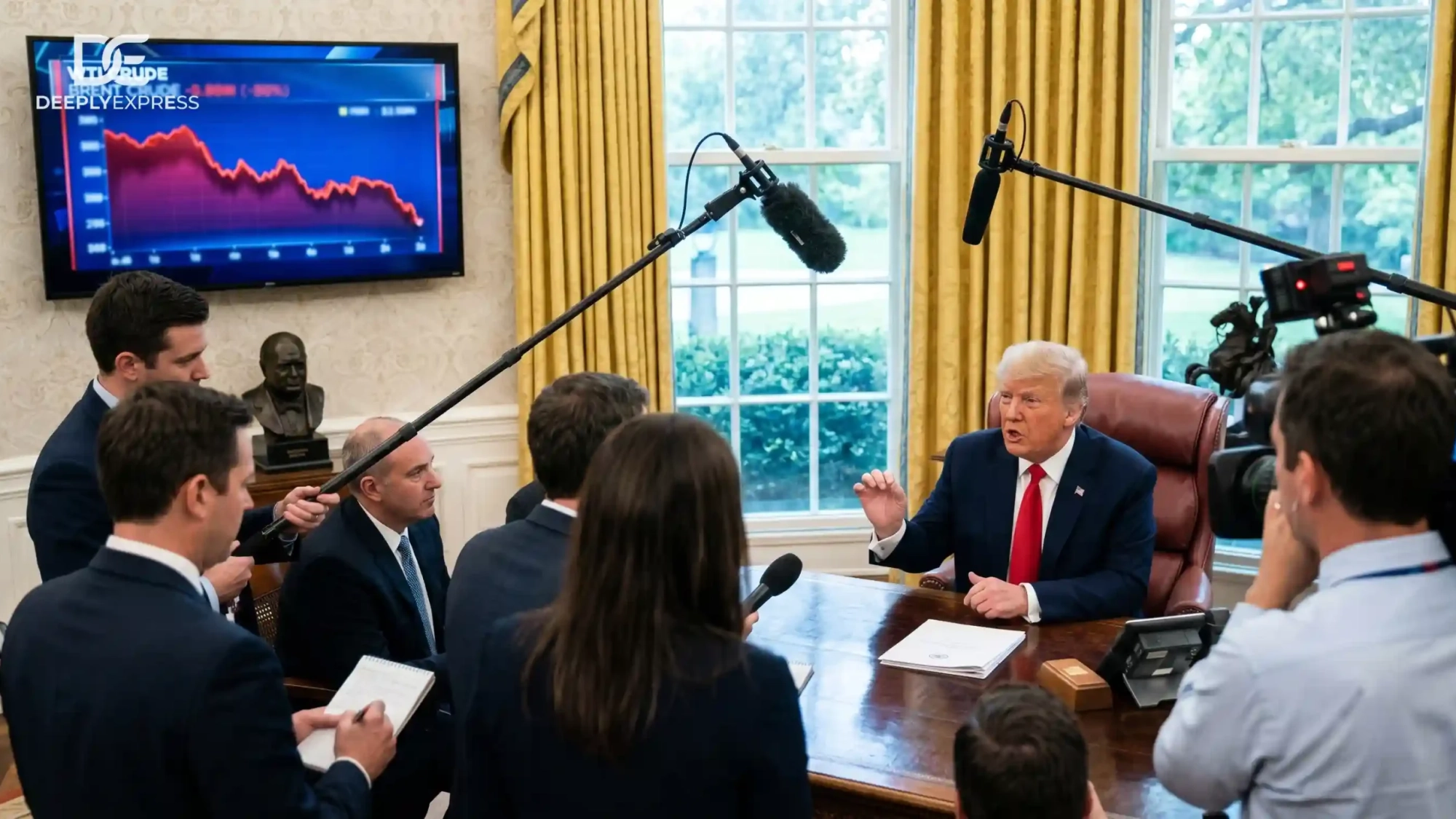
In one day on June 11, the President of United States warned he would bomb Iran “very hard” at one point, then decided against an attack a few hours later; made headlines by stating a peace deal had been signed; and maintained its naval blockade. Nothing was actually signed according to Iran. Oil prices fell 4 percent.
By DeeplyExpress News Desk
Imagine a situation where an individual promises to commence military strikes in one afternoon and then cancels them, only to tell the media that a historic peace accord has been negotiated between all nations in question, but then explains privately that the naval embargo will continue until the peace treaty is signed. Imagine the other party at the negotiation table simply responding to this person’s claims by politely pointing out that they have absolutely no idea what he’s talking about. This is precisely what happened on June 11, 2026, between the United States and Iran. As CNBC reported and subsequently counted, this was probably the 30th time that Donald Trump had announced the imminent deal since the start of the war.
WHAT HAPPENED ON JUNE 11: A DAY OF WHIPLASH
The morning of June 11 was the same pattern as much of this conflict: a threat. Trump posted to Truth Social claiming the US will strike “VERY HARD” on the evening of that day against Iran. This included threatening to take control of Kharg Island, the enormous oil export terminal responsible for exporting about 90% of Iran’s crude exports. Financial markets took notice. Oil prices shot up. Analysts adjusted their risk assessments at the major banks. In Bahrain, Kuwait, and Jordan, people prepared for the next night of siren warnings.
However, in the afternoon, Trump flip-flopped on his position. He made a second post on Truth Social: “Based on the fact that discussions with the Islamic Republic of Iran have reached the highest level of Iranian leadership and are approved, I, as President of the United States of America, have canceled the strike operations against Iran for tonight.”
“Talks and conclusions have been, conceptually as well as in full detail, agreed to by everyone concerned, which includes the U.S., Israel, Saudi Arabia, UAE, Qatar, Turkey, Pakistan, Bahrain, Kuwait, Jordan, Egypt, and many others.”
— PRESIDENT DONALD TRUMP, TRUTH SOCIAL, JUNE 11, 2026
Trump also mentioned that America and Iran will sign the agreement at some European venue, the date and place will be revealed shortly. The deal was already made. He told the reporters from the Oval Office that it was “a great agreement for ending the war with Iran.” It was also “subject to the finalization of the documents,” Trump continued. Immediately after the deal announcement, oil prices declined by 4.2 percent within several hours.
However, there was just one catch. Iran said that it was not true.
IRANIAN OFFICIALS INSIST NOTHING WAS AGREED TO
The situation started crumbling almost instantly after Trump made his move. In just hours after Trump’s address, the Iran Islamic Revolutionary Guard Corps released a statement saying that “Iranian officials have not yet reacted to claims by Trump” and that the statements were “contradictory and inaccurate ever since the beginning of the war.” An Iranian official who was personally involved in the negotiation process said that nothing of the sort had happened – no memorandum nor framework deal had been reached between Iran and the United States. Iran’s foreign ministry claimed that the United States was being “duplicitous”: while on one hand talking about agreements and deals, it was still bombing and maintaining the blockade. Trump confirmed the naval blockade would stay too. His Truth Social post mentioned that “the US blockade will persist in full force until this Transaction is finalized.” Thus, the deal has been signed, but the blockade is still active. The conflict is over, but new strikes can happen again. Negotiations have been authorized at the highest levels, but Iran hasn’t heard anything about them. To put it bluntly, that’s not how things are done with peace treaties.
THE TRUE IMPLICATIONS OF IRAN’S RESPONSE
- The IRGC dismissed the comments from Trump as “contradictory and inaccurate” since the war began in February
- An Iranian official confirmed that no agreement on any framework for negotiations was ever reached by either side
- Iran’s Ministry of Foreign Affairs claimed the US government was displaying “duplicity” through its dual actions
- Though the cancellation of military strikes by Trump was recognized, Iran remained deeply skeptical about progress made
- Negotiation intermediaries such as Qatar announced some breakthroughs had been made during night talks
THIS HAS HAPPENED OVER 30 TIMES ALREADY
Here’s something that absolutely everyone reading this should be aware of, because it totally alters the context of everything going on right now. CNBC analyzed all of the social media messages and press statements that Trump issued since this conflict started on February 28. CNBC reports that Trump has hinted or directly stated his belief that the deal with Iran was about to happen over 30 times in less than four months. Over 30 times, and the markets reacted each and every time.
LATE MARCH 2026
According to Trump, the president of Iran personally requested from America a ceasefire. The WTI crude declined upon the announcement.
RESULT: NO CEASEFIRE WAS SEEN THAT WEEK. TRUMP THEN VOWED TO BOMB IRAN BACK TO THE STONE AGES.
MARCH 24, 2026
President Trump announced a temporary suspension of any intended attack on Iran, calling it “very good discussions.” State media from Iran said that there were actually no discussions taking place at all.
RESULT: THE SITUATION ESCALATED EVEN MORE RAPIDLY THAN BEFORE.
APRIL 7, 2026
Following threats to bomb Iran’s electrical grid, Trump called a ceasefire for two weeks. Crude oil dropped 16%. Market indices skyrocketed.
RESULT: THE CEASEFIRE LASTED TEMPORARILY, WAS RENEWED, AND BROKE DOWN IN JUNE FOLLOWING THE DESTRUCTION OF THE APACHE HELICOPTER.
LATE MAY 2026
According to reports, Trump and the Iranian negotiating team came “close to reaching agreement” on a 60-day memorandum of understanding. Crude oil prices dropped about 20 percent during May, their sharpest decline since the coronavirus pandemic.
RESULT: THE MOU WAS NOT SIGNED BEFORE THE ESCALATION IN JUNE.
JUNE 11, 2026
Mr. Trump canceled attacks on Thursday evening, saying that the deal was finally signed in high places and announcing the imminent signing in Europe. The oil price dropped by 4%.
THE IRANIANS SAY: NO AGREEMENT IS OFFICIALLY CONFIRMED YET. THE U.S. NAVAL BLOCKADE IS STILL FUNCTIONING.
THE ONE REAL OUTCOME: OIL PRICES FELL. WHAT THAT MEANS FOR YOU
While Trump’s negotiation style can be critiqued on many fronts, one tangible effect stands out: every time he claims success, oil prices drop. Every time oil prices drop, energy becomes more affordable for hundreds of millions of homes in South Asia and the Middle East.
| WTI CRUDE (US) $86.51 Down 3.9% on June 11 | BRENT CRUDE (GLOBAL) $89.15 Down 4.2% on June 11 | PEAK 2026 PRICE $111+ Up 58% since Feb 28 |
In other words, the price of Brent crude prior to the beginning of this war on February 28th stood below $71 per barrel. By mid-March the price was above $111 per barrel. For Pakistan, which is heavily dependent on imported LNG delivered via the Strait of Hormuz from Qatar and the United Arab Emirates, an increase of $40 per barrel means that their bills for cooking gas, grocery shopping, electricity use, and overall life have become more expensive. India was facing a similar situation. For Bangladesh, where the gas deficit has been severe even without the war, the problem is nothing less than a full-scale energy crisis.
When Trump tells us that a deal is near, and oil prices drop by 4 percent, it is not just another statistical change for the oil market. It determines whether people of Lahore will be able to make their daily meals. It means whether a Dhaka factory will continue operating its machinery. It determines whether Bangladeshi fishermen will be able to operate their boats. And in South Asian households across the region, the cost of a barrel of oil is becoming a part of life, and people there know its exact value every day.
“Trump claims a deal is imminent more than thirty times. Markets believe him each time. Iran denies it each time. And yet, the price of oil plummets. And yet the world sighs in relief. Until the next threat comes.”
DEEPLYEXPRESS ANALYSIS, JUNE 12, 2026
WHAT THIS MEANS FOR THE MIDDLE EAST AND SOUTH ASIA TODAY
The people impacted the most are not in Washington or Tehran but in the cities caught up in this war, above it, and surrounded by it. These are the citizens, employees, and inhabitants of nations who were never involved and cannot make this war stop.
- Pakistan
HEAVY ECONOMIC STRESS
99% of Pakistan’s supply of LNG arrives via the Strait of Hormuz from Qatar and the UAE. Prices have soared since February. With every deal declared by Trump, there is respite for some time. With every fallacy that follows, the strain returns once more. The Pakistani government finds itself in a precarious balance between its mediation, economy, and pressure from the US to enter into the Abraham Accords. - India
CRISIS OF IMPORT BILLS
India imports around 30% of its oil and 53% of its LNG via the Strait of Hormuz. Due to the war, India’s fuel import bills have risen to a level of $40 billion per year at a price of $111 per barrel of oil. On June 11, three Indian citizens died due to firing by US Navy vessels near Oman. India has highlighted the impact on its migrant laborers in the Gulf countries. - Kuwait
UNDER ATTACK
The country has experienced an attack on its airport, closure of its airspace for the second time in a week, attacks on its military base on two consecutive days, and protecting its workers from Iranian drone attacks. Being home to a large number of US military bases, Kuwait is suffering the consequences. - UAE & Bahrain
CAUGHT IN THE CROSSFIRE
Both countries have denounced the attacks on their regions made by Iran. Both are home to American military bases. Their economies have been affected directly by the activities of Hormuz. In just the month of May 2026, real estate transactions in Dubai fell by 37.5%. - Bangladesh
ENERGY CRISIS
Bangladesh sourced 72 percent of its LNG from Qatar and UAE before the war. The economists reckon that the Hormuz Strait crisis would be a 4.96 percent blow to GDP. There have been cases of power cuts. There has been an economic contraction in the industrial sector. - Qatar
QUIET MEDIATOR
The Qatari government has tried its best to make itself known as the most active and neutral negotiator between the warring factions by sending its foreign minister to Tehran and facilitating negotiation efforts. According to reports, the mediation from Qatar was taking place in Tehran on the night of June 10. This facilitated further progress in such a manner that President Trump withdrew his strike orders the following day.
TRUMP’S UNPREDICTABILITY BECOMES ANOTHER PART OF THE PROBLEM
There actually seems to be an ongoing dispute between international relations theorists regarding whether or not the US president’s unpredictability in this situation is a result of the negotiating strategy or the product of actual chaos going on within him. The theory of “madman” in diplomacy states that looking like a madman gives a negotiator an advantage, since the opponent doesn’t know where he draws the line.
But the problem with employing this theory in a war which lasted for 103 days, was fought by nuclear nations, involved an oil pipeline shut down, and affected millions of lives, is that every erroneous claim of a deal reduces the trust of any further claims made. As President Trump makes the 31st claim of making a deal, Iran doesn’t rush to the table to sign on anything. As the market reacts by going down by 4 percent on a non-existent deal, the reality sets in after a day and traders and investors have to find ways to cope with such volatility. The family in Karachi which makes budget plans for next month based on the news of an impending end of a war finds itself in hot soup three weeks later.
“On one hand, the US talks about negotiations, and on the other hand, it breaks its promises. This is hypocrisy.”
—IRANIAN MINISTRY OF FOREIGN AFFAIRS STATEMENT, JUNE 11, 2026
CNBC described this dynamic with remarkable insightfulness: When Trump generates hope in the markets, oil prices fall and stock prices rise. When he talks about striking Iran and taking their oil, oil prices soar and markets tank. This leads to a cycle where what Trump says about Iran is increasingly viewed as nothing more than a price mechanism, regardless of how true it is. And the repercussions of this cycle affect everyone around the world using energy. In other words, everyone around the world.
FREQUENTLY ASKED QUESTIONS ABOUT THE IRAN DEAL AND TRUMP’S STATEMENTS
- HAS THERE REALLY BEEN A DEAL BETWEEN THE US AND IRAN UP UNTIL JUNE 12, 2026?
No deal has emerged yet as of June 12, 2026. According to Trump, “final points” were agreed upon by all the sides on June 11. The Iranian IRGC, its Ministry of Foreign Affairs, and an Iranian official deeply involved in the negotiations have denied reaching any memorandum of understanding or deal structure. The US military blockade around Iranian ports is still operating. Some positive changes in the process have been confirmed by Qatari negotiators, but no final deal has been made. - WHY DID OIL PRICES FALL DESPITE THERE BEING NO DEAL YET?
The market tends to reflect signs of de-escalation, not deals per se. Whenever Trump calls off strikes and starts talking about peace, the investors assume a smaller likelihood of additional disruptions in Hormuz Strait area. Brent crude oil prices have fallen by 4.2 percent on June 11 due to Trump’s statements alone. However, this decline might be reverted in case of another failure of the negotiations. - WHERE AND WHEN WILL THE DEAL BE SIGNED?
Trump stated that the signing will happen “in Europe,” but added that the date and location for it would be announced “shortly.” No European country has so far confirmed it would host such a signing. No date has been announced. So far, Iran has not confirmed that it agreed to participate in the signing ceremony.
- HOW MANY TIMES HAS TRUMP PREDICTED THE NEARING OF A DEAL SINCE THE WAR STARTED?
Based on CNBC’s analysis of Trump’s statements on social media and elsewhere, since the start of the war in Ukraine on February 28, 2026, he has predicted the nearing of a deal at least 30 different times.
- IS IT TRUE THAT THE STRAIT OF HORMUZ WILL OPEN SOON?
In case the deal is indeed signed, it might still take several weeks or even months for the strait to fully resume its operations, since there would need to be de-mining, evacuation of vessels, restoration of facilities, and replenishment of stocks, according to Clear View Energy Partners’ analysis.
THE BIG PICTURE: WHO COMES OUT AHEAD, AND WHO LOSES ALL THE TIME
One thing that should be asked without hesitation: amid the ongoing threat-and-bombings and cancellations and deal announcements, whose pockets are filling and whose are getting drained?
US military corporations set their highest earnings records for the first quarter of 2026. Military equipment export licenses totaled $226.8 billion in fiscal year 2025 – an increase of 12.9% over the previous fiscal year. High oil prices mean the Gulf States make more money per barrel, although fewer barrels are being exported. Energy investors make money no matter which way the market goes.
In every scenario, those left behind in the dust are those who do not have any personal interest in the situation except their survival and safety. It can be the Pakistani nurse in Bahrain sending an SMS message to her family telling them that she is safe and well. Or the Bangladeshi family with an electrical bill that has skyrocketed three times in the month of March. And the Indian sailor in the ship that was attacked close to Oman.
DEEPLYEXPRESS BOTTOM LINE
Up until June 12, 2026, there is no Iran deal made yet. As far as agreements are concerned, none are signed nor agreed to. The memorandum of understanding is nowhere in sight. But what does exist at this point is a cancellation of any attack plan, a continuous naval blockade, a 4% reduction in the price of oil, and the 31st declaration by Iran of imminent peace which has not been confirmed.
That drop in oil prices is a real thing. It is significant for South Asian countries such as Pakistan, India, Bangladesh, among others. While the drop will be temporary should the war resume, it does offer a respite right now.However, the more serious issue is this: a situation such as this, which is both extremely dangerous, occurring in such a strategically important place, between nuclear-armed countries, and affecting so many countries, requires leadership which speaks its mind and keeps its word. Markets can take a beating; people cannot; neither can the Middle East nor South Asia. Only when there is a genuine agreement, recognized and respected by all, can the world turn its back on the millions of people who were forced to suffer the repercussions of a decision taken in Washington and Tel Aviv early in the morning on February 28, 2026. Unless this happens, every new ‘breakthrough’ must be greeted with one very simple question: Has Iran agreed?
Sources and References
- CNBC: Trump keeps saying an Iran deal is close. Markets keep believing it (June 10, 2026)
- CNBC: Crude oil prices fall 4% after Trump says US will sign deal with Iran soon (June 11, 2026)
- CNN: Trump cancels planned strikes and touts progress; Iran says no deal finalized (June 11, 2026)
- Bloomberg: Trump Insists Iran Deal Is Close After Scrapping New Strikes (June 11, 2026)
- NPR: Trump now says a peace deal will be announced soon, cancels further strikes (June 11, 2026)
- Fox News: Trump cancels planned strikes on Iran, cites near deal (June 11, 2026)
- The Hill: Trump cancels strikes on Iran; claims deal almost done (June 11, 2026)
- Washington Times: Trump cancels strikes on Iran, points to breakthrough in talks (June 11, 2026)
- MS.Now: Citing new talks, Trump says he has canceled strikes on Iran tonight (June 11, 2026)
- Al Jazeera: Iran war updates: Trump cancels strikes, says deal approved (June 11, 2026)
- Axios: Oil prices fall after Trump indicates US-Iran deal possible (May 24, 2026)
- CNBC: Oil drops 20% from 2026 peak on optimism over US-Iran ceasefire talks (May 29, 2026)
Leave A Comment