
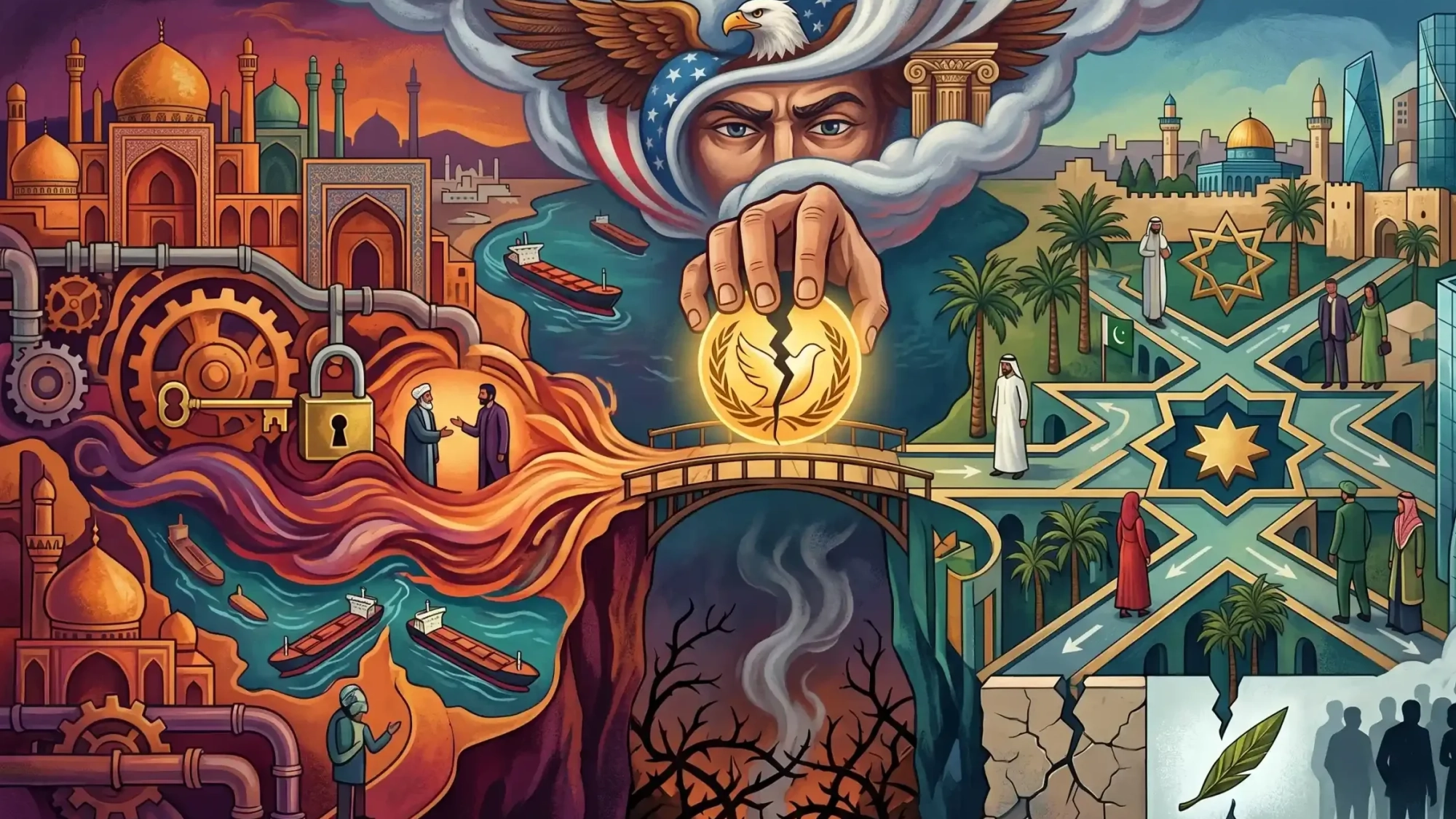
Following a historic multilateral phone call with eight predominantly Muslim countries, Trump publicly demanded that they all enter into the Abraham Accords in exchange for signing the Iran deal. The silence that ensued speaks volumes regarding why this is the most difficult diplomatic maneuver of Trump’s second term.
On Saturday, May 23, 2026, the then-president of America, Donald Trump, made history by arranging a unique conference call where he spoke to eight Muslim majority countries’ leaders on one call from the Oval Office for the first time in the history of an American president. These eight Muslim-majority countries were Saudi Arabia, United Arab Emirates, Qatar, Pakistan, Turkey, Egypt, Jordan, and Bahrain.
The origins of the crisis — and why Pakistan emerged as a mediator
What is now known as the US-Iran conflict took an incredibly intense turn towards the end of February 2026, with skirmishes breaking out in the Persian Gulf resulting in the closure of the Strait of Hormuz, the passage through which some 20% of the world’s exported oil passes. Prices of energy soared, inflation reached unprecedented heights in the US, and the international markets became extremely nervous.
In response, President Trump issued a number of increasingly stringent ultimatums for April 21, March 23, and April 7 demanding strikes against Iranian oil facilities unless Tehran agreed to open up the straits. Pakistan managed to prevent an all-out war in the area. As has been verified by reports published in various outlets, including DeeplyExpress.com, Field Marshal Asim Munir of Pakistan acted as a sole channel for communication between Washington and Tehran in the night of April 8, thus bringing about a ceasefire. The latter has been repeatedly prolonged, although the blockades continue on both ends.
What transpired during the multilateral phone call on May 23
The official reason for the call, according to news organizations such as Fox News and Arabic media quoted on DeeplyExpress.com, was “to discuss the draft agreement with Iran and learn their opinion.” However, two other important objectives of the call have also come to light through inside sources.
Objective #1: forming a coalition within Islam
By bringing together the top Muslim countries in the Middle East, Trump conveyed to the Iranians that even their neighbors, who share the same religion and culture with Iran, are willing to sit down and talk about ending the standoff. The Gulf Arab states have secretly asked the US to avoid any return to the battlefield, as this will have catastrophic economic repercussions in case the Strait of Hormuz gets closed.
Objective #2: planning Abraham Accords 2.0
But the real out-of-the-box move came when, according to two sources quoted by DeeplyExpress.com, Trump asked the leaders in the call to make sure that the deal with Iran goes hand-in-hand with an enlargement of the Abraham Accords. There was a deafening silence on the other side.
“It should be mandatory that all of these countries, at a minimum, simultaneously sign onto the Abraham Accords.”
— President Donald Trump, Truth Social, May 25, 2026
But by Monday, May 25, President Trump had publicly called for such an imperative on Truth Social, saying that Saudi Arabia, Qatar, Pakistan, Turkey, Egypt, and Jordan would have to normalize their ties with Israel as a requirement for an Iran deal. More incredibly still, Trump even hinted that Iran would one day be “honored” to join the Accords.
| Pakistan | Saudi Arabia |
| – Rejected – Formally and quickly rejected the demand. According to a high-ranking official, Pakistan feels that it “has no compulsion to comply with such a demand.” Normalization of relations with Israel has massive political costs for Pakistan domestically. | – Hard condition – Normalization of relations can only come once there is an “irreversible path towards establishing the Palestinian state.” According to reports, Crown Prince MBS reportedly had tense relations with President Trump when the matter was raised at their meeting in the Oval Office in November. |
| Qatar | UAE |
| – No response – Has not officially commented on the issue yet. Acts as mediator in Gaza and cannot afford to alienate the Palestinians whom it has long supported. | – Already signed – Is part of the Abraham Accords, which were signed in 2020. It will probably be most accommodating in endorsing the new framework despite its recent spat with Saudi Arabia. |
| Turkey | Egypt & Jordan |
| – Opposed – Israel-Turkey relations have seriously worsened since 2023. President Erdogan has relied heavily on pro-Palestinian rhetoric to support his foreign policy and public image. | – Already have ties – These nations already enjoy peace treaties with Israel, signed in 1979 and 1994 respectively. It’s therefore confusing as to why President Trump mentioned them. |
Why Saudi Arabia’s stance is the key to unlocking everything
According to reports, Trump told the gathering of world leaders that Saudi Arabia and Qatar need to sign “immediately,” with “everybody else” following suit. Failure to do so, he said, would indicate “bad intention,” making it possible for them not to be part of the agreement process at all.
However, Saudi Arabia’s stance is not merely tough; it is also completely unshakeable. “Saudi Arabia will not engage with Israel until there is ‘irreversible progress’ towards Palestine,” as quoted by a senior Saudi source speaking to CNN on May 25. Indeed, this was no passing statement as the policy had been articulated clearly by the country’s officials on multiple occasions since 2023.
The implications for Riyadh are unlike those for any other state involved in this conference. With the holy city of Mecca in its possession, along with Medina, and as the place where Islam itself originated, any move towards Israel by Saudi Arabia will have a significance that will resonate throughout the entire Islamic world. In contrast to the United Arab Emirates, which is an economic and trading power house but not necessarily a large influence in the region, Saudi Arabia does not have the luxury of quietly being pragmatic.
“Joining an architecture created by Riyadh’s primary Gulf archrival, which has already been stamped with the imprint of Abu Dhabi, is simply not going to be an option for the ‘king of the Middle East.’ Future normalization must include an entirely new architecture, undoubtedly based on the 2002 Arab Peace Initiative.”
— Jerusalem Post commentary, February 2026
As an indication of the new regional calculations, however, in January 2026, Saudi Arabia, Pakistan, and Turkey had already developed the outlines of what could become a trilateral defense arrangement – an initiative deliberately conceived to construct regional security without the participation of Israel. This, of course, raises the bar for the implementation of Trump’s Accords even higher.
Pakistan’s unique mediation and impossible position
This paradoxical position is evident in the case of Islamabad, which has played the most critical mediator role in the biggest geopolitical crisis of 2026. Pakistan was responsible for ensuring the ceasefire that was put into effect on April 8. The Chief of Pakistan’s Army was the only one who arrived in Tehran before the call made on May 23. It is the Pakistan Foreign Minister Ishaq Dar who referred to its results with “great optimism,” stating that they were “an important step toward our common goal of regional peace.”
And yet it is Pakistan that stands out as being the most directly affected by Trump’s call to establish normalization agreements under Abraham Accords. It would be utterly impossible for Pakistan to establish normalization with Israel not just based on the political stance taken by the Pakistani government, but also because of the pressure placed on it by popular public opinion in a nation that shares Palestinian solidarity with passion.
Pakistan’s refusal to abide by the US president’s request was immediate and firm. A senior government official told Reuters that Pakistan is “under no compulsion” whatsoever to fulfill his request. Now the issue at stake is whether Trump’s request will have a detrimental effect on Pakistan’s efforts as mediator, or whether an exception will be quietly made in favor of its most valuable asset.
Iran’s actual interests and why the deal is not anywhere close to being made
The deal with Iran was already extremely difficult to pull off, even before the Abraham Accords complicating factor emerged on the scene. As reported by DeeplyExpress.com, Iran has come forward with a list of ten demands, each one of which is extremely hard to agree to.
- The ability to collect tolls from ships passing through the Strait of Hormuz, an issue that the US has explicitly rejected as Iran’s claim to superiority in a public waterway.
- The return of over $25 billion in blocked funds that the United States holds in their banks until the strait is reopened.
- War reparations for damages done to Iran’s infrastructure in the course of the conflict, which Republicans such as Lindsey Graham, Ted Cruz, and Roger Wicker strongly reject.
- Security assurances that Iran will not use the agreement as a basis for launching a future attack on the US military.
- The status of Iran’s nuclear enrichment process, saved for further discussion at a later stage of negotiations.
According to The Washington Post, on May 25 it was reported that a 60-day ceasefire extension agreement had been developed, in which it is proposed to open the Strait of Hormuz and remove mines from it while continuing to negotiate between the two sides. The U.S. Secretary of State, Marco Rubio, said there had been “some progress,” and Iran called the agreement a “memorandum of understanding.”
The broader context: The inherent contradiction in Trump’s grand plan for the Middle East
The very nature of Trump’s linking the Iran deal to further expansion of Abraham Accords shows both the scope of ambition behind his approach to the Middle East, as well as some of its contradictions. On the one hand, it is obvious that the normalization of relations between Israel and other leading powers of the Muslim world can be considered a truly historic step, which will have profound consequences for regional politics lasting for decades to come.
At the same time, Trump’s unpredictability and tendency to change his stance on different issues depending on current circumstances is exactly what makes him an effective negotiator. It is worth remembering that in the same news cycle in which he was negotiating with Iran, Trump declared his willingness to “obliterate those [Iranians] completely, as if they never existed.” His Truth Social posts have on more than one occasion contradicted the official position of his Secretary of State in the course of the day.
There is, additionally, a structural issue that arises from the demands the Abraham Accords place on the Iran deal: a number of the countries Trump hopes to sign onto the Abraham Accords actually have an interest in the situation in Gaza, which continues to be characterized by Israeli military activities and Palestinian civilian deaths. Popular opinion in the Muslim world will ensure that normalizing relations with Israel under these circumstances is political suicide for leaders in Islamabad, Ankara, and Doha.
“The deal being negotiated is one that favors Iran; however, at the same time, Iran is not feeling comfortable enough to be sure that it’s not practicing for war either today or 30 days from now.”
— Vali Nasr, former State Department advisor, cited in DeeplyExpress.com
What is next
The next sixty days will be crucial. In the event of the successful demining of Hormuz, both parties will have something positive to point out and further prolong negotiations. However, should that not happen or if a new Trump truth social post sets different criteria, the whole construct might collapse as swiftly as it emerged.
As for Saudi Arabia, the way forward lies with statehood for Palestinians, an objective which the current Israeli government categorically rejects. For Pakistan, its diplomatic efforts have made it a world power but left it vulnerable to demands it can no longer meet domestically. As for Qatar, it is better to remain silent until the end while holding the right cards, those of Hamas mediator. Finally, for Trump himself, the Abraham Accords 2.0, ambitious as they are, might be the very factor to torpedo the whole deal.
It was not just politeness on the other side of Trump’s ultimatum made on May 23rd. It was the sound of eight countries working out for themselves whether this price is one they can afford, and all coming to the same conclusion.
Sources & References
- DeeplyExpress.com — Trump’s Multi-Nation Call 2026: The Impact of US-Iran Accord on the Region (May 25, 2026)
- The Express Tribune — Trump links Iran deal to Abraham Accords (May 25, 2026)
- CNBC — Trump links Abraham Accords to Iran deal (May 25, 2026)
Leave A Comment