

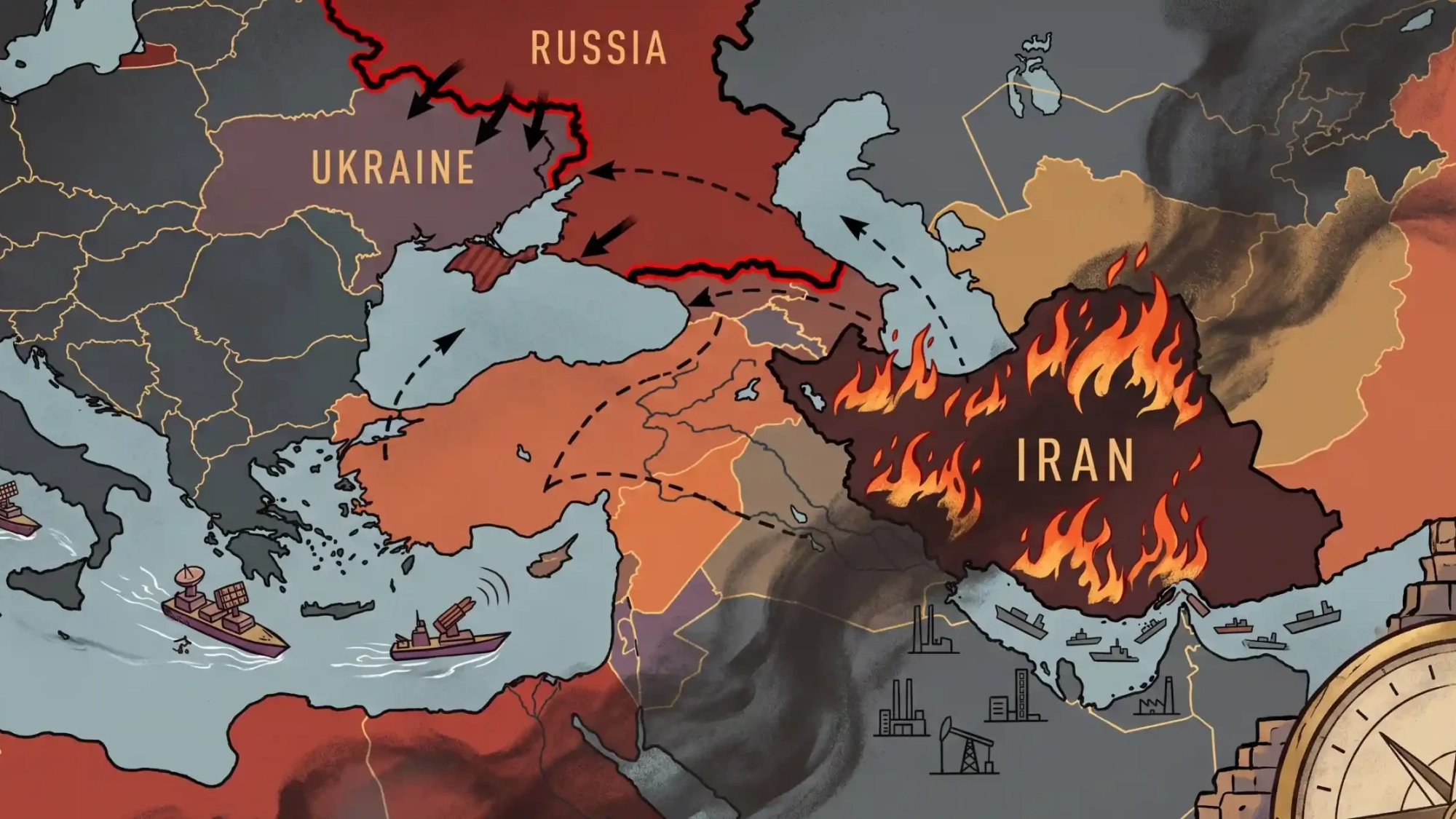
This year started with joy and optimism. But by the summer, everything that happens around us seems to have gone awry, as the Middle East is on fire, Russia and Ukraine are at war, America’s military manufacturers have made huge profits, and the people of the United Arab Emirates, Bahrain, Kuwait, and Qatar fear for their lives more than ever before.
By DeeplyExpress Analysis Desk · World Affairs
People welcomed the New Year as they usually did: with fireworks, their families, plans for a better future, and hopes that the New Year would be better than the old. The hope didn’t last long. Before the month of February was over, the United States and Israel began their attack on Iran. In this act, both nations managed to kill the Iranian Supreme Leader and set off a series of actions which closed off the world’s major artery for crude oil, causing prices for energy to skyrocket while dragging the Gulf countries — nations considered paradise by both inhabitants and visitors alike — onto the battlefield of an unwanted war. And yet, despite everything that has been going on, one question comes to mind, from newsrooms to living rooms all around the globe: what is the point of burning the world down?
World Situation of June 2026: How Were We Led to This?
The outbreak of the Iran war of 2026 did not happen out of thin air; the path could clearly be seen for years to anyone who cared to notice. Israel and Iran were involved in an exchange of missile fire in 2024. A “Twelve Day War” involving both nations occurred in June of 2025, resulting in a US airstrike on Iranian nuclear facilities. Further, in January of 2026, security forces in Iran engaged in a bloodbath of a massacre against their own people, killing thousands in the biggest unrest seen in decades following the country’s 1979 revolution. On February 28, 2026, the US and Israel executed Operation Epic Fury against Iran, resulting in the death of the Iranian Supreme Leader among other strikes on military and nuclear targets.
The Iranian retaliation swept through the region. Pro-Iranian groups launched attacks against cities and high-end resorts throughout the Gulf. Air travel in the entire Middle East ground almost to a halt, leaving countless local and foreign people stranded. Countries like the UAE, Bahrain, Kuwait, and Qatar – nations renowned for their security, affluence, and prospects – now faced challenges their citizens never imagined possible. The Strait of Hormuz was sealed off, blocking 20% of the planet’s oil. The price of oil skyrocketed from $71 per barrel to more than $111 per barrel.
WAR BETWEEN IRAN AND THE US-ISRAELI COALITION
Commenced on February 28th, 2026
The US-Israeli coalition attacks resulted in the death of Supreme Leader Khamenei of Iran. The country blockaded Hormuz. The Gulf States were subjected to the coalition’s attack in retaliation. Ceasefire discussions are taking place through Pakistan.
RUSSIA-UKRAINE CONFLICT
Commenced on February 24th, 2022
Entering its fifth year now. Oil export boom from Hormuz made more funds available to Russia to finance their military operations.
GAZA / WEST BANK
Ongoing since October 2023
Continued intensified Israeli security activities in the West Bank. A CFR analysis suggests high probability of large-scale violence beginning in 2026.
SUDAN / CONGO / SOMALIA
Growing crisis
Sudan: increasing danger of mass atrocities. Congo: continuing civil unrest. Somalia: US security mission pullout anticipated. All humanitarian crises.
On the other hand, meanwhile, Russia and Ukraine wage on. The irony is, the revelation that the Iran war had brought about concerning this particular battle was indeed disturbing. The Hormuz closing caused the price of oil to soar – thus generating more funds for Russia and allowing the latter to finance its efforts in Ukraine. Furthermore, defense experts have been cautioning the public that the already scarce Patriot interceptors are being redirected to the Middle East from Ukraine.
Who Benefits? The Profitability of War in 2026
This is an awkward question that people prefer not to think about — but it is by far the most crucial one to be asked with full awareness. At times of war, some economies flourish and not others struggle.
America is the biggest arms seller in the globe, representing 39% of the worldwide weapon sales within the timeframe of 2016 through 2025, which amounts to around $115 billion of the overall $295 billion sales. In just fiscal year 2025, US Direct Commercial Sales authorizations amounted to $226.8 billion — a 12.9% increase from the previous year. Private defense contractors have been awarded $2.4 trillion in Pentagon contracts since 2020 to 2024, accounting for over 50% of the agency’s discretionary budget in that period.
“In a time when the economy surrounding them is collapsing, defense shares have hit record levels, due to the necessity of making billions of dollars’ worth of military equipment. The largest defense contractors in America have promised to increase production fourfold.”
— Al Jazeera, covering US defense earnings, April 2026
Lockheed Martin, which is the world’s biggest defense manufacturer, and produces the F-35 fighter aircraft, increased its revenue and profit projections for 2025 due to “strong and sustained demand for fighter aircraft and ammunition in light of rising geopolitical tensions.” The Patriot missile system’s manufacturer, RTX (formerly Raytheon), similarly increased its full-year forecast as the company experienced strong growth in missile sales, munitions sales, and sales of aerial defense systems. US military assistance to Israel amounted to over $18 billion in the year since October 2023; military assistance to Ukraine has been more than $65 billion from 2022 onwards. All this money comes back to the US defense industry.
The US defense budget in 2025 approached $1 trillion and was higher than the combined spending on the military of the other nine biggest spenders on Earth. President Trump wanted to increase this budget to $1.5 trillion by 2027. It is reasonable to ask the question: is a one-trillion dollar per annum military industry requiring war to prove itself? Again, while it does not necessarily mean causation, the correlation between rising tensions and arms sales is impossible to deny.
“In 2026, there are 59 active state-based conflicts worldwide — the most since the end of the Second World War.”
— Institute for Economics and Peace, Global Peace Index 2026
Military-Industrial Reality
The term military-industrial complex was first used by then US President, Dwight D. Eisenhower in his 1961 farewell speech as an expression of concern that the weapons manufacturers as well as the US military might come to form a mutually reinforcing partnership that could work for their own benefit irrespective of the country’s benefit. Six decades later, when private businesses have been given Pentagon contracts worth $2.4 trillion within a four year span, one can see that Eisenhower’s warning is prophetic indeed.
Changes in the Middle East and Why They Matter for All of Us
For years, the Gulf countries had been a shining example of a certain kind of development miracle: fast-paced growth, security, cosmopolitanism, and economic opportunities in a part of the world often perceived through the prism of conflict. The UAE was home to the world’s tallest building and the busiest international airport. Qatar had hosted the World Cup and boasted of some of the richest people per capita in the whole world. Bahrain and Kuwait were safe, prosperous, and tolerant towards millions of immigrants from South Asia, Southeast Asia, and other parts of the world.
However, the 2026 Iran War destroyed all this. Iran’s military operations against the cities in the Gulf States, aimed at punishing the Gulf countries’ decision to allow the US to build bases and perform logistics there, introduced violence into places that previously knew nothing about it. Travel warnings published by foreign governments to travelers heading to the UAE, Kuwait, Bahrain, and Qatar throughout March-May 2026 are unheard-of. Even a country like Spain – a NATO member – refused to allow the US to deploy planes from its bases, receiving threats from Trump as a result.
The crisis has not only affected South Asians in the Gulf region and their families back home, whose livelihoods depend on them sending money home to support entire economies, but it has devastated them personally. From suspended flights, evacuation nightmares, loss of employment, and a crumbling energy supply chain, the crisis has not spared South Asia either.
Where Can a Person Still Be Safe? The Answer in 2026
Increasingly, individuals ask the question out of real concern for their personal well-being — no longer just a theoretical study in geopolitics, but a concrete aspect of their lives. And according to the answers presented every year in the Global Peace Index (GPI), compiled by the Institute for Economics and Peace based on scores from 23 indicators, 163 nations each year.
As reported in the Global Peace Index in 2026, the world’s top ten most peaceful countries tend to come from the same place geographically: small, neutral, or non-aligned European states, as well as countries that hold the same position in other parts of the Pacific and Asia.
- #1 – 18 years as Number One – ICELAND
No standing army. Extremely low levels of violence. NATO member without its own military. High levels of political stability and social cohesion. - #2 – IRELAND
Nonaligned and neutral. Very low levels of crime and conflicts. Highly stable society. - #3 – NEW ZEALAND
Isolation in the Pacific region. Excellent rule of law. Non-militarized. One of the best nations in the world regarding quality of life and security.
- #4 & #5 – AUSTRIA / SWITZERLAND
Neutral position for decades. The UN and the Red Cross have their headquarters in Geneva. Switzerland has not waged war abroad for over 500 years. - #6- SINGAPORE
The safest city-state in Asia, with unparalleled rule of law and social order. No international conflicts, good governance, and best safety records in the world. - #7 to #10 – PORTUGAL, DENMARK, SLOVENIA, FINLAND
Small European countries with very little crime, high social cohesion, and no border disputes. Notably, Portugal has become entirely unrecognizable since 2014.
A clear trend emerges from this list: The world’s safest countries in 2026 are neither the most influential nor the most prosperous. They are the nations that have chosen to remain neutral, built up their societies and not their armies, had stable institutions, and kept themselves free of involvement in any other country’s disputes. Iceland has no military. Switzerland has remained neutral for five hundred years. New Zealand is sixteen thousand kilometers away from the nearest hotbed of conflict.
South Asian Citizens
The practical possibilities for emigration to other countries by the citizens of Pakistan, India, Bangladesh, and Sri Lanka will be limited by the availability of visas, earnings, and opportunities. However, the underlying idea is relevant even from a domestic standpoint, as the countries which will have been most secure in 2026 are those which have made a commitment to education, rule of law, and economic stability above all else.
But why does this happen?
To understand, one needs to embrace a few unpleasant realities at once. Superpower confrontations do not just involve ideological or political considerations or even freedom or security – which, of course, play their roles in official explanations. Economics plays its part. So does control over energy supplies and energy transport routes. Military expenditures provide a lifeblood for certain industries in many countries. Thus, the Iran conflict of 2026 involves not only nuclear issues but also Israel’s security concerns, America’s standing in the region, control over the Strait of Hormuz – but also the fact that America’s defence budget, which exceeds a trillion dollars, needs a hostile environment to prove itself. The same could be said of the Russian invasion of Ukraine – which involved Russia’s desire for territorial gain, Ukraine’s wish for independence, NATO’s eastward expansion, and other factors – but also the fact that European energy dependence, which sustained Russian gas revenues for decades, provided the impetus for the aggression.
The Honesty
All of this could’ve been avoided in 2026. There were diplomatic solutions available to Iran before 28th February. There were at least three chances in 2022 to end the Russia-Ukraine conflict through negotiation. And while there are currently 59 active conflicts being tracked by the Institute for Economics and Peace, each one of them could’ve potentially been solved through diplomacy. But governments and industries have decided otherwise.
So where can a person seek refuge from all the madness? In Iceland, Ireland, New Zealand, Switzerland, or Singapore. Countries that took another road. Countries that, without a shadow of a doubt, proved that there is no contradiction between peace and politics and that the former is nothing but a political decision — that is made every day.
Is peace possible? Yes, it definitely is. Will the powerful decide on it? That’s the key question.
The above article statistics have been taken from the CFR Preventive Priorities Survey 2026 by Council on Foreign Relations (CFR), Global Peace Index 2026 by Institute for Economics and Peace, FY2025 Arms Transfers Report by US State Department, Al Jazeera global militarization study April 2026, Encyclopedia Britannica Iran War article 2026, the UK House of Commons Library Iran Conflict briefing June 2026, Reuters and Costs of War by Watson Institute & Quincy Institute.
Leave A Comment