
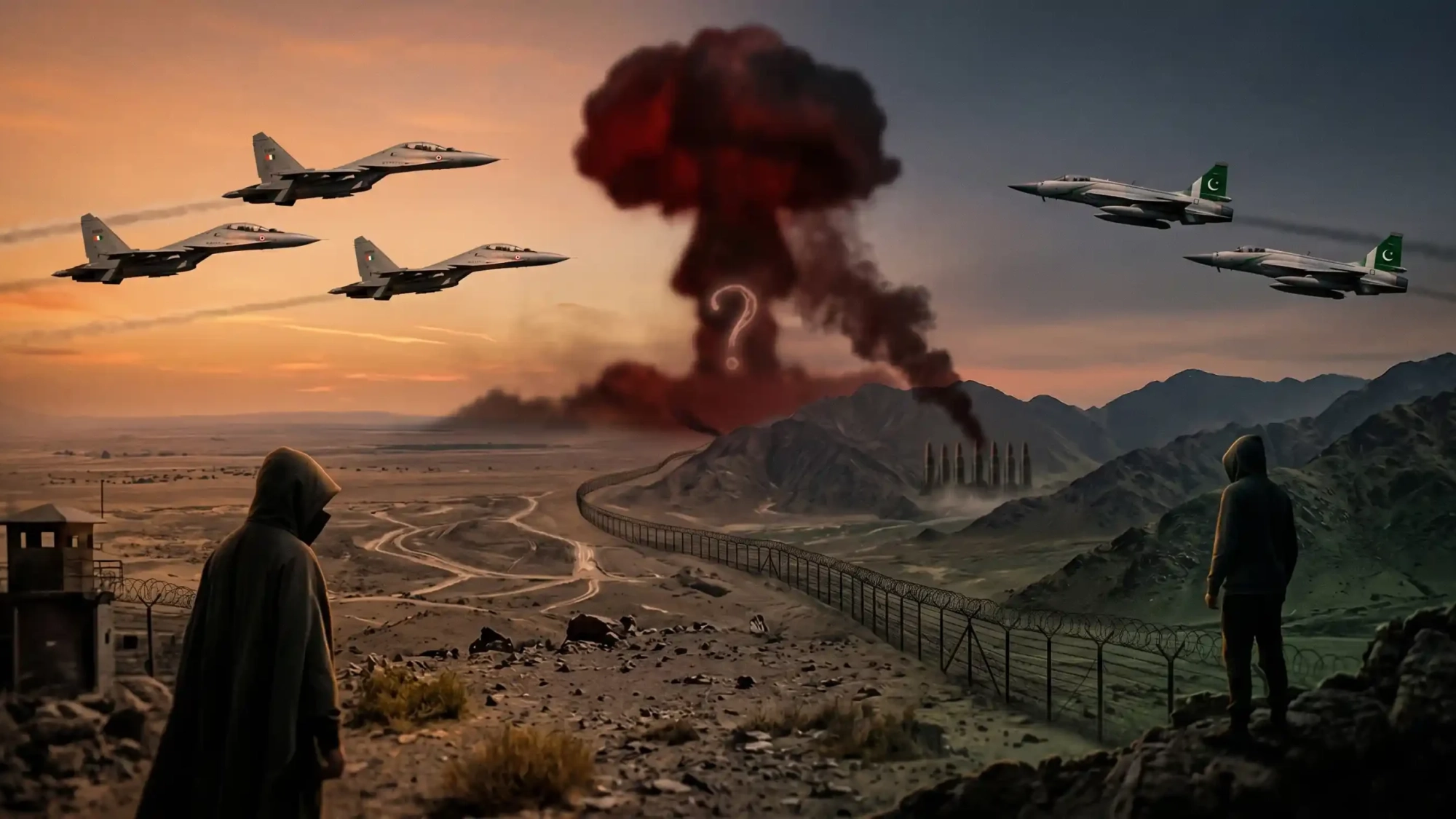
From the skyfall of May 2025 to 77 years of unsolved division – an objective account of the factors that sustain the planet’s most perilous conflict, and whether the two nations in question will ever be able to take another route.
— By DeeplyExpress Analysis Desk
The sub-continent before August 1947 was united, colonial and named Hindustan. Partitioning resulted in the formation of the two countries, and it was one of the most tragic partition incidents in modern history as it uprooted 14 million people and caused death to thousands in inter-communal killings. Yet, even after nearly 80 years, the scar hasn’t healed as the two nations have been in conflict for 4 wars, nuclear confrontation on multiple occasions, and in May 2025, seventy-seven years after attaining their sovereignty, engaged in their most intense aerial war post-partition. Hence, we can raise some sincere questions that are usually avoided by most analysts; first, why is India obsessed with Pakistan; second, whether Pakistan Air Force is such a force to be reckoned with; third and lastly, will these two countries ever come at terms?
Why does the Indian media talk about Pakistan from morning till night?
Observe any prime-time Indian television show on any evening, and you will see that Pakistan – its politics, its army, and its inadequacies – have become the center piece of discussions. That’s because scholars studying Indian media describe it as an obsessiveness embedded into the very structure of the news. A study conducted in 2026 revealed that Pakistani media has turned Pakistan into a “perpetual threat” and a consistent focus of coverage – sometimes to the extent of neglecting other domestic problems such as unemployment, inflation, and government accountability.
There are many reasons behind this obsession, and one must understand them objectively.
The Theory of the Domestic Distraction Strategy
Maintaining Pakistan as a constant threat to the mind-set of its citizens plays a certain political role. As one expert media analysis pointed out, if Indian viewers were engaged in watching the conspiracy theories by Pakistanis and events at the border on prime time, they would not be engaged in watching programs regarding governance problems and other economic issues. Although such a strategy has been employed throughout history by many nations in the world, it has recently become particularly evident in India under Prime Minister Modi.
Factor of Nuclear Anxiety
Here is a more difficult truth: even with a defense budget ten times bigger than Pakistan’s, and an army that greatly exceeds that of Pakistan in terms of both numbers and armament, India cannot “get rid” of Pakistan as a source of danger because Pakistan possesses nuclear weapons. Indeed, the Pakistani nuclear deterrence policy is aimed at India alone. Islamabad has devised its strategy of “Full Spectrum Deterrence,” i.e., having nuclear power at tactical, operational, and strategic levels, exclusively aimed at preventing India from having any opportunity to conduct a limited conventional attack. This factor produces genuine and lasting anxiety in New Delhi, which cannot be countered by additional expenditures on aircraft or tanks.
“India’s pursuit of conventional superiority cannot neutralise Pakistan’s nuclear deterrent. Pakistan’s Full-Spectrum Deterrence has left India’s growing military edge without a clean path to dominance.”
— Dr Zahir Kazmi, Arms Control Advisor, Pakistan’s Strategic Plans Division, 2026
Kashmir Problematic
In virtually all India-Pakistan tensions, whether it was the 1965 war, the 1999 Kargil battle, or the 2025 clash in Pahalgam that provoked Operation Sindoor, Kashmir is at the root. The territory has been unresolved since 1947, wholly claimed by both states while partially governed by both. Until Kashmir stays in this situation, there will continue to be sparks for tension. Until then, Pakistani business will always be dominating the airwaves in India.
Clear and Simple
The obsession India has for Pakistan is far from irrational; on the contrary, to some extent, it represents the concern of a bigger power that finds it difficult to neutralize the smaller nuclear power. However, it also represents a story that has been fabricated for a certain purpose.
Lesson of 1971: Why Pakistan’s Self-Created Problems Created a Strategic Dilemma
In order to comprehend how Pakistan has developed its strategic doctrines since then, it is important to consider the experience of 1971. The loss of East Pakistan as an independent nation of Bangladesh could not be regarded merely as a defeat. This was a humiliating experience for the country which led to more than 90,000 Pakistani soldiers becoming POWs while the newly divided country lost half of its population in a single blow. For Pakistan, the lesson of that fateful year was that no more should it find itself involved in two-front wars where there are no matching capabilities in conventional warfare.
It was in the wake of this national embarrassment that Pakistan intensified efforts to develop a nuclear capability. It was the nuclear test by India in 1974 that made Pakistan even more determined to achieve success in its nuclear programme. By 1998, both these nations had conducted public nuclear tests.
- 1947
Partition; First Kashmir War starts soon after India’s independence.
- 1965
Second Indo-Pakistani War; ends in a standoff under UN mediation.
- 1971
Bangladesh Liberation War. Loss of Pakistan’s eastern province. Surrender of 90,000 troops. Nuclear determination intensifies.
- 1998
Both countries carry out open nuclear tests. South Asia officially becomes a nuclear hotspot. - 1999
Kargil crisis; the first military confrontation between two officially nuclear countries. - 2019
Balakot strike; shooting down of IAF MiG-21 by PAF. Capture of Wing Commander Abhinandan repatriated back.
- May 2025
Operation Sindoor: Most serious aerial combat since partition. Heavy casualties for both sides. Ceasefire mediated by US on May 1
Operation Sindoor: What Really Took Place During the 2025 Aerial Warfare
In response to the Pahalgam terrorist attack that took place in Indian-administered Kashmir and which claimed the lives of 26 tourists on April 22, India initiated an operation called “Operation Sindoor,” during which the country conducted airstrikes using missiles against its adversary, targeting what it claimed to be the terrorist infrastructure located in Pakistan. This was arguably the most severe and violent confrontation between the two nations’ air forces since their creation.
What surprised military experts around the world was the result of the first night of the conflict. According to various reports, including those from Fair Observer, The Diplomat, as well as an analysis made by CHPM (Centre for Military History and Perspective Studies), a think-tank based in Switzerland, the Pakistan Air Force managed to shoot down between five to seven aircraft from the Indian Air Force. Importantly, among the destroyed were reportedly several Rafale fighters that India acquired from France.
The chief of India’s defence forces, General Anil Chauhan, made an official announcement during the Shangri-La Dialogue held in Singapore on May 31, 2025. Although the figures were not revealed, it was stated that the cause of some of these losses was due to the fact that political considerations prevented the Indian Air Force from attacking Pakistan’s defenses during that first night.
“The Indian Air Force lost fighter jets to Pakistan on the night of May 7, 2025, only because of the constraint given by the political leadership to not attack the military establishment or their air defences.”
— Indian Defence Attaché, as reported by The Wire and cited in The Express Tribune, June 2025
However, the PAF’s tactical triumph on May 7 can be attributed to its use of a “networked kill chain” system, wherein radars, AWACs, and fighters were integrated using a common data link. The PAF fighters did not require the use of radars to target enemy aircraft since they could access the necessary information without turning their radars on, which would have exposed their location to the enemy, at the same time jamming Indian sensors and communication lines.
However, the incident had further developments
India took action. During the next few days, the Indian Air Force conducted joint airstrikes against eleven PAF bases using BrahMos missiles, SCALP cruise missiles, and Harop/Harpy weapons systems. These targeted the radar installations, airfields, and command structures of the Pakistani military forces. According to the Centre for Aerospace Power and Strategic Studies (CAPS), India’s attacks were so fierce and accurate that the country was compelled to call for a cease-fire after just 88 hours. Pakistan also suffered considerable losses as part of the operations. The retired Air Marshal of Pakistan confirmed through Pakistani national television that one of the SAAB-2000 AWACS aircraft was hit by a Brahmos missile between May 9-10. The loss of Pakistani air power was estimated at around $1-1.5 billion, which included losses in fighters, surveillance assets, and airbase infrastructure at multiple locations such as Chaklala, Sargodha, and Bholari.
| Category | Pakistan (PAF) | India (IAF) |
Combat Aircraft | ~400–425 | ~570–580 |
Key Platforms | JF-17, F-16, Mirage III/V, J-10C | Rafale, Su-30MKI, MiG-29, Tejas |
AWACS/AEW | -2000 Erieye (1 confirmed lost May 2025) | Phalcon, Netra (S-400 integration) |
May 7 result | 5–7 IAF jets downed; no PAF losses in air | Losses confirmed by CDS Chauhan |
Overall outcome | Tactical air win (night 1); forced ceasefire (day 4) | Initial losses; IAF bases struck; ceasefire from position of strength |
Budget (2025) | ~$7.7B total defence | ~$75B total defence |
Nuclear doctrine | Full-Spectrum Deterrence (tactical to strategic) | No First Use (officially); counterforce posture |
Don’t forget to read DeeplyExpress’s post on the India vs Pakistan conflict of 2025:
“India – Pakistan 2025 Aerial Conflict: Outcomes, Economy, and Global Perceptions”
Is the Air Force of Pakistan its Most Valuable Strategic Asset?
One of the most interesting aspects of studying South Asian military strategies is whether or not Pakistan makes a disproportionate use of its Air Force compared to its other two branches.
Pakistan indeed uses its Air Force excessively. Yet it is not accidental but rather deliberate. In the face of a much bigger ground force in India, it is a war scenario Islamabad would prefer to avoid under any circumstances. While winning a traditional confrontation against the Indian army is unrealistic, the PAF can still impose substantial costs to dissuade India from escalation while allowing for time to work for international pressure and a possible nuclear exchange to kick in. By investing in technologies that enable networking, the PAF made sure to pursue just such an approach to strategy. By doing so successfully on May 7, 2025, it has managed to make itself felt in a war that pitted a bigger and costlier air force against it.
“Pakistan’s ability to inflict losses on India has altered immediate perceptions of air superiority — quality and smart tactics can momentarily outweigh quantity.”
— Prime Rogue Inc. Comparative Assessment, August 2025
But the PAF is actually constrained by a set of structural weaknesses. The military-industrial base of Pakistan is much less extensive compared to that of India. In case of an extended war, the Indian Air Force will be able to compensate its losses better and continue operations for a significantly longer period. Pakistan understands this, and that is why the whole of its strategic doctrine is based on preventing the prolonging of any hostilities.
The Nuclear Factor: The Equaliser that Alters Everything
The making of the Pakistani atom bomb by Pakistan, and the testing thereof in the public domain in May 1998, just months after their own Indian counterparts had done the same thing, constitutes arguably the most important strategic move in the nation’s history.
The reasoning behind this statement is simple yet irrevocable: any fight between India and Pakistan will be one in which there always exists an element of escalation through the use of nuclear capabilities. Any plan made by India for the invasion of Pakistan without such escalation being considered is not one that can succeed. At the same time, anything planned for by Pakistan without taking into account that such a strategy might force India into this situation is equally doomed.
This principle is known as mutually assured destruction, and while this may sound very unpleasant, this is what has kept these nations from engaging in a fully-fledged war.
Finding of Key Importance — The Diplomat, May 2026
“Following one year since the crisis that occurred during the span of four days in May 2025, South Asia finds itself in a state of fluid instability. While deterrence still works, the root causes of instability persist.”
Nuclear doctrine of Pakistan, named as Full Spectrum Deterrence, aims at deterring India in its entire range starting from a minor skirmish along the border lines until a conventional invasion. This was tested successfully in the May 2025 episode. In his article published in January 2026, Zahir Kazmi, an adviser to Pakistan for arms control stated that India had failed “to gain escalation dominance.”
Was It Because of Poor Pilot Skill? Or Was It Something Else?
This issue has led to heated discussions starting from May 2025, and it must be admitted that this was most likely not because of the skills of individual IAF pilots.
The IAF is one of the most seasoned and best-trained air forces around the world. Its pilots have many hours of flying experience and practice for complex situations. The situation which was revealed on May 7, 2025 had nothing to do with the incompetence of pilots but was a result of problems in the doctrine and lack of situational awareness of IAF as an integrated military unit.
Thus, according to CHPM Switzerland, there were three concrete weaknesses of the IAF identified during that incident. First of all, “limitations in cross-platform data integration” resulted in less effective sharing of battlefield intelligence compared to PAF aircraft working through its networked kill chain. Furthermore, the electronic warfare environment of IAF planes suffered from PAF jamming, affecting its radar and communication efficiency. Finally, the problem identified by the Chief of Defence Staff of India is the fact that the IAF was not allowed to attack Pakistani air defense due to its rules of engagement.
As soon as those constraints were removed on the second and third days, India unleashed their weapons – BrahMos, Harop drones, and S-400 missiles – which inflicted massive destruction to Pakistan’s military facilities, and caused Pakistan to seek a ceasefire. It was reported that the S-400 had shot down a Pakistani AWACS at a distance of 314 kilometers inside Pakistan’s territory – an unprecedented feat that demonstrated the impressive extent of India’s technological capabilities.
Both air forces acquired new insights about themselves through this May 2025 experience. Pakistan realized that they could no longer replicate their initial success after India took off their gloves. India discovered that integrated and interconnected warfare, not advanced weaponry alone, is key to winning air wars today.
Will India and Pakistan Ever Be Friends?
This is the question that has the most gravity and demands the most honest response.
The answer is not yet, but possibly not never. However, probably not soon or easily. The underlying causes of the rivalry — Kashmir, mutual terrorism allegations, disputes over water, nuclear deterrence, and the unresolved issues of Partition — are issues that remain unresolved after 77 years and are not going away. There are politicians in both countries who have found political advantage in being rivals. There are media in both countries that find gain in anger. There are militaries in both countries where their institution’s identity relies on the other military as the enemy. What the May 2025 crisis showed, though, was something that alarmed many observers but which also shed light in an odd way: there is no place for limited conventional warfare between two nuclear weapons powers. Any escalation poses an inevitable threat of miscalculation that neither side’s politicians truly want to confront. In fact, as reported, Trump told his advisers that the May 2025 crisis might have resulted in the deaths of millions more people if the ceasefire had lasted only another 24 hours.
“Fast forward to April 2026: India – which is now headed by its own Trump-like leader in PM Modi, a longtime personal friend of the president – finds itself on the outs with the US. Meanwhile, Pakistan has become the new world diplomatic mediator for the ceasefire between America and Iran.”
— Chalkboard Politics, Good Authority, April 2026
With Pakistan’s remarkable rise in international standing in 2026, mediator of the US-Iran conflict, host of the Islamabad summit and recipient of praise from the US government for its back-channel mediation, the international perspective of the two nations’ relationship has likewise changed. Efforts by India since the summer of 2025 to isolate Pakistan on the international stage have, in several accounts, fallen short of expectations on the part of Indian leaders.
The conditions for a better future may be theoretically discerned: real progress on the Kashmir issue, consistent people-to-people contact, normalization of economic ties and, most importantly, a climate in the two countries’ media which no longer regards the other as its ultimate foe. Nothing here is beyond possibility. Each of these did happen, if only temporarily, at times when there had been genuine efforts at a rapprochement: the bus diplomacy of Atal Bihari Vajpayee in 1999, the Agra summit in 2001, and the composite dialogue process of the 2000s.
The Truth of the Matter
The more immediate prospect is what The Diplomat refers to as a state of “no war, no peace,” a situation in which nuclear weapons prevent a total military engagement while leaving unresolved the reasons for conflict. Another crisis, according to most experts, is not a question of “if” but “when.” After the next crisis emerges, the hope is that there will then be the political willingness from both sides to tackle the root problems instead of merely reacting to the next problem.
This analysis is written using verified sources from The Diplomat, Fair Observer, The Express Tribune, Stimson Center, CHPM Switzerland, Carnegie Endowment for International Peace, Al Jazeera, and Good Authority. This analysis has been sourced from information provided by the above-listed organizations. This analysis has been written without any biased perspective.
Sources & References
- Fair Observer — India-Pakistan May 2025 War Shows Limitations of Air Power
- The Diplomat — The 100-Hour War: India versus Pakistan (June 2025)
- CHPM Switzerland — Operation Sindoor: The India-Pakistan Air War, Exploratory Note No. 1 (January 2026)
- Express Tribune — Decoding Defeat: Five Times Indian Military Officials Admitted Losses Against Pakistan (July 2025)
- Stimson Center — Four Days in May: The India-Pakistan Crisis of 2025 (June 2025)
- Al Jazeera — How Indian PM Modi’s efforts to isolate Pakistan ‘backfired’ (May 2026)
- Carnegie Endowment — Escalation Dynamics Under the Nuclear Shadow (February 2026)
- Good Authority / Chalkboard Politics — How Did the 2025 India-Pakistan Conflict Change Global Politics? (April 2026)
- The Friday Times — Pakistan’s Nuclear Doctrine & Youm-e-Takbeer (May 2026)
- Prime Rogue Inc. — Comparative Assessment IAF and PAF (May 2025)
Leave A Comment