
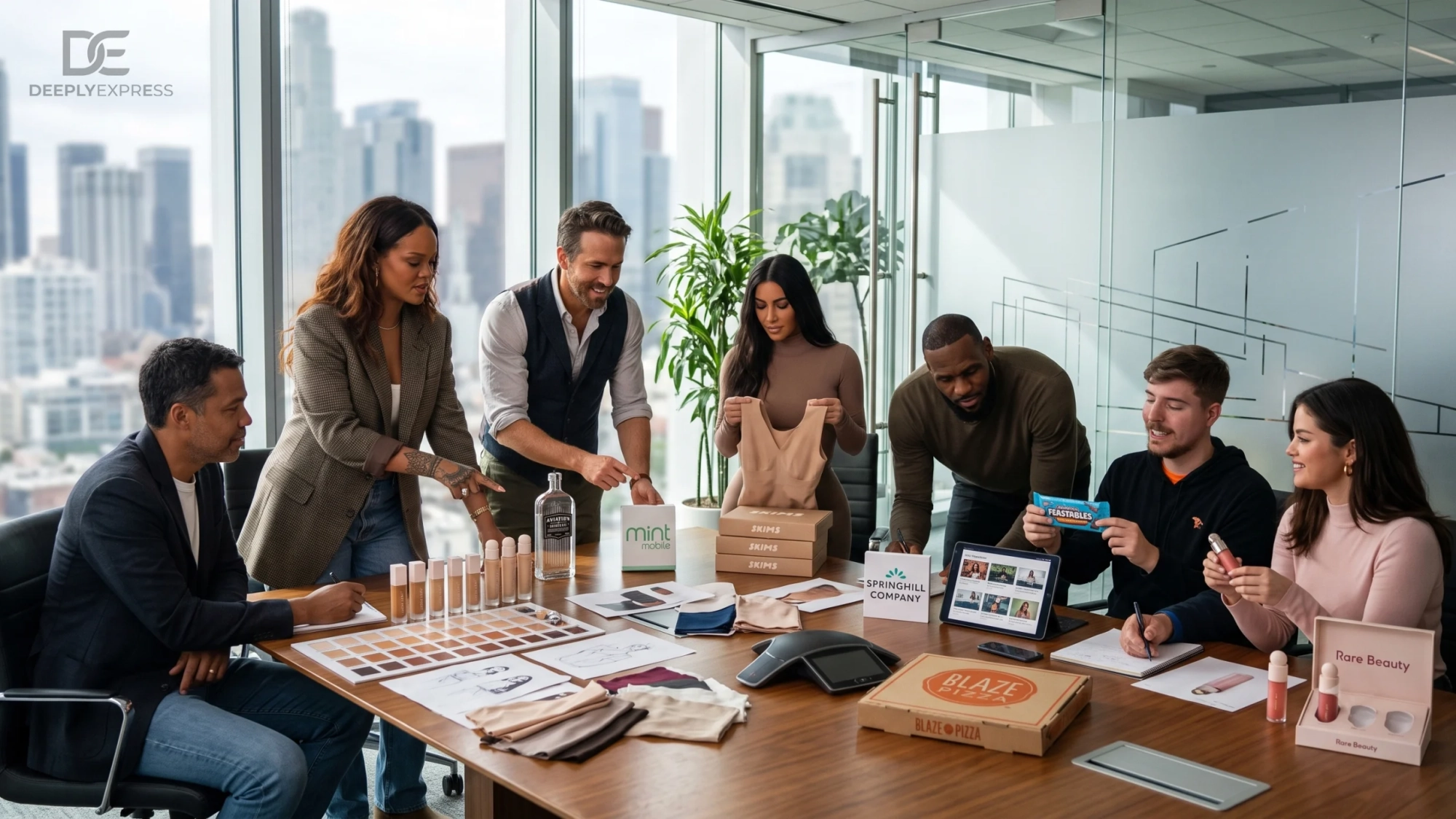
The decade before 2026 saw something genuinely different happen to celebrity culture. Fame wasn’t the end anymore. It morphed into a seed fund.
The 2026 richest celebrities aren’t the ones with the biggest movie contracts or the most streaming plays. They are the ones who looked at their audience, their industry knowledge, and their personal credibility, and asked a different question: what business do I actually want to build? Rihanna makes more money from cosmetics than from music. Ryan Reynolds has earned more selling two companies than he has from all of his acting roles combined. Selena Gomez made a billion dollars selling makeup, not a record deal—Kim Kardashian’s $5bn empire of shapewear. LeBron James co-founded a media production company that’s now signing multi-year streaming deals with major platforms.
This isn’t a tale of celebrities dabbling in business. This is the story of a whole new breed of entrepreneur, people who have learned that sustained public attention, used in the right way, is one of the most valuable business assets on earth.
WHY 2026 IS THE DEFINING YEAR FOR CELEBRITY ENTREPRENEURSHIP
According to several industry reports, the most financially successful celebrities in 2026 make most of their wealth outside their original career. The revenue streams include founding or owning stakes in consumer brands in beauty, spirits, and fashion, venture capital investments in technology startups, sports team ownership, media and production company stakes, and direct-to-consumer businesses that bypass traditional retail entirely.
The trend accelerated around 2017 and has not slowed down. Goldman Sachs led a $225 million funding round for SKIMS that raised its valuation to $5 billion. Rare Beauty hit a $2.7 billion valuation within four years of launching. Fenty Beauty earns more than $600 million a year. Ryan Reynolds sold his stakes in Aviation Gin and Mint Mobile for a combined total of more than $2 billion. MrBeast’s Feastables snack brand surpassed $1 billion in revenue in 2026, competing directly with legacy consumer goods companies that have been around for decades.
The reason 2026 is significant is that celebrity entrepreneurship is no longer in its experimental phase. Those brands that survive are not trading on name recognition anymore. They compete on the quality of the product, the operational infrastructure, and a real relationship between founder and customer.
RIHANNA – THE ROLE MODEL WE SHOULD FOLLOW
When Fenty Beauty launched in September 2017, it did what the beauty industry had been shying away from for decades. It had 50 foundation shades for skin tones the major cosmetics houses had always ignored. The answer was immediate. In its first 40 days, Fenty Beauty did $100 million in sales. By the end of 2018, it had attracted close to $573 million. By 2025, annual sales topped $600 million, and the brand’s value was estimated at $2 billion to $3 billion. Rihanna owns it as a 50-50 joint venture with LVMH, the luxury group that owns Louis Vuitton and Dior.
That business, not her music, accounted for most of Rihanna’s $1.4 billion net worth. Separately, her Savage X Fenty lingerie brand is valued at more than $1 billion. Fenty Beauty also expanded into over 50 additional Sephora locations worldwide in 2026, while Savage X Fenty prepared for a potential public listing with valuation estimates above $3 billion.
What Rihanna proved is that it’s more than just celebrities who can launch beauty brands. She proved that a celebrity brand based on a real personal conviction (that all skin tones should see themselves reflected in cosmetics, in her case) would outperform anything based on name recognition alone. This was dubbed the “Fenty Effect” by Vogue magazine and changed the industry standard for good. Every major cosmetics brand that followed had to debut with at least 40 shades of foundation.
KIM KARDASHIAN AND SKIMS: WHEN SHAPEWEAR CREATES A REAL EMPIRE
SKIMS launched in 2019 with a concept that seems obvious in hindsight: make shapewear in sizes and shades that reflect real human bodies. That decision alone created an opening in a market where most existing products served a narrow range of body types and skin tones.
The business was growing at a most singular rate. In November 2025, SKIMS reached a $5 billion valuation after raising $225 million in a Goldman Sachs-led funding round, with annual sales approaching $1 billion. In 2026, the brand expanded significantly across Europe and Asia, launched a performance athleisure line and added a menswear range, alongside new NBA licensing partnerships.
What makes SKIMS instructive is the operational discipline that goes with it. Kim Kardashian did not just slap her name on somebody else’s product. Together with the entrepreneur Jens Grede, who brought the manufacturing and retail infrastructure, she co-founded the company, bringing the audience and the cultural antenna. That split between the public-facing credibility of the founder and a strong operational co-founder is a pattern that repeats itself in the celebrity businesses that endure.
Kardashian also owns a private equity firm and was involved in a number of other beauty ventures. She also earns from her media company that produces the streaming series, The Kardashians. But the masterstroke is shapewear. It occupied a real gap in the market, rather than entering an already oversaturated category.
RYAN REYNOLDS: THE BEST-EXECUTED CELEBRITY BUSINESS EXIT EVER
Ryan Reynolds made most of his $350 million net worth not from acting, but from two transactions. Aviation Gin, in which he took a stake in 2018, was sold to Diageo in August 2020 for $610 million, with Reynolds reportedly making around $120 million from his ownership stake and retaining an ongoing stake. In 2019, he purchased a 25 percent stake in the budget wireless carrier Mint Mobile, which was sold to T-Mobile in 2023 for $1.35 billion.
Reynolds has done something very different than most celebrities. He didn’t create brands from scratch. He found companies that had great products but not enough marketing reach, bought stakes in them, became their creative director and public face, and then changed the marketing entirely with his own personality and humor. Aviation Gin became one of the most talked-about spirits brands in the country, taking off from a respected but little-known product, thanks to campaigns that mocked traditional alcohol advertising at every turn.
His approach was most clearly articulated in the Peloton response ad. When a Peloton ad was widely criticized in 2019 for its apparent sexism, Reynolds recruited the actress from the ad within 72 hours and cast her in an Aviation Gin ad, drinking gin in what looked like the immediate aftermath of the Peloton situation. Within days, the ad had gone viral around the world, cost a fraction of a traditional advertising campaign, and demonstrated a model of real-time cultural marketing no competitor could easily duplicate.
Reynolds co-founded a marketing production company called Maximum Effort to bring some system to this approach and to apply it to other brands. He also owns Welsh soccer club Wrexham AFC, which was the subject of the FX TV series Welcome to Wrexham. The Wrexham project has become a business model in itself: sports team ownership and content production combined, turning a struggling lower division club into a global media property.
Reynolds doesn’t teach us that humor sells. It’s that authenticity in business communications, when the founder actually loves and uses the product, that builds a level of audience trust that no marketing budget can manufacture.
If you care about how celebrity influence impacts what people buy and wear, the Gen Z entertainment and fashion trends shaping 2026 paint a bigger picture of how celebrity culture and consumer behavior are intersecting today.
SELENA GOMEZ AND RARE BEAUTY: PURPOSE AS A COMPETITIVE ADVANTAGE
Rare Beauty launched in September 2020 with a mission most beauty companies would consider a liability: Rather than perpetuating unrealistic beauty standards, Rare Beauty is tackling the mental health impact of those standards. The brand donates a portion of its revenues to mental health programs via the Rare Impact Fund, and explicitly frames its products as tools for self-acceptance, not self-transformation.
And that positioning created a brand that attracted not only customers but a fiercely loyal community. Rare Beauty was valued at $2.7 billion by 2025, making Selena Gomez a billionaire from the business. Annual revenues were over $370 million. The vegan and cruelty-free brand entered more than 35 new international markets through Sephora in 2026.
The Soft Pinch Liquid Blush became the product that defined the Rare Beauty launch, selling out time and time again, creating one of the most recognizable beauty items of the early 2020s. Products like this one, which you can see reflected in the current coral blush and glow makeup trends of 2026, proved how a celebrity brand with real aesthetic credibility can set trends instead of just following them.
Gomez’s case is also instructive in what it teaches us about the personal base of a successful celebrity brand. She has shared publicly about her health struggles and mental health journey, and the mission of Rare Beauty is directly tied to those experiences. This brand doesn’t seem like a business opportunity she went out to pursue. It’s like a cause she’s funding with cosmetics. That distinction resonates with consumers in ways that market research cannot fully explain and competitors cannot easily replicate.
LEBRON JAMES: THE ATHLETE WHO CHOSE TO OWN THE NARRATIVE
LeBron James went a different way than most athlete entrepreneurs. He didn’t create a product line; he created companies. He is co-founder of the SpringHill Company, which produces film, television, and other content. In 2026, it signed multi-year streaming production deals with two major platforms. He uses his media platform, Uninterrupted, to allow athletes to tell their own stories, rather than having sports journalists tell them. He is also a partner in Fenway Sports Group, owners of Liverpool FC and the Boston Red Sox.
His investment in the fast casual chain Blaze Pizza grew to over 400 US locations in 2026, representing real equity value in a consumer business with measurable physical scale.
Arguably the most transferable template for athletes who want to build lasting business value is the SpringHill model. It takes the accumulated skills and relationships of a sports career (the storytelling, the network, the cultural impact) and makes them the central assets of a media business. The business doesn’t depend on James playing basketball forever. It is not related to his on-court performance.
James has also been unusually voluble about the financial lesson behind his approach. He has said publicly that he wants to be a billionaire from owning companies, not from earning salaries. That is not far from that goal in 2026.
MRBEAST: THE RULE-BREAKING CONTENT MAKER
Jimmy Donaldson, aka MrBeast, is something truly new in the world of celebrity entrepreneurship. He did not become a businessman from being a musician or an actor. He built a media audience, and then leveraged that audience to start consumer businesses from scratch, without the traditional celebrity machinery of agents, publicists, and entertainment studios.
His snack brand Feastables, which launched in 2022, hit over $1 billion in annual revenue in 2026, outpacing legacy snack brands which had been around for decades. The brand’s drops sell out in hours, driven by the same audience engagement that makes his YouTube videos rack up hundreds of millions of views. His streaming series, Beast Games, was a hit, and his portfolio now includes a fintech app and a content analytics platform.
What MrBeast demonstrated was that the old celebrity route (develop a performance career, then leverage that fame to go into business) is no longer the only way. A large enough and engaged direct audience, developed through content rather than entertainment industry gatekeepers, provides the same starting capital. The execution must follow, but the audience advantage is even.
The celebrity business model has also changed the way everyday fashion and secondhand shopping trends are evolving, with creator-led brands increasingly skipping wholesale altogether to sell directly to communities built on social platforms.
WHAT EVERY SUCCESSFUL CELEBRITY BRAND SHARES
As you look across these cases, five patterns emerge that distinguish the businesses that last from those that fade.
Real human connection. The founder used the product or needed the product, and then built a business model around it. Rihanna couldn’t find a shade-matched foundation. Rare Beauty is trying to address the mental health journey Selena Gomez’s has had. Ryan Reynolds drinks Aviation Gin. Kim Kardashian wore shapewear and didn’t think there were enough options out there for her. When that connection is authentic, it shows up in every decision the company makes.
A specific problem that the current products did not solve. Not a version of something that already existed, but a gap in the market that the celebrity’s own experience had identified. Fenty Beauty, SKIMS and Rare Beauty all entered spaces where there was a clear group of consumers being underserved.
Your operations partner. The star supplies the audience, the credibility and often the creative vision. The professional executive provides the supply chain, the financial discipline and the infrastructure—Jens Grede with Kim Kardashian. Rihanna owns Kendo Brands of LVMH. That’s why so many celebrity businesses fail. The celebrity wants to be in control of operations, but does not have the right business partner.”
Speak directly to your audience. Every celebrity in this list has a personal relationship with its consumers via social media, not advertising agencies or retail intermediaries to bring the message. That direct line is a structural advantage most traditional consumer brands can’t recreate.
Be patient. It took Fenty Beauty a decade of compound growth to reach its current scale. SKIMS launched in 2019 and reached a $5 billion valuation in 2025. Rare Beauty was launched four years ago and is now valued north of a billion dollars. These are not overnight results. They are established businesses with consistent product quality and a real relationship with the customers.
If you’re interested in the wider intersection of luxury, fashion and personal brand, you might also want to read this piece on affordable luxury fashion and how celebrities use brand identity to signal status.
THE PART OF THIS STORY NOT TOLD.
Not every celebrity brand works, and there’s a common thread to the failures. Celebrity fragrances became a cautionary tale for this very reason: there’s no real connection between a pop star and a bottle of perfume, other than the name on the label. The category enjoyed some success in the early 2000s, before collapsing as the consumer base aged.
Celebrity NFT projects in 2022 and 2023 are a more recent iteration of the same pattern. Various high-profile celebrities promoted digital collectible projects to their audiences, most of which lost most of their value within months. The trust damage from those promotions has been measurable and in some cases has been the subject of regulatory scrutiny.
The point here is not that celebrities are bad business people. The lesson here is that audiences are not buying the name any more. They are buying the product or the mission or the story. Any celebrity brand that can’t answer authentically the question of why the founder cares about this particular thing will probably find the launch easier than the long-term operation.
FREQUENTLY ASKED QUESTIONS
- BEST BUSINESS FOR WHICH CELEBRITY IN 2026?
Revenues and valuations for Rihanna’s companies are some of the highest. Fenty Beauty is a $600 million-plus business and is valued at between $2 and $3 billion. Savage X Fenty itself is valued at more than $1 billion. Kim Kardashian’s SKIMS reached a $5 billion valuation in late 2025. Ryan Reynolds has sold two businesses for nearly $2 billion combined. - WHY ARE SO MANY CELEBRITIES BUILDING THEIR OWN BRANDS INSTEAD OF JUST DOING ENDORSEMENTS?
Equity ownership is far more financially significant than endorsement fees. A one-time endorsement deal pays you one time. Owning a stake in a company that is then sold can generate ten or one hundred times that amount. Ryan Reynolds reportedly earned around $120 million from the Aviation Gin sale, a return that would require decades of endorsement work to match. - WHY DO SOME CELEBRITY BRANDS SUCCEED, AND OTHERS FAIL?
Most successful celebrity brands are based on a true personal connection with the product, or a gap in the market they are filling. They also have professional operational leadership behind the celebrity founder, direct relationships with the customer community, and patience for multi-year growth. The ones that fail tend to rely on name recognition without a meaningful product story behind them. - IS MRBEAST A CELEBRITY, OR A BUSINESSMAN?
Both. And that is one reason his model is new. He built a massive audience through content, then used that audience to launch consumer businesses directly, without the traditional entertainment industry pathway. Feastables generated $1 billion in revenue in 2026, qualifying as a bona fide consumer goods company by any measure. - IS A CELEBRITY BRAND ABLE TO OUTLIVE THE CELEBRITY?
Some have. The Olsen twins’ fashion label The Row reached a $1 billion valuation in 2024 and is now regarded as one of the most respected luxury fashion brands globally, largely independent of its founders’ individual celebrity profiles. Victoria Beckham’s fashion label, valued at approximately $700 million, similarly operates as a serious fashion business. The key is whether the brand builds its own identity and loyal customer base that eventually stands independently of the founder’s ongoing public profile.
Leave A Comment